Looking to upskill yourself or your team?

Leave your contact details — and we’ll get in touch to help you find the most relevant course or workshop.We’ll tailor our recommendations to your goals, answer your questions, and explore how we can support your professional growth.
We will contact you as soon as possible on weekdays

We have received your application!

Thank you for your interest in learning at Beetroot Academy
We will contact you within one business day and answer all your questions.
Sorry, this is a technical error. Please try again!

Твій перший крок!

Залиш свої контакти, і ми зв’яжемось із тобою, щоб розповісти більше про курс і допомогти стартувати.

Отримали твою заявку!

На твоїй пошті вже чекає наступний крок, тому не забудь перевірити вхідні і розділ “спам“.

До зустрічі!
Вибач, це технічна помилка. Спробуй ще раз!

Beetroot Academy Blog

Read tips for beginners in IT, success stories of our students, and news from Beetroot Academy.

Blog articles

Read:
minutes
min
No items found.
Why using Times New Roman is a sin?

History corner

Not quite unusual for computer fonts, Times New Roman has been around since before computers became a thing. The British newspaper The Times commissioned it in 1931 as a retro update from a regular 19th-century font to something more solid with a strong 18th-century vibe. Old broom sure knows the corners (or so the saying goes), but you can see how the font may feel outdated in the 2020s.

Aesthetics

It would not be a stretch to say Times New Roman looks ancient, as we already know it was designed this way. Even Roman in the name is a nod to the Italian school of printing from (15th century!). Seeing old-fashioned characters on a groundbreaking visual device, CRT screen, was weird enough. Now that we have modern LCD screens with much higher resolution and fidelity, a font capturing aesthetics from 300 years ago feels crystal odd.

Fonts classification is usually much more objective than old-fashioned or modern. One reason why Times New Roman may give an archaic vibe is that it is a serif font. All letters (or other characters) come with decorative lines, which range from very subtle to indeed something you would see in an 18th-century newspaper. Note how you can’t see any tails on the letters in this article—or almost any website created in the last 10 years.

Serif and Sans serif versions of Inria font from Black[Foundry]

Practicality vs Usability

Times New Roman, much like a lot of newspaper fonts, is rather narrow. It is a mostly business decision: you gotta fit in as much text on a page as possible—even during the times (ha-ha!) when the ratio of ads to stories was much lower. At the end of the day, all publications did that and it’s not like many people would’ve changed morning newspapers just because one is a bit easier to read than the rest.

Computers, however, do not have the same limitation. You don’t pay more for publishing an article or sending a document with much more reasonable line spacing and kerning than the average Victorian newspaper. If it’s the intermediary audience (e.g. client that commissioned an article) that needs to save costs, they can always change character size or pick a narrow font themselves.

Furthermore, the mobile boom is not helping narrow fonts like Times New Roman. Most devices connected to the internet now have a vertical layout. Trying to squeeze in extra characters on screens with little horizontal space will bring nothing but frustration for the reader. Interestingly, The Times had to adapt similarly in print: they had to create yet another Times New Roman-inspired typeface after moving from broadsheet to tabloid in 2004. These days, a narrow font is a compromise on usability that you don’t actually have to make—and people would appreciate it if you didn’t.

Perception

One could argue that a document in Times New Roman screams laziness or indifference. If the sender didn’t change the default option to something more balanced, it communicates that they either did not want to make your experience better or did not bother to do that. That kind of attitude does not help to secure a job or scholarship.

On the other hand, certain institutions would have you use nothing but Times New Roman. Some universities strongly encourage if not outright mandate the use of Times new Roman for papers, and so do scientific journals. Older government forms coming as templates to be filled out in Word would not play nice if you try to change the font. That being said, such restrictions are getting scarcer, especially with the rise of Mac. The OS and default office-like apps there have a default font different from Times New Roman (and a new one every few years at that).

The current default font on MacOS

Summing up, the cardinal sin of Times New Roman is defaulting to it without consideration. The font is a must in very few scenarios, but you see it much more often than that. Even Microsoft agrees something has to change: the default font for Word has been Calibri since 2007.

Times New Roman alternatives

The above-mentioned Calibri is a spiritual successor to Times New Roman. It is now the default font for Word, PowerPoint, and Excel. It is a sans serif font (no decorative lines) that looks perfectly fine on both screens and paper.

If you want to ditch the default and stay sleek, Georgia is a great option. It is a serif font but letter strokes are much more subtle than what you see with Times New Roman. Georgia does not look outdated and works better for vertical screens, as it is not too tight on the horizontal space.

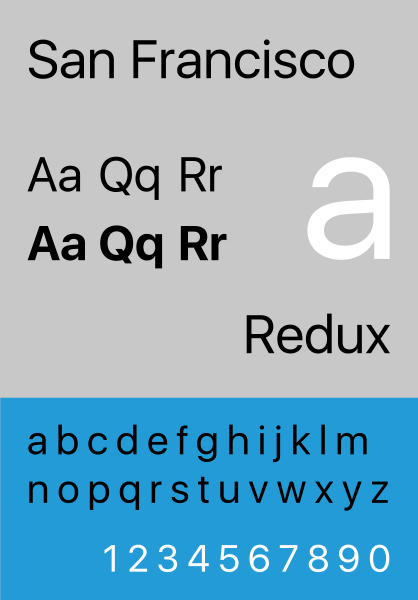
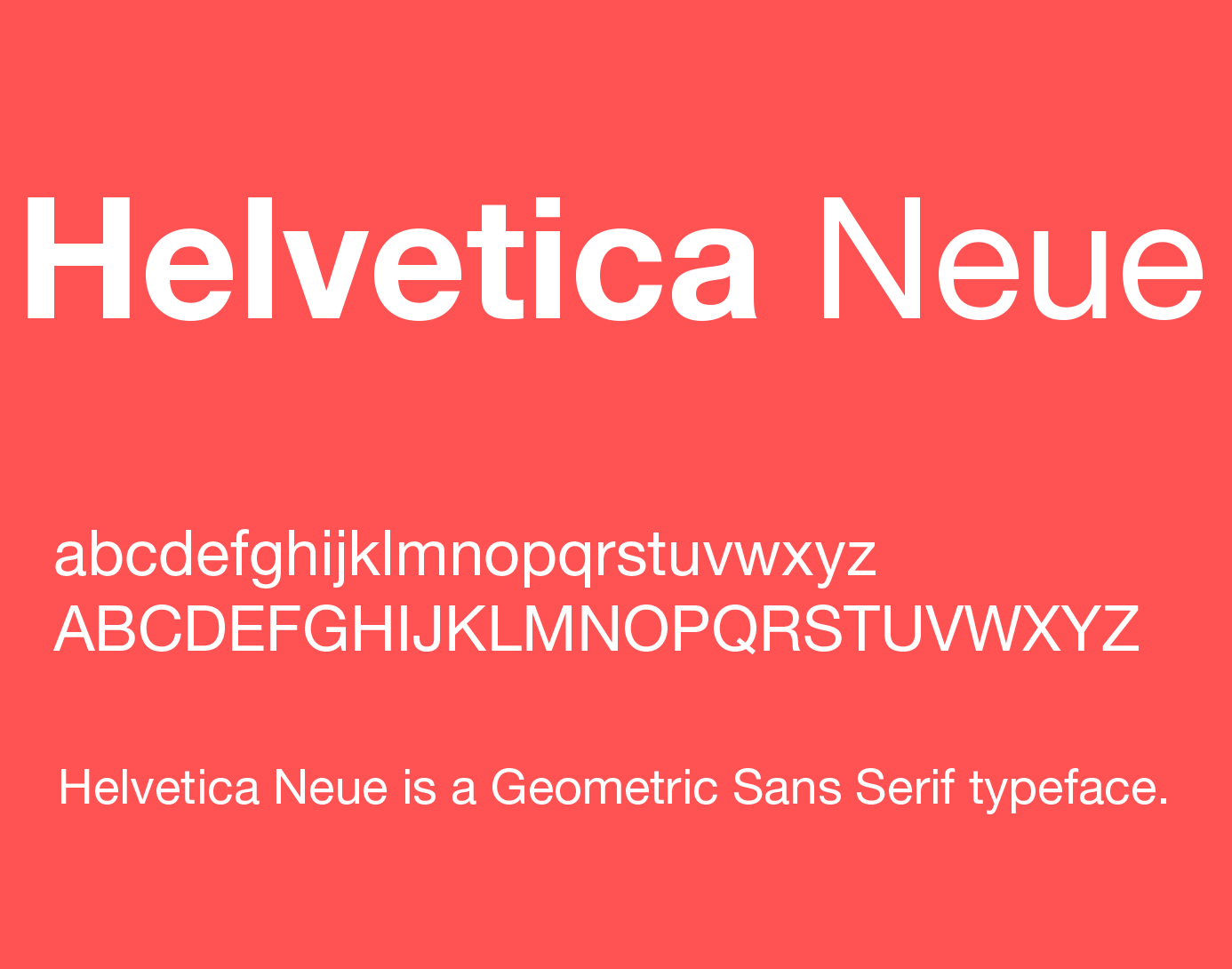
Should you feel like going barebones, Helvetica is the right font. It is a sans serif font looking as bland as it gets—in a good way. Helvetica lacks elements that would make it look too modern, but it also has no archaic elements that would make the font too classic. I think we can trust Apple on that: they used a spin on Helvetica, Helvetica Neue, as the MacOS system font for two years.

Read:
minutes
min
No items found.
Why Ukrainians are worth any donation for tech education

Somehow, I felt a big future for tech when the Internet connection was provided in my dormitory

I'm from Kramatorsk, Donetsk region. I studied in Kharkiv and was supposed to become a radio-electronic engineer, but in 2001 I understood exactly what I wanted to do. It was the time when the Internet “appeared” in our dormitory. I liked what was happening there and felt a future was behind it. So I switched to web development. I bought some books, and for the next two years, I had the luxury of free time to study without having to work. 2003 I graduated from the university, and within one month, I found my first work as a PHP developer. I was the happiest junior developer who was paid for the work he liked. I remember my first salary — $250 transferred via Western Union from the USA — was like a fortune. Back then, there were no web developers among my friends. Compared to nowadays, it wasn't that hype. But for me, it was evident that this was a future. I told my friends that all the companies I knew would need a website or should be represented online somehow. And I wanted to be a part of this evolution.

Starting my career in tech


Pink Floyd, my lifetime project, and three kids 

I was always a fan of the music of the 70s, and Pink Floyd was my favorite band. But there was no website dedicated to Pink Floyd in Russian or Ukrainian. So I decided to do that on my own. I reached out to the person who did the official newsletters about Pink Floyd to help me with that, and long story short — I made a website, and it turned18 recently. This fan website is the most extended project in my life, but I switched it off because I didn’t want to contribute to the Russian-speaking community anymore. The most crucial thing is the following. Remember I mentioned that person who worked on the official newsletters about Pink Floyd? She is currently my wife, and we are bringing up two kids. We used to make jokes that we actually had three kids — our first one was the Pink Floyd website.

Pink Floyd fan website


From a web developer to a start-up founder

After two years of work in Moscow, I was back in Kyiv. I didn't like living in Russia, so moving back to Ukraine was obvious. At this time, I stepped out of web development, and in 2007 I started my own business. All went well, but the political regime of Yanukovych reminded me of Russia, so we decided to move to Poland and work remotely. Since 2014, when the war started, it has been impossible to run my business in Ukraine.

And after a 7-year break in web development, a dozen hours of upskilling, and 60 interviews, I have found a new job in Berlin as a senior back-end developer. Now in 2022, I'm a co-founder of the tech startup countX, and all my engineering team is from Ukraine.

How I met Beetroot Academy

It was a coincidence and proof that networking rules. One of my colleagues, Alex, also works as a teacher at Beetroot Academy, so I've heard a lot about this online school. When Alex introduced me to Dmytro, CEO of Beetroot Academy, I was ready to start our partnership. He told me about the fundraising campaign on a mission to help Ukrainian people affected by the war start a new career in tech. So I couldn't stay away from it and donated for scholarships — the less I could do in these challenging times. Now seven women from Donetsk and Luhansk regions are studying at Beetroot Academy, and I’m happy to be their mentor.

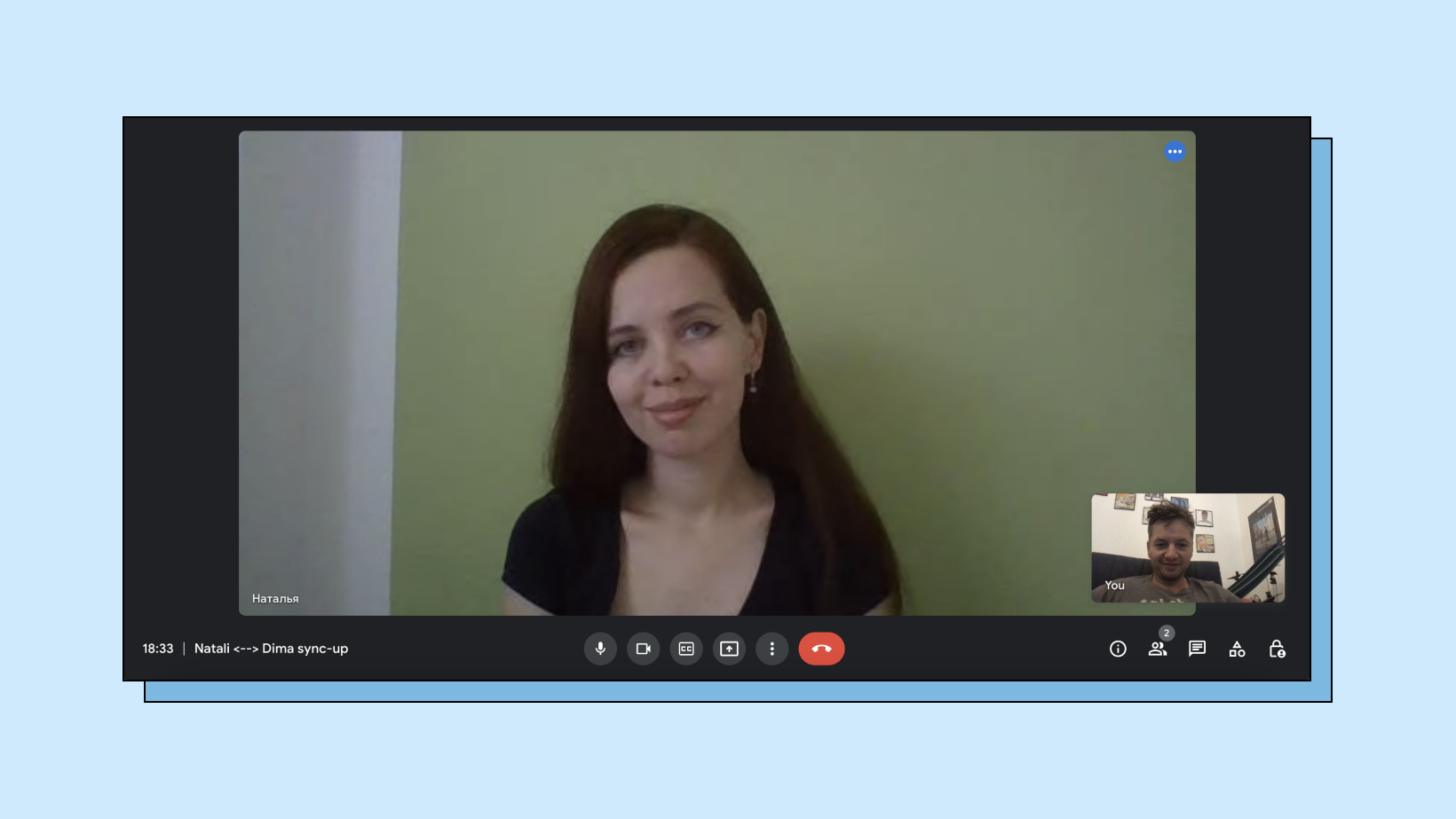
Sync with Natali, my mentee at Beetroot Academy


Why I support tech education for Ukrainians

Ukrainians, especially men who are out of the country, live with the feeling of guilt. My life is safe, but my three classmates are now fighting against Russia, risking their lives. People try to find their own way to help Ukrainians win this war, overcome the consequences and rebuild the country. So do I. 

I already had an idea of investing in tech education. That is where I can contribute as a professional and entrepreneur, so I chose to support the future of Ukraine this way. Many Ukrainians affected by war want to enter the tech industry and need an opportunity to do that. Tech education is one of the most impactful and cost-effective ways to help Ukrainians restore their lives and fight poverty after the war ends. I believe our country will be the next tech cluster after Silicon Valley in the USA and Bengaluru in India. Moreover, I want many Ukrainians to be a part of that success story. I contribute to it by donating for scholarships and would like to encourage others to support Beetroots Academy’s mission.

Read:
minutes
min
No items found.
What a front-end developer should know: basic terms for your glossary

What a front-end development is

Imagine a house. To have it running steadily, there should be a good foundation, building blocks, proper infrastructure, good furniture, designs, and usability functions. In web development, the front-end developer is somewhere in between the processes as he takes the ideas from the UI\UX team to turn them into clickable websites that work. Back-end developers, PMs, and QAs take care of the other vital parts, such as proper foundation, team and project management, and testing. 

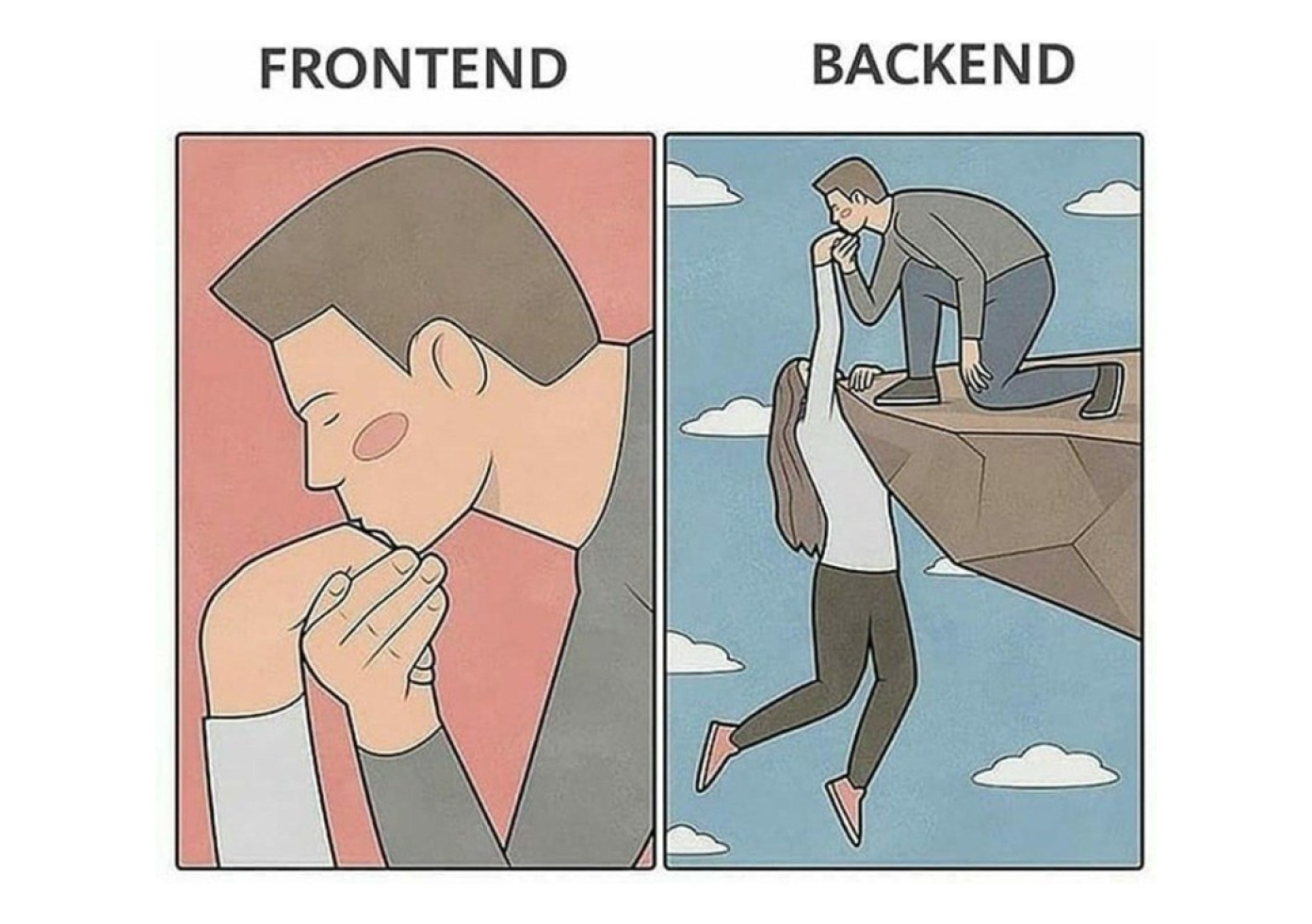
So there's actually a front-end and back-end. We won't say which one is easier. Let's just leave one picture here for your understanding.

To light up a room, you have to click the button. Ensuring it is clickable is a job for a front-end developer; ensuring there is a light is a task for a back-end developer. Front-end web development is the art of using HTML, CSS, JavaScript, and a set of other tools for a website/app for a user to see and interact with them. 

Basic front-end development glossary

In front-end web development, there are vital terms you should know. We bet you've heard most of them, so let's just keep them handy in the list below. 

Programming languages or codes

For example, HTML

In development, you need to speak a language everyone understands — your machine, your code compiler, your user, and your project manager. Below are just a couple of languages we use in the front-end. They look different to everyone, but mean the same and help achieve the result — have the webpage ready and running.

HTML, or HyperText Markup Language, is the code developers use to structure a webpage. Remember seeing a webpage made up of blocks, paragraphs, or tables? HTML helps with that. It originates from a code developed by WHATWG some 30 years ago, in 1993.

JavaScript, conveniently referred to as JS, is a programming language considered one of the cores for front-end development. Designed over 26 years ago, it is now used in almost every webpage you see. Even on the Beetroot Academy website, too :) JS is used to create animation, control multimedia, and generally work with dynamically updating content, buttons, banners, etc.  

Here, you can also look at some Javascript libraries — jQuery, React.js, and more here on Kinsta, for example.

Front-end development tools

Git, Google Fonts, W3C, and more

Compilers, linkers, code editors are essential for every front-end developer. These are basic tools that you will use in your daily routine — as home technicians use multitools for repairing the leakage, for example.

To name a few, there are Google Fonts to help you work with fonts, W3C Markup Validation Service to validate your code, and many more. 

Version control tools are also part of the list here, used for monitoring changes to your code. We guess you strive to make your code better and better each time. Hence, version controls will help manage the evolution of your code as it becomes clearer and more effective. Git is the most popular, and it's open and free of charge.

Design principles in front-end

In front-end development, we use responsive design to ensure our content fits every (or almost every) gadget and looks good on it. Recall how you open a webpage on your iPhone, reopen it on your laptop, and send it to granny's email — and it still looks good on your grandparents' old-fashioned computer? That's responsive design in action. 

Design automatically adapts to given dimensions, so all users feel comfortable interacting with the content. The feeling is the key here — because the front-end is mostly about what the user feels while using your web piece. 

CSS, closely connected to HTML, is a code used actually to style an HTML doc. It has everything to do with the colors, styles, and other properties.

Looks quite interesting, huh? Now that you're familiar with the basic front-end development glossary, it's high time to learn the front-end. We hope you find this glossary helpful, no matter which tech direction you will choose. Keep it in your saved links to come back once in a while. 

Join our next group in May and start learning with tech industry experts to gain knowledge you need to work as a junior front-end developer.

Read:
minutes
min
No items found.
What is C#? Why is it cool? Does this programming language fit me?

The origin story of C#

While such languages as Python and PHP have existed for quite a long time, C# is regarded as a young programming language. Danish software engineer Anders Hejlsberg developed it in the year 2000. Today, he still works for Microsoft as the lead architect of C#. Anders Hejlsberg is also known for being the chief architect of Delphi and the original author of Turbo Pascal.

C# was originally named COOL, whereby the acronym stood for “C-like object-oriented language”. Alas, Microsoft could not hang onto this “cool name” because of trademark law.

C# is pronounced, “see sharp”. The name was taken from the musical notation, whereby a sharp symbol points that the written note should be played a semitone higher. The “sharp” suffix has been used by several other .NET languages that are editions of present languages, including J#, A#, and the functional programming language F#.

The base syntax of the C# is similar to C-style languages such as C, C++, and Java. This programming language most directly represents the underlying Common Language Infrastructure (CLI).

Does C# fit me?

If you plan to create apps for the Microsoft platform, you should definitely learn C#. The developers favor this language for being easy to use and well-designed. Also, it is often recommended programming language to use when creating games through the Unity Game engine.

C# used for:

  • Website development. It allows you to create dynamic websites on the .NET platform or open-source software.
  • Windows applications. Being created by Microsoft, the most used case for this language is developing programs and applications specific to the Microsoft platform's architecture.
  • Game development. C# integrates easily with the Unity engine. It can be used on any modern mobile device or console thanks to cross-platform.

A list of programs and applications written in C# includes Microsoft Visual Studio, Paint.NET, Windows Installer XML, Open Dental, FlashDevelop, KeePass, NMath, Pinta, Banshee, OpenRA.

Why should I learn C#?

Here are a few reasons to work with this particular programming language:

  • C# is readable, simple, and easy to use. Readable and compact code is extremely valuable for optimizing modern team-based software development.
  • C# runs on .NET runtime, which is solid and well-engineered.
  • It can save you time because this language was developed to make it easy to build powerful tools on top of it.
  • Programming language C# is scalable and easy to maintain. It is an open-source language and is led by Microsoft.
  • There’s a large C# developers’ community where you can go to ask, answer, or brainstorm.

The future looks bright for C# because of its popularity, versatility, and existing creations. If you want to have a solid foundation to become a master developer, you should learn this “cool” programming language.

Read:
minutes
min
No items found.
What is a QA engineer, and what do they do?

What is quality assurance? 

QA or quality assurance is a part of the software development process. Statistics say that we are using from 10 to 30 applications per day. Each application, website, and desktop application results from someone's job —  from QA and developers who make software.  

Developers are writing some code and QA engineers provide tests. They can be involved to provide full support and try to be on the side of a user. So, testing means that we can prove that the user of any application will have a successful experience, enjoy the application, and will not face some issues.

What is a QA engineer?

A lot of people think that testing is just searching for bugs. This is not entirely true. Let's imagine we want to develop a fitness application with some exercises and diet for a day. Every project of every application starts with an idea. Then we should understand what needs our users have and how people will use such applications. At this stage, QA engineers join the team. The specialist helps to analyze requirements and understand how we can move in our project.

After that, developers start their work. At the same time, QA engineers prepare additional documentation and try to imagine how customers will use one or another feature and which exact scenarios need to be covered. So, the actual testing stage starts in parallel with development.  

The most exciting phase is the release. During the release, QA engineers also provide lots of support. Sometimes QA engineers can even communicate with end users to get feedback and to collect it or make some improvements based on results. 

QA are people who communicate both with the development team and with customers. They try to understand both sides and make a product as good as possible. QA engineers always help applications to be stable and safe.

Quality is everyone's responsibility. But QA is the last point before real users. 

What do QA engineers or testers do:

  • communicate with team and customers;
  • analyze the software requirements;
  • create documentation and testing application;
  • make improvements to the team's work process.

Quality assurance is not only about exact product creation but all processes and making all teams feel more comfortable in this process. 

Soft skills for QA

If it's true for you, then maybe a QA role will be a good choice:

  • Willingness to make an order in chaos.
  • Empathy.
  • Perfectionism.
  • Willingness to learn every day.

Soft skills needed for a QA role:

Attention to detail. We talk about being organized and attentive both to colleagues and some requirements. 

Communication skills. Communication is not only about small talk; it is more about asking and trying to find an answer, solving the problem with the whole team, or reading the documentation.  

Problem-solving skills. It is also about the ability to find decisions, not just finding bugs and “throwing” them into your developer. It is more about trying to find a key to a problem trying to solve, sharing it with the team, and making your experience valuable for others.

Empathy. We are talking about the ability to step in your customer's shoes and also the ability to become the heart of the team and make everyone work together. Maybe, it is an inner QA superpower.

The career path for QA

There are two main ways to choose. 

The first one is growing your hard skills. It is becoming better at testing. For example, you can choose some exact specialization. You can test web applications, mobile applications, and so on. 

Becoming a QA and growing in this area by increasing hard skills and learning new tools is a chance to become a technical expert with a specialization. And many companies are looking for specialists who can build some specific processes for them.

Other paths are more about some kind of switching. On the one hand, they are based on hard skills and technical backgrounds. If you feel interested in learning some coding languages, you can try parallel work in QA to learn some languages to add some automation to your projects. And then, if you feel that it is yours, you can switch to development and continue your pass on this role. Many companies provide you with this chance because they are interested in your growth.  

The second way is growing your soft skills. We are talking about management and leadership. Suppose you feel confident in communication, people management, and risk management. In that case, you can choose this path and grow, for example, from a QA lead to a QA manager or a department manager. For this, you can take some courses to improve your skills, and try to lead a small team in the beginning.

Another point relates to changing positions, but we talk about deepening into requirements and business analysis. Business analytic specialists have a lot of communication with customers and development teams. So if you feel confident in this area and have good analytical skills, you can think about this path. There are many positions for QA analytics, not just business analysts, so it is positioned in between these two ways, and you can also be analytic in quality assurance. 

One of the most frequently asked questions is how to start; where can you get an experience in testing if you don't get hired without experience? It is hard, but it is possible. For example, some schools help their graduates by sharing vacancies in partner companies. 

You can also help your friends with testing some applications if someone has their own business. Besides, you can try to open applications you are frequently using, read QA theory, and try to go through and test them.

Many companies are ready to hire people without experience, just with a theoretical base, because it is a perfect way to grow the specialist you need for your product. 

One more question is, how can you practice QA and prepare a portfolio to use it to display your skills or experience?

It is hard to make a portfolio for QA because there is no visual data, code, and so on that could be shown to the employer. But QA has different testing tasks. So you can show how you can write a test case and prepare a bug report. You can practice on some site you are using, write this list of test cases, and write an example of bug reports. And if you are asked, you will share these examples as proof of your knowledge. 

After reading this article, if you feel that a career in QA is for you, then start your path at Beetroot Academy — read more about the QA manual course

The original video on which this text is based, watch here

Read:
minutes
min
No items found.
What is front-end development

Front-End Development is the most straightforward path to what some would refer to as the IT proper. You are actually working with programming code using languages and frameworks. Contrary to the industry stereotype, Front-End Developers have their share of challenges at work as well.

Front-end development work

As a Front-End developer, you are the person shaping how the website is rendered on your user’s screen. Backend developers set up the infrastructure, the copywriter works their text magic, the designer comes up with stunning visuals—but you are the one bringing them to life. This is where the name comes from: you are ultimately responsible for what is in front of the user.

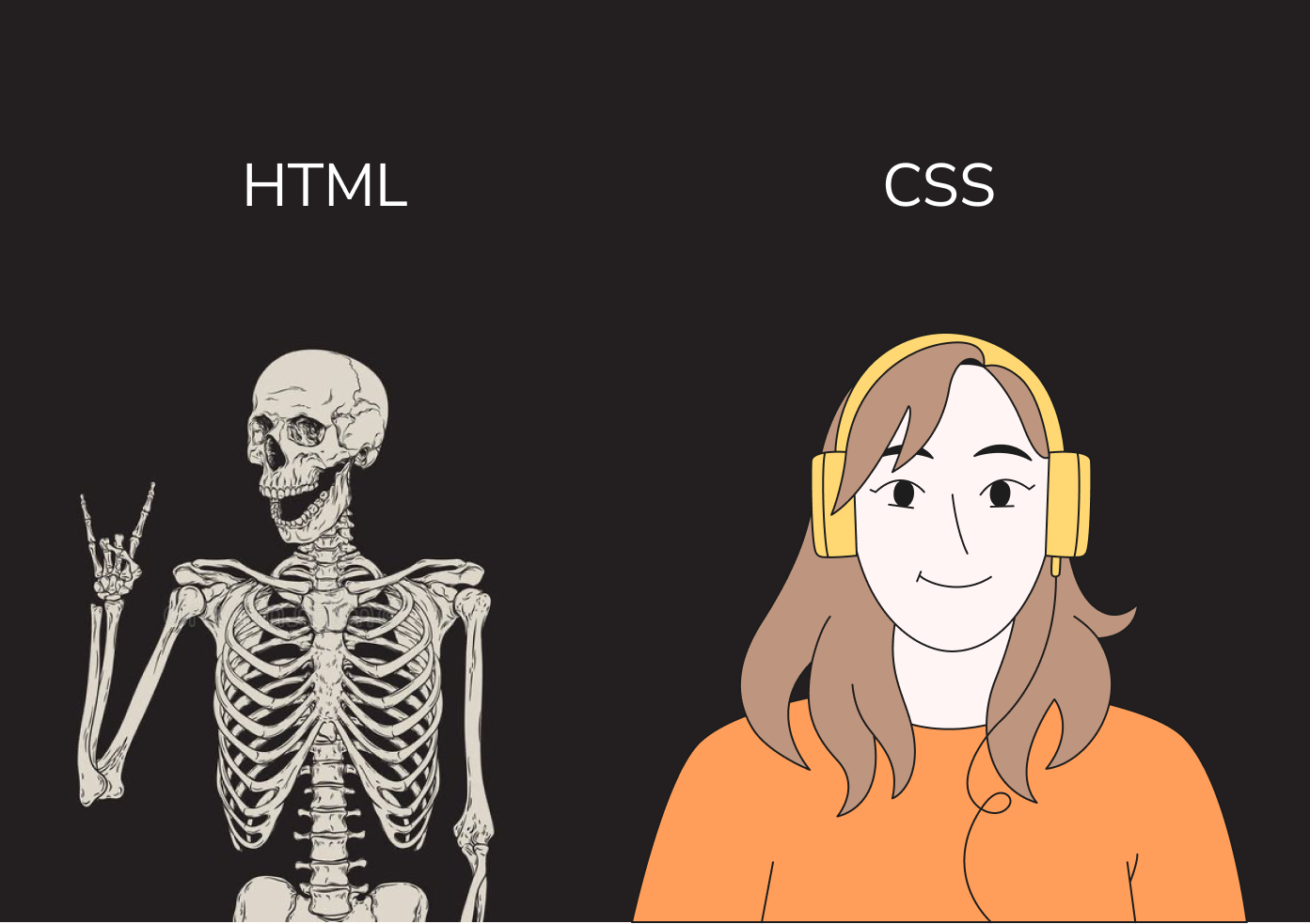
Working with websites, you’ll be using the holy trifecta of Front-End development. HTML serves as the skeleton, communicating to the browser that this text is bold while I’m using italics here. Next comes CSS to make things more colorful and playful. Finally, Javascript is what you use to make the page react to what the user is doing on it.

Front-end development languages

HTML

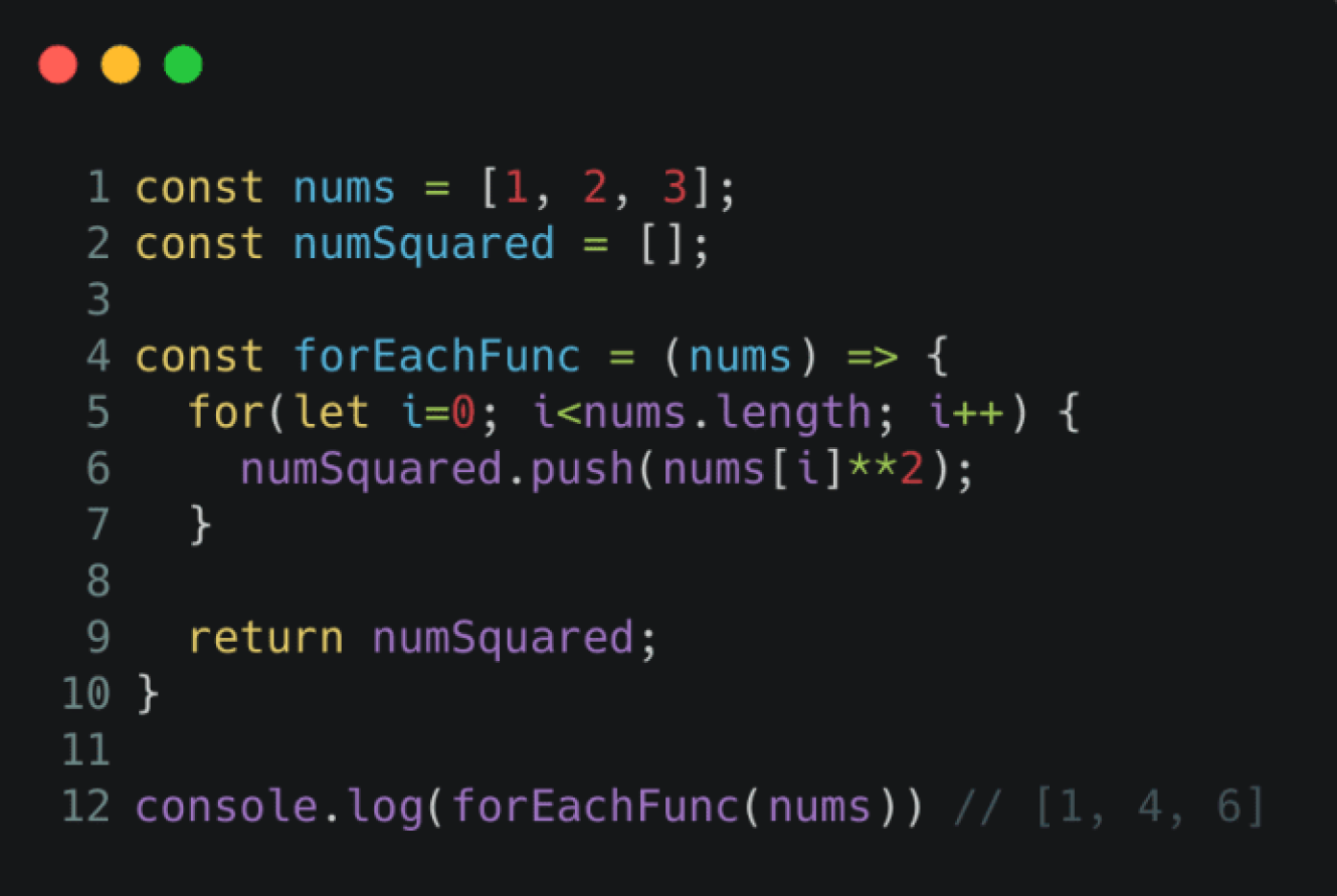
These days, HyperText Markup Language is simply the initial part of a project that you want to get over with. Like I’ve mentioned, you use tags to communicate the very basics of how a website should look. <b></b> is used for bold text, <h2></h2> denotes a level 2 heading (commonly separating article sections), <img></img> helps you embed a photo of a borscht.

The key thing to understand is although HTML can and will give your website structure, it won’t make this structure particularly perceivable. The <ul></ul> lists look atrocious without properties defining indent, spacing, and list markers. A dropdown menu with nothing but <optgroup></optgroup>... Let’s not talk about that here.

undefined

This is not the type of color scheme, fonts, or layout that your company will be able to sell nice things. They will probably not even understand that the things you are selling are nice. This is where CSS comes into play.

CSS

Now, this where things get pretty (and challenging!). CSS (Cascading Style Sheets) allows you to prettify things that you outlined with HTML and add some unique stuff as well. In this decade, Websites without any CSS hardly see the light of day. Good thing mad enthusiasts like Design Lance put the effort to illustrate why.

undefined

CSS also allows you to add animations. They serve aesthetic purposes but also cover your friends in the backend development. Loading is less frustrating when Front-End Developer (and the creative!) spend the effort to make it fun!

As for challenges, CSS has the word Cascading for a reason. You would want the website to render appropriately relative to the size of a device (or a tab) that the website is displayed on. There are two key approaches to that, responsive and adaptive design. Responsive design is about elements created and coded to be potentially shrunk and expanded again. Adaptive websites present one of the predefined layouts depending on the screen estate. UX people explain it better.

undefined

Each option has its advantages but that's a topic for a different (and not necessarily Front-End) article. The key point here for us is that responsive designs require a lot of work to get everything right one time. Layouts for adaptive designs call for repetition: you’re coding more of the same. Oh, and adaptive designs need Javascript!

Javascript

Javascript is what makes websites interactive. You use them to implement forms, pop up windows, chat boxes, and all other elements that react to user input or actions. Mobile apps and server-side apps utilize this language as well.

Nowadays, you could argue that no commercial website in the EU can function Javascript. Even if you wanted to omit all the fun stuff that keeps users engaged, there is no hiding from GDPR. Consent forms are mandatory and get increasingly complex if you are collecting more information and/or sharing it with multiple providers. Below is an example of a reasonable GDPR cookies&tracking form. You'll find websites with fewer buttons to click but there are plenty that would prove more tedious.

undefined

For a Front-End Developer, Javascript is the top block of the pyramide. You used HTML to give browser the general idea of the website, you utilized CSS to make it an eye candy, and Javascript makes the website useful beyond just reading the text and checking out the images.

Front-end development prospects

After nailing the Javascript basics, you can start picking up Javascript frameworks to start executing projects at large. The most popular ones are Google’s Angular and Facebook’s React. Front-End development frameworks have the same core ideas behind them:

  • Reduce the number of coding routine
  • Simplify implementation of adaptive designs
  • Improve performance

Alternatively, you can become a full-stack developer, wielding both Front-End and backend development tools. Yet another Javascript framework, Node.JS, is a popular option for powering online solutions. Mindset and thinking-wise, there will be a lot of catching up to learn the backend side of development, but your Front-End experience and Javascript knowledge go a long way here.

We at Beetroot Academy believe in starting fast and strong to progress from there. Our Front-End Development course introduced you to HTML, CSS, and Javascript over 4 months of classwork and self-studies. We’ve still got a couple of spots left on the group that starts in the middle of August.

Read:
minutes
min
No items found.
Why our graduate came to study though he already had a job: an example of not changing but improving your career

I didn’t need a new profession – I wanted to master my old one

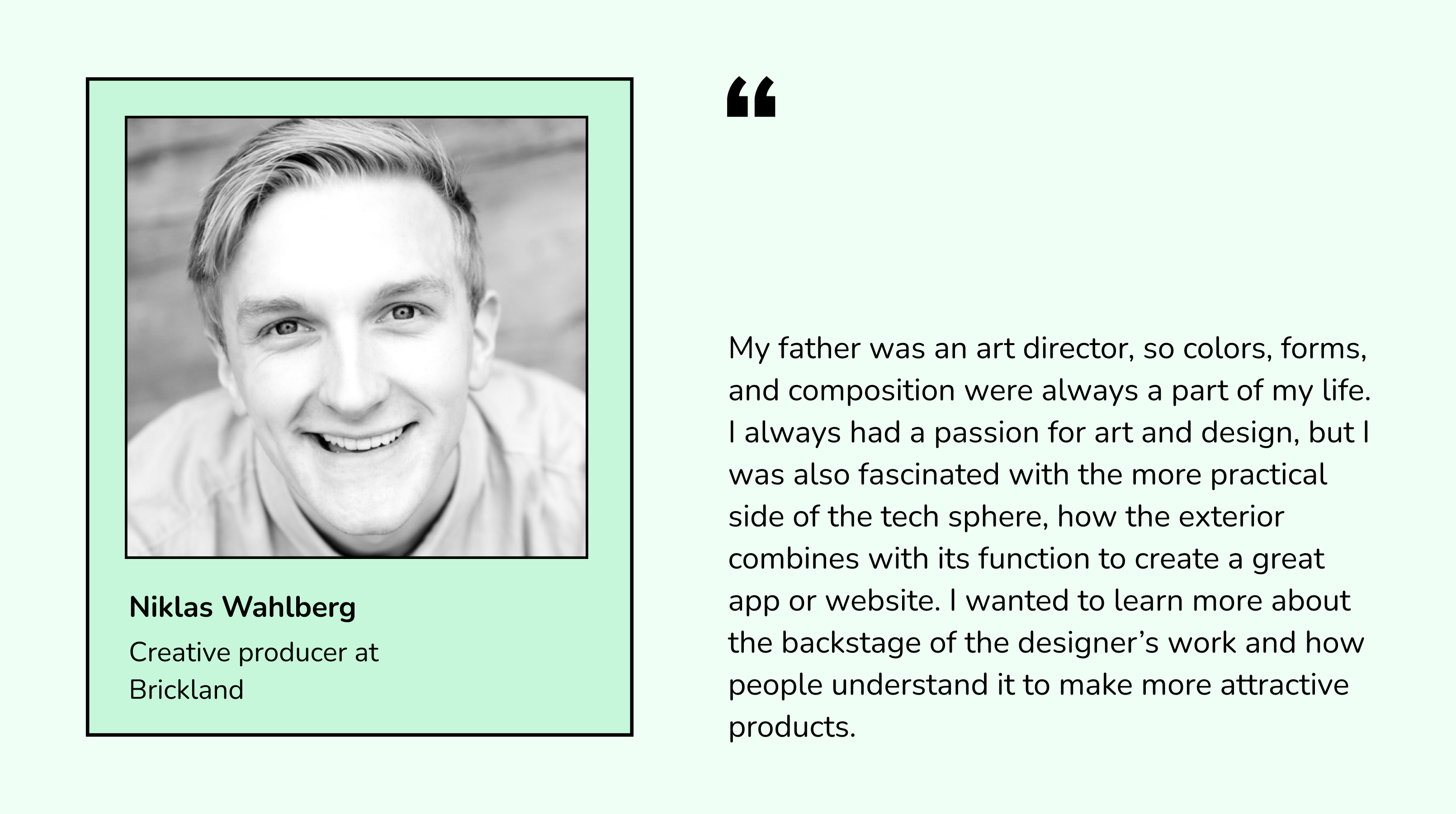
Before even thinking about design courses, I was already employed in this sphere. I worked at Berge and later Brickland as a creative producer and 3D artist and was content with my position. I was pretty happy with a full-time job in the sphere I liked. 

However, I wanted to improve my understanding of the topic. I was interested in gaining a deeper comprehension of the design process, especially from the customer's point of view. I needed to know the sense behind the design and how to make it readable for people to understand it. I wanted my design decisions to be not only attractive but meaningful and clear. That’s how I began to think about taking a course on design and how I came to the Academy. 

The course was helpful, even though I’m not a beginner

As you can see, my query was specific enough. I needed insights, practical experience, and a wide range of knowledge to get the answers. And I am pleased to say that I got the help I needed at the Beetroot Academy. My teacher, Alex, managed to conduct the classes according to the curriculum and devote time to our questions and requests. He also shared much of his experience and work insights, which are a valuable part of the education process. 

I have been studying in an international school before, so it was pretty easy to connect with other students. Still, the friendly atmosphere that emerged in our group is worth mentioning. Our teacher was also open to our advice and feedback so I could share some of my work experience. 

I learned to think about other people’s experience

I had my hard times during the course as the UX part was a bit difficult for me. However, I loved the UI part, which helped me understand how to look at the design process from a different perspective. What struck me most was that you must consider user experience a safe place – ask yourself what is comfortable and familiar to your customer. So, I think my studying at the Academy was successful as I got what I wanted. I learned how to analyze the design process and focus on what others will experience while using the app or the website I create. 

Read:
minutes
min
No items found.
What the training at the Project management in IT course gave me

Materialization of my desire

In the short time before registration for this training, I felt like I was marking time, and I could not move forward in my study of English. Thinking of what would help there, I concluded that creating conditions for a long-term but gentle immersion in English is necessary. And the thought flashed: “It would be nice to find some useful course with education in English.” I found it a few days later. Fortunately, my English level (Intermediate+) was enough for studying in the PM direction. 

The course is not for free, but I noticed the grant program possibility. I applied for it and got into the group. For training without payment, I went through four stages of selection, including screening by a registration form, one interview, and two tests in English. And there were four months ahead of studying materials in English.

Ready to take the “anti-course”? 

Even at the interview, the curator told me that Beetroot Academy uses an “anti-course” approach. In the standard teaching method, students come to a class, and a teacher explains the theory and gives examples and tasks for practice. The homework is based on what was in the lesson. 

Here, it works opposite: a few days before the lesson, the teacher opens materials on the topic for self-study. Students should come to an online class already prepared and with completed homework. They have the opportunity to find out everything that was unclear or undone at home and to ask any questions. 

In online classes, a teacher explains the most critical points and gives practical tasks to make them in mini-groups during a lesson. Then they talk about how to do the following homework.

The first month of training

It was a seething cocktail of thoughts, doubts, emotions, and feelings, visually reminiscent of a rollercoaster. On the one hand, it was exciting and even pleasant to study. But on the other hand, the lack of the opportunity to become a real participant or observer of the whole development process in a tech company raised doubts, fears, and questions. 

It was necessary not only to study but also to cope with internal resistance, emotions, procrastination, and other companions while achieving the goal. In addition, English, which seemed familiar and even understandable, suddenly became an obstacle. A few weeks after the training, my brain decided that there was too much English and, at times, refused to accept it at all. Even with many years of experience as a manager, business trainer, and coach, I sometimes had to “talk about it” with someone. And it’s good when there is support from family or friends during a long study.

Study days

We communicated with classmates, student success managers, and a teacher via Slack. We still continue to chat and share helpful links and news. 

The training program included everything you need to work as a project manager in a tech company: 

  •  SDLC. Waterfall, Agile, Kanban, and Scrum (definitions, values, principles, ceremonies, artifacts, examples, etc.). 
  • Skills in working with tech teams and stakeholders. 
  • Study of project documentation and practice with PM tools: Google Sheets, Asana, Trello, Jira, etc. 
  • Risk management, task assessment, project budget calculation, and much more. 


And I treated the very process of learning on the course as a project implemented according to Scrum. Based on the Scrum guide-2020, I distributed the roles in this way: 

  • Product owner –  the student success manager of our group (from the Academy). 
  • Scrum Master  –  the  teacher. 
  • Developers –  me. 


Each week was a sprint, and timely homework assignments were increments that complemented the learning project. After completing the course, we had a final exam – a test in English on all course topics. Students who pass it receive a certificate.

Practice and study project

A project manager's training is built on the practical consolidation of the studied material. For this, in the first lesson, we should choose a project based on which everyone will complete homework throughout the course. As an educational project, I took the development of an informational multipage adaptive website for a private language school for children. 

Topic by topic, stage by stage, I supplemented my project with documents and artifacts made using existing project management tools. Subsequently, I made my project presentation in English as a final result of my training. 

One of the tasks I completed using Trello. On the presentation slide, there is a board: the columns indicate my project's document, stages, and roles in the team. Then there is the task of estimating tasks in the backlog. For this, I created a list of activities to achieve the learning goal of the course. Color labels show the level of importance of each item. The following is an abbreviated example of a structured and results-oriented work breakdown structure (WBS) that a team must complete to achieve project goals and create desired results. 

The green color marks the work of a project manager. The gray is teamwork. The light blue is the team's work on creating the MVP, and the blue is the overall work on creating the MVP. The presentation contains an example of a project roadmap, where the so-called milestones, or significant stages of development delivery from project start to closure, are displayed with dates. 

Jira  is software that is often asked about in interviews. On the slide, there is homework with the backlog (list of tasks) to implement my educational project. And below is a project roadmap in the form of a Gantt chart with milestones.

A nice bonus

The process of basic education includes an optional English-speaking club. There are 32 hours of speaking practice + listening and grammar exercises with a professional English teacher. Toward the end of my study, I felt that my relationship with English had improved:

  • The texts of English-language articles and job descriptions stopped prick the eyes with unfamiliar words and technical terms.
  • My knowledge of grammar was refreshed and strengthened.
  • The embarrassment of speaking English with strangers has disappeared.
  • The pronunciation has changed from hard Runglish to English.
  • My brain began to perceive the fast English speech, with different voices and pronunciations.


Yes, I have been working hard on this daily, because I have difficulties learning languages. In the end, it turned out that the wish came true. I mastered the IT project manager profession and raised my English level from B1+ to B2+.

Career perspective

Changing the job is not an easy process. Even during training, many students felt an emotional swing from “I can handle it” to “I can't handle it.” And that's why Beetroot Academy offers an elective career counseling course. The materials are open closer to the end of the main course. Thanks to this, you can prepare a CV and cover letter for finding a job in a new profession. And also to get a consultation, post a CV on job sites, and prepare for an interview. 

Getting your first job in tech is challenging. The job search process takes several months for many graduates, and I am no exception. It's nice that Beetroot Academy supports its graduates after graduation. There is a community for alumni where you can learn about vacancies and events. Such support and the numerous success stories gave me confidence that I would soon find my dream job. 

Following the Project management in IT course, I also completed a Scrum-study course to increase the chances of getting the desired result. We mainly analyzed cases and how to apply Agile and Scrum methods in tech companies. I am currently looking for a job as a project manager, scrum master, or learning specialist. I will be happy to discuss the details in a personal communication via Linkedin.

Read the original text here

Read:
minutes
min
No items found.
What does a Python developer do? An introduction to the profession

Who is a Python developer?

A Python developer’s role can encompass a wide variety of duties. He could be a software developer, data analyst, web developer, data scientist, automation tester, AI engineer, or machine learning engineer – it depends on the need of the project.

A typical Python developer’s job description could span responsibilities including:

  • Writing efficient, scalable, testable, and reusable Python code.
  • Designing and creating applications and websites.
  • Integrating data storage solutions.
  • Creating integrative systems.
  • Integrating user-facing elements into different applications and data storage solutions.

The Python developer is also expected to be able to:

  • understand, analyze, and implement business needs into software components;
  • create predictive models for AI and ML-based features;
  • performance tuning and automation of applications;
  • keep up with the latest technology and trends;
  • work with Python libraries like NumPy, Pandas, etc.

What skills must a Python developer have?

Python developer needs to have a fundamental knowledge of various foundational concepts such as Variables and Data Types, Data Structure, Exception Handling, Object-Oriented Programming, understanding of data analytics, data visualization, and statistics. He must have skills in AI, ML, Neural networking, Deep Learning, and, of course, Version Control, as well as decent knowledge in front-end technologies like HTML, CSS, and JS.

Such a specialist must be able to integrate various data sources and databases into a unified system and design principles that are executable for a scalable application. The ability to robust testing and debugging capabilities for tools such as Selenium and basic knowledge about Object Relational Mapper libraries would be an advantage.

Technical Skills for Python Developer include proficiency in:

  • core Python fundamentals;
  • Python Libraries;
  • frameworks like Flask and Django;
  • code packaging, release, and deployment;
  • code versioning tools like SVN, Git;
  • database knowledge.
  • circles, conditional, and control statements.

Python developers must-have soft skills like:

  • Being able to write clear and optimized code.
  • Good understanding of algorithms and logic or analytical skills.
  • Communication skills to establish effective and friendly communication between developers, designers,  testers, and users.
  • Excellence in problem-solving and project management.
  • Being good in time management, task organization, and project management.
  • Out-of-the-box thinking capability, creativity.

The future of Python developer

Massive demand for Python developers is observed in all corners of our planet. Python is used in various development fields such as App development, Web development, Game development, IoT Development Projects, Machine Learning, Data Science, and much more. Its popularity resulted from the growing data science community, including artificial intelligence and machine learning — industries like healthcare, education, and finance use machine-learning applications to improve their organizations through innovations.

Therefore, the future looks bright for Python developers. You can build a career in ML, AI, data science, data analytics, etc. From web development to automatic scripts and startups to giant organizations, you can realize your skills and knowledge and earn a decent wage. According to, the estimated total pay for such specialists in the USA is from $97.968 to $112.590 per year.

Do you want to become a Python developer? Apply for the course at Beetroot Academy.

Read:
minutes
min
No items found.
Top 5 programming languages in 2023

JavaScript

We decided to put JavaScript at the top of our list of the 5 most popular programming languages. It rightfully takes first place as the most popular and widespread language globally and holds its position for the second decade. Almost 90% of all websites work thanks to it. 

One of the primary reasons why JavaScript is so popular is its ubiquity. Almost every website and web application use JavaScript, making it an essential language for web development. Moreover, JavaScript is also used in front-end frameworks like React, Angular, and Vue.js, as well as in server-side environments like Node.js. With the rise of mobile app development, JavaScript is also being used in platforms like React Native and Ionic.

JavaScript is an excellent starting point for newcomers to the IT world. Its syntax is relatively simple, and it doesn't require a complicated setup to start writing code. That's why our Front-end development training course uses JavaScript and is the most popular choice on our platform. This course is ideal for you if you want to learn the basic principles of programming and website development. Even if you later decide to master another technology - the knowledge you get during the 4-month course will help you much easier to understand the principles of the next programming languages you choose.

Main features:

  • Dynamically typed: JavaScript is a dynamically typed language, meaning variables are not assigned a specific data type. This feature makes it easier for developers to write code quickly and efficiently.
  • Object-oriented: JavaScript is an object-oriented language that uses objects to represent data and functions. This feature makes it easy to reuse code and logically organize data.
  • Event-driven: JavaScript is an event-driven language that responds to events like mouse clicks and keyboard presses. This feature makes it ideal for creating interactive user interfaces and animations.
  • Asynchronous: JavaScript is an asynchronous language that can handle multiple tasks simultaneously without blocking the main thread. This feature makes it ideal for creating real-time applications like chat apps and online games.
  • Client-side scripting: JavaScript is a client-side scripting language that runs on the client's computer rather than the server. This feature makes it ideal for creating dynamic and interactive web pages.

For newcomers to the world of IT, JavaScript is an excellent starting point, and its main features make it a powerful language for creating interactive and dynamic applications. It is also one of the top 5 easiest programming languages to learn.

Where is it used?

It is often hard to understand a programming language and how it works, especially for someone new to technology. If we were to give an excerpt of code here as an example, it would make little sense to most of our audience. But applications made with JavaScript speak for themselves! Check out the top 3 applications that use JavaScript:

  • Netflix

You've heard of this streaming giant, no doubt. 148 million subscribers worldwide, 26 years in business, all the code, both back-end, and front-end, is written entirely in JS. Impressive, isn't it?

  • Facebook

Another digital giant that not only uses JS as the main language of its platform but has also made a huge contribution to the development of JavaScript. Not many know, but Facebook developed the popular React Native framework to optimize the mobile app experience.

  • LinkedIn

A company, well-known to all specialists in the field of information technology. Thanks to the optimal use of HTML and native JavaScript code, LinkedIn’s development team created a well-crafted application with a stunning user interface.

Need help figuring out where to start? Start with JavaScript!

Python

This language is not named after a snake, which will please those who are wary of crawling creepers. The name "Python" comes from the British comedy group Monty Python. Guido van Rossum, the creator of Python, named the language after the group as a tribute to their comedic genius.

As you can see, the language itself is designed quite simply. Watching stand-up, of course, is a lot more fun than learning python language, but don't let the difficulty scare you. 

Python is a high-level programming language that has recently gained immense popularity. In 2023, Python will continue to be a popular language among developers, thanks to its readability, versatility, and ease of use. 

Python is widely used in data analysis and scientific computing because of its extensive library support, which includes libraries like NumPy, SciPy, and Pandas. These libraries allow developers to work with large amounts of data and easily perform complex mathematical calculations. Python's readability also makes it an ideal choice for data analysis, as it allows developers to write code that is easy to understand and maintain.

Beetroot Academy offers a 4-month Python development course covering Python programming basics, web development with Flask, data analysis with Pandas, and more. The course is designed to help students master a Python developer's promising and in-demand profession.

Main features:

  • Readability: Python's clean and simple syntax makes it easy to read and understand, even for beginners.
  • Versatility: Python can be used for a wide range of applications, from web development and scientific computing to artificial intelligence and machine learning.
  • Interpreted: Python is an interpreted language, which means that it does not need to be compiled before execution. This feature allows developers to test and debug code more quickly.
  • Object-oriented: Python is an object-oriented language, which means that it uses objects to represent data and functions. This feature makes it easy to reuse code and organize data in a logical way.
  • Large library support: Python has vast library support, which includes libraries like NumPy, SciPy, and Pandas for data analysis, and Django and Flask for web development.

Python's main features, including its readability, versatility, and extensive library support, make it a powerful language for any application in the top 5 web programming languages.

Where is it used?

To better appreciate the applicability of this programming language, let's find out the top 3 applications developed with Python.

  • Instagram 

A true media giant that has turned the world of digital photography and social media upside down. With about 500 million active users daily, Instagram proves the scalability and effectiveness of the Python language. According to Instagram engineer Hui Ding, Instagram engineers' motto is "Do simple things first,"-and that's what Python allows developers to do.

  • Spotify

Spotify is the world’s largest streaming service, with annual revenue approaching €10 billion. This makes it a significant market player and one of the top Python business users. The company preferred Python development because of the language's speed and advanced data analytics.

  • Uber 

One of the most beneficial mobile programs made with Python is Uber. A ride-hailing service that also offers food delivery, peer-to-peer ridesharing, and bicycle-sharing (among other services), Uber has a lot of calculations to do. Think about it: the company operates in 785 metropolitan areas worldwide and is estimated to have 122 million users. That’s a lot of math. But again, Python handles large amounts of data and is easy to learn and work with, which is why Python is so popular.

C#

Microsoft developed a modern, object-oriented programming language called c # (pronounced C sharp). In 2023, C# continues to be a popular language among developers thanks to its versatility, performance, and ease of use. C# is used to create a wide range of applications, from desktop software to web and mobile applications.

C# is trendy in game development, where it is used to create high-performance games for consoles, PCs, and mobile devices. C# is also used in enterprise application development, where it is used to create software for businesses and organizations.

If you are an avid gamer and adore video games, then this language is exactly what you need! Thanks to his knowledge, perhaps your contribution will help change the gaming field beyond recognition.

Main features:

  • Object-oriented: C# is an object-oriented language that uses objects to represent data and functions. This feature makes it easy to reuse code and organize data in a logical way.
  • Garbage collection: C# includes automatic garbage collection, meaning developers do not need to manage memory manually. This feature makes C# code more reliable and easier to maintain.
  • Cross-platform: C# is a cross-platform language, which can be used to create software that runs on different operating systems, including Windows, macOS, and Linux.
  • Versatile: C# is a versatile language that can be used to create a wide range of applications, from desktop software to web and mobile applications.
  • High-performance: C# is a high-performance language that efficiently handles complex tasks and large amounts of data.

Due to its features, this language is used by the world's top game development companies. It's one of the top 10 programming languages for game development in 2023!

Where is it used?

C# has established itself as a complex and layered programming language. Let's dive a little deeper into the language and see what programs have been written using C#.

  • Microsoft Windows 

The most popular operating system in the world was written in C#. In general, other languages were used in the development of the whole operating system and its individual functions, but it is C# that is responsible for the core functionality, which proves the reliability and great computational capability of this language.

  • Microsoft Office 

All the applications that many people are used to handling on a daily basis have been developed with C#. Thanks to it, we are able to use convenient and functional programs such as Word, Excel, PowerPoint, or Outlook.

  • Adobe Photoshop

The most popular photo editor was also developed with C#. This choice of language is due to the multitasking and multilevel nature of the program. Only C# can do such a thing.

Ruby

Ruby is a dynamic, object-oriented programming language that has recently gained popularity. In 2023, Ruby will continue to be a popular language among developers, thanks to its simplicity, readability, and ease of use. Ruby is used to create a wide range of applications, from web development to automation scripts.

Ruby is particularly popular in web development, where it is used to create powerful and scalable web applications. It is also used in automation and scripting, where its simplicity and readability make writing and maintaining code easy.

In 2023, the global IT trends show that there is an increasing demand for developers who are skilled in Ruby, particularly in the field of web development. Knowledge of Ruby opens up career prospects in software development, web development, automation, and scripting. 

Main features:

  • Simple and readable syntax: Ruby's syntax is designed to be simple and easy to read, making it a popular language among developers new to programming.
  • Object-oriented: Ruby is an object-oriented language that uses objects to represent data and functions. This feature makes it easy to reuse code and organize data in a logical way.
  • Dynamic typing: Ruby is a dynamically typed language, meaning variable types are determined at runtime. This makes it easy to write code quickly and allows for greater flexibility.
  • Metaprogramming: Ruby's metaprogramming capabilities allow developers to write code that can modify itself at runtime. This feature makes it possible to create complex programs with a smaller amount of code.
  • Web development framework: Ruby on Rails is a popular web development framework that is built on top of Ruby. It simplifies the development of web applications by providing a set of conventions and best practices.

With the rise of e-commerce and online businesses, the demand for Ruby developers is expected to continue to grow in the coming years.

Where is it used?

  • Github

The mecca of all programmers was created using this wonderful language. There are currently more than 57 million repositories on the service. If you want to create large-scale projects, learn Ruby!

  • Airbnb

The most popular travel service in the world is also made in Ruby. Over 800,000 offers in more than 190 countries. The numbers are staggering, aren't they?

  • SoundCloud 

SoundCloud is built using Ruby on Rails and is one of the commercial giants these days. It offers various attractive features such as uploading podcasts, a collection of millions of songs from across the globe, building a blog, a library of liked audio tracks, and many more.

Java

Java is a high-level programming language that has existed since the mid-1990s. Despite its age, Java is still a popular language in 2023, thanks to its portability, reliability, and wide range of applications. Java is used to create everything from mobile apps to enterprise-level software.

Java's history begins in the early 1990s, when a team of Sun Microsystems engineers led by James Gosling started to work on a new programming language. The team wanted to create a language allowing developers to write software that could run on any platform, regardless of hardware or operating system. The result was Java, which was released in 1995.

In 2023, Java is still a popular language among developers, thanks to its wide range of applications and its portability. Java is used in mobile app development, enterprise-level software, game development, and more. It is also a popular language for building backend systems and APIs.

The global IT trends in 2023 show that there is a high demand for Java developers, particularly in the field of enterprise software. Knowledge of Java opens up career prospects in software development, enterprise-level software, mobile app development, game development, and more.

Main Features:

  • Platform independence: Java's "write once, run anywhere" capability allows code to be compiled on one platform and run on another, regardless of the underlying hardware or operating system.
  • Object-oriented: Java is an object-oriented language that uses objects to represent data and functions. This feature makes it easy to reuse code and logically organize data.
  • Strong typing: Java is a strongly typed language, meaning variable types are checked at compile-time. This helps catch errors early and makes code more robust.
  • Garbage collection: Java has a built-in garbage collector, which automatically frees up memory that is no longer being used. This feature makes it easier to write and maintain large, complex programs.
  • Large standard library: Java has a large standard library that provides a wide range of functions and tools for developers to use in their programs.

Where is it used?

Let's lift the veil of mystery from this programming language and find out where it is used. 

  • Android OS 

The most popular mobile operating system owes its existence entirely to this programming language. Java has proven itself as a reliable and time-tested programming language.

  • NASA WorldWind

An open-source virtual globe that is built on the Java development platform. It allows the users to zoom from any of the satellites into any place on Earth. 

  • Twitter

One of the most popular social networks is also written in Java. If you want to create something as popular and long-lasting as this, learn Java!

So what will you choose?

So, what will you choose? The top 5 programming languages of the future will undoubtedly be the most promising and in-demand areas in the tech industry. From web development to data science and machine learning, mastering one or more of these languages can open up a world of opportunities for your career. 

The good news is that many of these languages are already available to study at Beetroot Academy. Whether you're a newcomer to the IT industry or a seasoned developer looking to expand your skill set, we have a course to help you achieve your goals. Don't wait any longer to pursue your dreams — enroll in a course today and take the first step towards a successful tech career!

Read:
minutes
min
No items found.
The newly updated UI/UX design course will start this July

A brief overview

Five experts, practicing designers with senior level experience, worked on the course update. The course will last five months, consist of six mandatory and one bonus module, and involve working on three projects you can add to your portfolio. Specifically, you will receive the following modules with updated lessons, useful links, theory tests, and homework:

  • Figma 
  • UX Design
  • UI Design
  • Mobile application design
  • Final project
  • Personal Brand and portfolio
  • Bonus Module: Photoshop (independent study)

While doing your homework, you will apply your knowledge and hone your skills by working on three projects in sequence. The final one is the most important, as here you will be able to prove yourself as a UI/UX designer ready for your first commercial job.

This course is for you if:

You’re starting or switching a career

You’d like to join the tech field, and UI/UX design feels like the best way to go about it.

You already know quite a lot but would like to polish and systemize your knowledge

You’re familiar with Figma, Photoshop, Sketch, etc., and curious about design trends. Furthermore, you have an eye for great design and usability of websites, so you’d like to organize your knowledge base and improve your prototyping and UI skills.

You’re a designer in a different field 

Working as a graphic designer or an illustrator, you’ve felt the urge to learn about customer experience, composition, and typography on the web. Your goal is to try your hand specifically at UI/UX design. 

If you want to become a UI/UX designer and pursue a career as a tech professional, register for the updated course and start studying this July.

Read:
minutes
min
No items found.
The newly updated QA manual course is out now

Before we move on to the updates, this two-month course is aimed at beginners in testing. All future students require is motivation, digital literacy, and 18+ hours per week to study. 

The authors carefully analyzed the program and suggested changes based on their experience teaching in previous cohorts and student feedback. This has been implemented in the following updates. 

QA manual course guide 

The course has a concise summary with the essential theory for each lesson. It goes hand in hand with many recommended reading articles and homework assignments that involve independent work and practice with the teacher.

Three levels of homework difficulty

Each homework assignment has two levels, depending on your engagement in the course. 75% of the course assignments have a third level for those who have completed the first two. All completed homework must be documented in Google Docs so that at the end of the course, during the lesson on Git and GitHub, you can upload it to your Git page and present it to future employers. 

New lessons and materials

We've added new lessons to broaden the horizons of beginner testers, including:

  • Git and work with the command line.
  • Estimation. The practice of creating test documentation.
  • Overview of test design techniques.

We also added a new topic, "Introduction to IT. Companies and projects", in the lesson "What is testing and why is it important?". In the lesson "Test Rail and TestLink test control systems", we replaced the topic of TestLink with Azure DevOps. And in the lesson "Automated Testing Fundamentals", we work with Selenium as a browser extension. We added a subtopic about Pairwise in the lesson "Practice the Black-Box test design technique". We've also updated all the links to relevant articles in QA manual. 

Enrollment for the updated QA manual course is now open. So, register here if you want to start your career as a QA engineer after two months of intensive training led by an industry expert.

Read:
minutes
min
No items found.
The best Python books for beginners and professionals

But diving into Python isn't about learning a few lines of code. It's about understanding its essence, nuances, and capabilities. And what better way to do this than with books? While the online realm is bursting with Python tutorials and courses (shoutout to Beetroot Academy's awesome Python-centric module), there's something timeless and deeply enriching about flipping through the pages of a well-curated book. 

This list will guide you through some stellar Python books tailored for every learning curve. From the absolute newbie seeking to decipher Python's mystique to the seasoned coder hungry for more, we've got something for everyone. So, pull up a chair, and let's embark on this literary journey into the Python universe.

"Python Crash Course" by Eric Matthes

Audience: Beginners

About the book:

"Python Crash Course" is a fast-paced and comprehensive introduction to Python programming. Designed with the beginner in mind, it's a fantastic foundation for those new to coding and Python as a language.

What makes it special:

Hands-on Projects: After grounding you in the basics, the book delves into three substantial projects: a Space Invaders–inspired arcade game, data visualizations using Python’s super-handy libraries, and a simple web app.

Accessible Language: Eric Matthes breaks down complex topics into easily digestible chunks, ensuring that you grasp the concept before moving on.

Real-World Applications: The real magic is in the latter half of the book, where readers get to use their newfound knowledge in real-world scenarios, giving a sense of purpose to the initial chapters.

Why Beetroot Academy recommends:

For beginners, it’s an incredibly practical and hands-on introduction to Python. The book introduces you to the language and encourages you to think programmatically and solve real-world problems. Pairing this book with a Beetroot Academy course can truly elevate your Python journey and provide a solid foundation for future learning.

Availability:

While we cherish the tangible feel of books, we also understand the digital age's conveniences. Hence, attached here is a downloadable PDF version for those eager to dive in right away!

"Automate the Boring Stuff with Python" by Al Sweigart

Audience: Beginners to Intermediate

About the book:

If you've ever thought, "There must be an easier way to do this tedious task," then this book might just be for you. "Automate the Boring Stuff with Python" revolves around the central idea of leveraging Python to handle mundane, repetitive tasks, freeing up your time for more creative endeavors.

What makes it special:

Practical Tasks: From updating Excel spreadsheets to sorting files, the book provides Python solutions to a range of everyday problems.

No Prior Experience Required: While it's helpful, you don’t need any prior programming knowledge. Each concept is introduced in the context of a complete project, ensuring understanding.

Interactive Learning: The book comes with an accompanying website featuring video lectures and interactive Python sessions.

Why Beetroot Academy recommends:

This book is golden for anyone who wants to see the immediate real-world application of Python. It's not just about learning Python; it's about improving productivity. Integrating these automation techniques while studying at Beetroot Academy can greatly enhance your coding efficiency and workflow.

Availability:

Eager to delve into Python's automation magic? Grab the PDF version here and start today!

"Fluent Python" by Luciano Ramalho

Audience: Intermediate to Professionals

About the book:

"Fluent Python" by Luciano Ramalho stands out as an in-depth analysis of Python’s constructs. The author doesn't merely introduce Python; he examines it, presenting an intricate look at its foundational components, from data models to built-in functions.

What makes it special:

Depth Over Breadth: Focuses on understanding the 'why' behind Python's design.

Python's DNA: Dissects Python, showcasing its elegance and design rationale.

Transitioning: Ideal for programmers keen on evolving from intermediate to advanced coding.

Why Beetroot Academy recommends:

"Fluent Python" is the guide for those yearning to move beyond mere coding to crafting articulate, efficient Python scripts. Our team believes that this book shines a light on the path to true Python fluency.

Availability:

Ready to dive deep? Access the PDF version here and immerse yourself.

"Head-First Python" by Paul Barry

Audience: Beginners

About the book:

Paul Barry's "Head-First Python" is part of the highly popular "Head First" series, known for its unique teaching approach. The book provides a visually rich format to engage the reader, making complex concepts easier to grasp. Instead of burdening the reader with lengthy chapters, "Head-First Python" adopts a visually rich approach, utilizing diagrams, images, and playful text.

What makes it special:

Visual Learning: Emphasizes understanding through visual representations.

Playful Approach: Uses humor, stories, and engaging exercises.

Comprehensive Content: Takes readers from the basics to more advanced Python concepts, ensuring a thorough understanding.

Why Beetroot Academy recommends:

For those who find traditional coding books a tad dry or challenging, "Head-First Python" is a breath of fresh air. Its unconventional teaching style aligns with Beetroot Academy's approach of making learning interactive and fun. We appreciate the book's commitment to ensuring that the learning sticks.

Availability:

Ready for a unique learning experience? Dive into the pdf version here.

"Think Python: How to Think Like a Computer Scientist" by Allen B. Downey

Audience: Beginners to Intermediate

About the book:

"Think Python" by Allen B. Downey isn't just another book about Python syntax and semantics. Instead, it serves as a guide to cultivating the thought processes required for computer science. Downey simplifies complex principles into digestible chapters, each one advancing your comprehension and capacity for computational problem-solving.

What makes it special:

Conceptual Approach: Encourages readers to think like computer scientists, not just code.

Exercise-Driven: Every chapter concludes with practice problems, reinforcing learned concepts.

Broad Range: Covers foundational topics as well as more intricate Python subjects.

Why Beetroot Academy recommends:

At Beetroot Academy, we believe that coding isn't just about knowing a language; it's about the logical and analytical approach to problem-solving. "Think Python" aligns with our ideology by emphasizing the 'why' and 'how' behind coding rather than just the 'what'. It's a resource that goes beyond the basics, nurturing the computational mindset essential for aspiring developers.

Availability:

Ready to mold your computational thinking? Access the pdf version here.

Coding your way forward

Diving into the world of Python is like embarking on an exciting trek through a vast and diverse landscape. Just as every traveler needs a reliable map, every coder needs good books to guide them. The selections we've discussed aren't just manuals; they're compasses pointing you to Python mastery.

Beetroot Academy has always believed in providing resources that aren't just informative but transformative. And while these books are fantastic jump-off points, remember that the journey of learning is perpetual. With its evolving frameworks and libraries, Python will always offer something new.

To the aspiring Pythoneers reading this, Beetroot Academy beckons you to take the leap. Engage with these resources, immerse yourself in projects, and soon, you'll not just be coding in Python but thinking in this lamguage.

Happy coding, and remember: every line of code you write brings you closer to the developer you aspire to be.

Read:
minutes
min
No items found.
The habit of constantly learning new things and improving as a key to success: about the transition from medicine to tech

Practical approach – effective learning

When I started the course, I did not want to change my job immediately. I decided to gain knowledge and skills for my general development and understand whether Project Management was what I had imagined. I looked at the program, took a test, and talked to the coordinator. Everything was very clearly organized. I like it when everything is structured, and you see well-established processes.

In my opinion, a big advantage was that our teacher, Nastia Yudina, was a practitioner who decided to share her experience with newcomers. We were her first group. Nastia has a very cool methodology, so the course was full of practical things. 

You ask, and the Academy helps you

I want to note the teacher's credo and, probably, the entire Beetroot Academy, which is helping with employment. I sent Nastia some test assignments three times, and she checked them and told me how to improve them and what to do. She also looked at my CV several times and helped me improve it. 

I am sure that this is not only the culture of the teacher, but also the school culture, that they will help you at any time. And even now, we call up our group and Nastia every six months or four months. We communicate, exchange news, and tell each other who works where and what they do. 

This is the atmosphere created at Beetroot Academy; it's very cool and fun. And now, having already worked in two companies, I realize that the materials and knowledge taught in the course correspond to what companies need from project managers.

Advice to those who want to move to tech

You should understand why you are doing this, i.e., weigh the pros and cons and not expect rapid success. You will have to work more than a few hours, and no one is waiting for you with a bag of money. 

You have to understand that you will work more than 8 hours a day at the beginning, and you may earn even less than before. When I came to tech, I lost half of my income. However, I understand that this is the learning curve. But it will get easier, just like in any profession. 

I think those who are thinking about tech should try it. There are a lot of free lectures. And if you are interested, try to take courses because, without courses and experience, you will not be hired anywhere. 

As for age, for example, in the last company where I worked, there was a junior developer aged 42 on the team. In general, it is important for an employer, regardless of age, to have a transparent motivation, i.e., why did you decide to change your profession? The main thing is that you should be able to explain to your employer your desire to work and develop here, and when you are hired, you should show that you really want to and are capable of it.

If you're a senior manager, you must prove that you deserve this position. I think that in any field and any position, and especially in project management, it is crucial that you develop, that you learn something, and that you can do more today than you did yesterday. And you don't just know; you take it and do it.

As for the financial component, I have not yet reached the level of income I had when I worked in pharmacy. But I think it will take about a year of my official employment, and my income will be at the same level, or maybe even higher.

Where to look for a job after graduation? What should you be prepared for?

Firstly, you must look for a job while still studying, because it is a very long process. I was looking for my first job for three months. 

Secondly, I looked at vacancies everywhere: on various job boards and received a newsletter from Beetroot Academy. Several times, I just opened the websites of tech companies from the top 10 or 15 and just looked at their vacancies. 

What should you be prepared for? There will be a lot of rejections and a lot of ignoring. They will give you test tasks that you will do, and you will not be given feedback. And this will be 90%.

And this is normal because, for example, when you apply for a junior position from a job board, you need to understand that there are already 200 responses, and yours will be the 201st. It's unlikely that you will be selected. But you must still respond and write a cover letter to attract attention. 

In one of the companies I got into, I first sent my resume with a cover letter through a job board, and I was rejected. A week later, I sent a CV through the same company's website, and as a result, I got a job there. 

I would like to talk separately about test tasks. They all aim to see that a person already has some experience and understands what they can do. Such tasks usually take an hour or two. There are more complex ones that take up to four hours. Once, I saw a test task that would have taken me several days to finish. I didn't even try to complete it. 

As for the feedback on the test, they usually give it, but some ignore it - that's 10%. Sometimes, you must ping: "Can you give me some feedback?". They answer: "Oh, I'm sorry, you're not suitable for us." 

In any case, each test gives you some understanding; you learn something. And doing tests, in my opinion, when you are a junior, is normal. You get experience, and you'll feel more confident on future tests. 

In addition, during the interview, they may also give you a test task to solve right there and then tell you about your thoughts. Therefore, it is helpful to prepare, do a few tests, and discuss them with your teacher so that you can be confident in your abilities at the interview. 

I have never had an offline interview, even with companies in my town. The preliminary screening takes place online with a recruiter; it takes half an hour and is quite quick. Now, I work at Sigma remotely. There is an office, but I am comfortable working from home.

Read:
minutes
min
No items found.
‘That's what she said!’ and Other ways not to start your cover letter (The Office edition)

What is a cover letter?

At its core, a cover letter is like that epic movie trailer before the blockbuster film, which in this case, is your CV. It’s the appetizer before the main course; believe me, everyone remembers a good one! It gives potential employers a glimpse into the sequel of who you are beyond your resume's bullet points and IMDb-style headlines.

Imagine your CV is like the list of all the movies you’ve watched (or at least claim you've watched). On the other hand, the cover letter is that one memorable scene you can’t stop talking about at the water cooler (or, these days, on a Zoom call). While a CV states the facts — think film titles, durations, and star ratings — the cover letter dives into the reviews. Why did you watch those films, and why do you think 'The Office' (come on, we all love it!) is peak comedy?


Now, a cover letter isn’t just a highlight reel of your CV. Picture it as the moment in a sitcom when a character breaks the fourth wall, looking directly at the audience — that’s you connecting with the recruiter, sharing an inside joke, or a "Did Jim just look at the camera?" moment. It's where your achievements and bloopers, tailored to the vacancy, create a memorable impression.

Moreover, if your CV is the script, the cover letter is the director’s commentary. It demonstrates your communication skills and proves that you're not just another extra but the main character of your career story. In a world filled with reruns, your cover letter is that fresh new episode everyone’s been waiting for. And while qualifications are the season finales, employers love those unexpected plot twists and the behind-the-scenes tidbits you bring to the set.

So, to sum it up, if someone asks, "What is a cover letter?", just wink and say, “It’s the Jim Halpert smirk in a world of Dwight Schrutes.” Your cover letter is a handshake, a nod, and that knowing glance toward the camera, inviting employers to tune in for the next episode of your career.

Motivation letter vs. Cover letter

Okay, imagine you're binge-watching your favorite series, and two characters pop up — one is wearing a beet farmer's hat, and the other one a suit from Dunder Mifflin's finest. Now, even if they're from the same show, you wouldn't mistake Dwight for Jim, would you? In the professional world, the motivation and cover letters can sometimes seem as confusingly similar as Kevin's famous chili recipe versus a beet salad. But let's get one thing straight: they are as different as our beloved Dwight and Jim!


Motivation letter: The Dwight of Letters

  • Purpose: Often required for academic pursuits, internships, or volunteer work. It's where you get to explain why you're as passionate about a subject as Dwight is about beets or martial arts. It’s your moment to tell your chosen institution or organization, “Bears, beets, and this opportunity are my top priorities.”
  • Content: While Dwight might include detailed plans for Schrute Farms, this letter focuses on your motivations, passion, and alignment with the institution or program. It dives deep, just as Dwight delves into Battlestar Galactica theories.
  • Length: Typically longer than a cover letter. It's where you pour out your heart like Dwight explaining the merits of owning a farm.

Cover letter: The Jim Halpert of Letters

  • Purpose: When you’re aiming for a job and want to introduce your CV with a smirk and a wink. Your Jim-style camera glance shows employers you're the best fit for the job. While a CV gives the facts, the cover letter says, "Yep, that was me pulling that epic prank on Dwight.”
  • Content: More tailored to the specific position and company. It focuses on your skills, achievements, and experiences, like Jim's playbook of pranks.
  • Length: Short, sweet, and to the point, much like Jim's concise yet impactful comments.

To sum it up, a motivation letter is your inner Dwight shining through – it's about passion, dreams, and why you’d chase down that opportunity like Dwight chasing after someone who stole his stapler. On the other hand, a cover letter is your Jim moment, showcasing how perfect you are for the role and perhaps adding in a slight smirk as you highlight your achievements.

Remember, whether you're channeling your inner beet farmer or paper salesman, it's essential to be authentic. So next time you're drafting one of these letters, ask yourself: "Would this make Dwight give a proud nod or Jim flash his iconic smirk?"

The art of crafting the perfect cover letter

Crafting a cover letter is akin to devising the ideal prank – it demands planning, accuracy, and flair. Now, imagine your "cover letter for resume" as your ticket to Beetroot Acade 's elite club. Let's guide you through this, step by step.

Opening: The importance of grabbing attention

Your cover letter's opening is your first call to the recruiter. Make it count.

  • Tip #1: Start with a captivating hook. While balancing a Jell-O mold on your head is commendable, spotlighting a unique “achievement” or relevant experience might be more suitable for a "cover letter for work".
  • Tip #2: Customize it for the position. Don't send a generic "cover letter sample". Address the specific vacancy, and remember, a tailored cover letter can be as impactful as Dwight's title of "Assistant to the Regional Manager".

Body: Detailing qualifications without regurgitating the resume

Your resume showcases your skills. Your cover letter, however, dives into your knowledge and the content of your experience. It's like Jim's pranks – we know he's a prankster, but the details of each joke make the difference.

  • Tip #3: Use real-life examples. Instead of saying you're a great team leader, detail an instance where your managerial skills shone. Perhaps, a "cover letter example" where you lead a project or defuse a team conflict quicker than Jim could hide Dwight's stapler.
  • Tip #4: Demonstrate your research. Allude to something unique about the employer. A light-hearted company reference can make your "cover letter sample for a job" stand out, but avoid a Michael Scott faux pas of getting details wrong!

Closing: Ending with impact and leaving a lasting impression

This is where you seal the deal.

  • Tip #5: Include a call to action. Prompt them to peruse your "sample cover letter for resume", initiate an interview, or just ring you up.
  • Tip #6: Keep it concise. Your sign-off should leave a mark. Think of it as Jim's smirk after pulling off a prank.

In essence, your cover letter is your platform to dazzle and intrigue, making the recruiter want to dive deeper into who you are. And remember, just like the best pranks are those executed with care and precision, the best cover letters are crafted with thought and passion.

Profession-specific examples & templates

When crafting your cover letter, the content should resonate with the specific profession you're targeting. Much like Michael Scott's management style, a' one-size-fits-all' approach doesn't always hit the mark. Here's a breakdown for each major profession offered at Beetroot Academy:

UI/UX design

Example: 

"Having gained solid experience in Adobe XD, I recently led a team to redesign a mobile app that improved its user retention rate by 20%. My skills align with Beetroot Academy's UI/UX Design course, where I honed my expertise."

Template Tip: Focus on user experience outcomes and design software expertise.

Project Management in IT

Example: 

"As an IT project manager, I've successfully completed over 30 projects on time and under budget. Beetroot Academy's course instilled in me the knowledge to balance both tech and managerial perspectives."

Template Tip: Highlight a specific project achievement and mention any methodologies you're familiar with, like Agile or Scrum.

Front-end development

Example:

"Coding isn't just a skill; it's an art. From responsive design to seamless user interactions, my portfolio showcases projects I've enriched through Beetroot's Front-End Developmeprogram."

Template Tip: Mention specific languages or frameworks you're adept in, like React or Vue.js.

QA manual

Example: 

"Ensuring software perfection, one test at a time. At Beetroot Academy, I learned the nuances of QA Manual, allowing me to spot and rectify over 500 bugs in the past year."

Template Tip: Speak about specific testing environments or tools you're comfortable with.

Python development

Example: 

"Python is the language of the future, and with the expertise from Beetroot Academy, I've developed three applications that optimized backend processes for my employers."

Template Tip: Reference specific libraries or frameworks, such as Django or Flask.

Golden tips for a stellar cover letter

  1. First Impressions Count: Like Dwight Schrute's beet farm, your opening paragraph should be memorable. Make it count!
  1. Tailor-Made Approach: Don't use a generic cover letter. Customize it for the job and the company, just as you'd pick a specific episode of "The Office" for a particular mood.
  1. Showcase Achievements: List specific accomplishments instead of general duties. Numbers speak louder than words!
  1. Mirror the Job Description: Use keywords from the job vacancy. It's like mirroring the language of your favorite character; people will notice!
  1. Be Authentic: Write genuinely about your experiences and passion. No need to be the "World's Best Boss" — just be the best version of you.
  1. Skip the Regurgitation: Your cover letter isn't just a repeat of your CV. It's the storyline behind your resume's facts.
  1. Strong Closing: End with a call to action or express keen interest. The cliffhanger makes them want the next episode (or in this case, an interview)!
  1. Mind the Length: It shouldn’t drag on like a good sitcom. Aim for 3-4 paragraphs or half a page.
  1. Proofread, then Proofread Again: Spelling or grammar mistakes? That's like serving a bad batch of Kevin's famous chili. Avoid at all costs!
  1. Seek Feedback: Before hitting send, get a second opinion. Even Jim always had Pam to double-check his pranks!

Signing off with style

Crafting a compelling cover letter is an art. With guidance from Beetroot Academy and the insights shared above, you no longer paint on a blank canvas. This process is a blend of your professional narrative, achievements, and a touch of personality, all tailored to the position and organization you're targeting.

From distinguishing between cover and motivation letters to tailoring your application for specific roles, Beetroot Academy has equipped you with the tools to shine. Take a page from Jim Halpert's playbook: be genuine, be memorable, and always seize opportunities with style.

As you venture into the job market, remember the value of a tailored cover letter. Let your resume introduce your skills, but let your cover letter tell your story. So, when that dream job appears on the horizon, pair your CV with a standout cover letter. Think of it as your golden ticket, ensuring your application doesn’t get lost in the shuffle but stands out like a fan-favorite episode of "The Office."

Best of luck! And remember, with Beetroot Academy by your side, you're not just applying—you're making an indelible mark. Here's to ensuring your cover letters are always the "Dundie Award" of every HR pile!

Read:
minutes
min
No items found.
The power of networking: how our UI/UX design graduate from Italy found a job in a Swedish company

The era before my tech career was completely different

My whole life up to finishing a master's degree, I was sure that the field I wanted to work in was art. I studied art history and planned to work with museums, researchers, and critics. And yet, exactly after getting my master’s, I realized that wasn’t what I wanted to do at all. And I panicked a lot. I felt the pressure of society that I must have my life together and be sure of what I wanted and with a career I successfully pursued. 

I started to go from the opposite and tried to make a list of things I definitely didn’t want to do; it seemed like a good practice. And while I was searching for something to spark my interest, my husband suggested trying UX/UI design – I didn’t even know what that meant. He explained that he had found Beetroot Academy, browsed its courses and reviews, and thought it might interest me. So, I did some research myself, and it really was a field that spoke to me. Everything else happened really fast, I enrolled in the Beetroot Academy and began studying right away. 

My experience at Beetroot Academy

My studying at the Academy was great, and I miss those days. Though it was pretty intense with three weekly classes, I was lucky with my teachers. They were passionate about their job and us as their students. Another bonus was that I had a small group. It allowed everybody to speak up, present their work, and get personal feedback.

The course structure was clear, and we did a pretty good job following it. I also enjoyed the bonuses, such as career counseling; it helped with the basics like CV, cover letter, and LinkedIn profile. Yet, as the teachers continued to repeat, you had to study independently and study a lot. So, I joined various webinars on interview techniques and tips on improving your CV – anything I could find. I also went through some mentorship programs, which gave me insights into the Swedish job market, a good topic for a foreigner. 

To change your career isn’t impossible, but it is hard

I started looking for a job in the middle of the course, and at the end of it, I got an internship as a UX/UI designer on a small startup project. It was a fun experience, as the design team consisted of me and one more person, and I had the freedom and space to work and learn from the practice. The only downside was that it wasn’t paid, and after some time, I found the courage to say goodbye to that environment and search for a real job.

Yet the Swedish job market is a tough place. I noticed that if the company doesn’t know you, your background, and what you are capable of, they won’t even give you a chance. And for a foreigner, it’s even harder to make them notice you, with no connections and nobody to recommend you. I went through many interviews and rejections, but I knew I had to do something actively to get the best out of my studies. So, I sent more applications and passed more interviews. 

Networking is a key

After some time, I still couldn’t find a job. I felt like I needed some advice or help or just a few words of support, and I reached out to the people I trusted, my teachers from the Academy. 

What happened next I consider a miracle: my UI teacher said that the company his wife works for is currently looking for a UX designer. He suggested contacting her, so that is what I did. She offered to pass my CV and portfolio to her art director – and that was the moment it all went right. I still had to go through the full interview process and showcase my experience, but now I had someone to back me up, who recommended me.

Be humble to learn and grow

Except for the network, I would say the way to get a dream job is to study constantly. And the best way to do it is to practice and ask for feedback. That can be scary and may make you feel frustrated, but it’s also the only way to learn from your mistakes. 

While studying, it’s your chance to seek advice from a more senior specialist who is there to help and guide you. Trust them, as their more experienced eyes can pinpoint your areas of growth and improvement. Also, I recommend finding a mentor to get hands-on experience in the job market. At the end of the day, UX/UI design, like any other field, is constantly growing and developing, and to be a good specialist, you have to keep up with it. 

Read:
minutes
min
No items found.
Taking a course in summer? 7 tips how to get started and staying motivated

Here are some tips to support your motivation

Set a goal

The best way to get motivated is to set a well-thought-out goal. This will help you to keep focused during the course. A good idea is to write your goals down, so you can visualize their accomplishment. Think about the big reasons why you study. How is this course going to help you, your family, word?

Stick to a routine

You can draw up a plan on how to achieve your aim. When you stick to the plan, everything is going right, and you won’t become anxious. So, stick to a routine and don't forget to reward yourself occasionally after your tasks are accomplished. Guilty pleasure, party with friends or a new book —  whatever you want would be nice.

Get organized

Make a schedule and stick to it strictly. Think about how you can simplify your life during studying. For example, set reminders, so you won't miss a lecture or forget to do your homework. Don’t be distracted by instant messengers and social networks while doing your homework. 

Avoid overload

It may seem that if you try to give it one hundred and ten percent every day, then the result will be better. But it's not. You’ll be more focused and productive in studying if you aren’t overloaded. Therefore, try to rationally split the time between study, personal life, work and leisure time so as not to overwork and not sacrifice communication with family and friends. Find time for hobbies, sports, and the like. Don't run yourself ragged!

Say NO to procrastination

To do this, find out what exactly is preventing you from starting the task. Reasons might be:

  • you don't know where to start;
  • you don't believe you can do it;
  • you haven't scheduled time to work on it and so on.

To beat procrastination, sometimes just getting started is enough. And in the process of completing the task, you realize that everything isn’t as hard as it seemed at first.

Organize or change your space

If you don't feel motivated enough, if possible, try to change your space up a bit. Find a place to study where you won’t get distracted. Also, you can choose a picture of what inspires you, then hang it up where you will see it while studying. This could be pictures of your dream home, new car, or whatever else to encourage you to do better.

Eat, sleep, exercise

To stay productive, you need to get enough sleep, eat healthy food, and find time to exercise. Limit junk food in your diet and pay attention to seasonal foods. Summer is the best time to enjoy local in-season foods like fresh fruits and vegetables.In the summer, you can comfortably engage in physical exercise in the fresh air. For example, you can go jogging, walking, do yoga, and so on. By the way, a good idea would be to invite friends. Healthy food plus moderate exercise will help boost your brain capacity and improve your intelligence! And don’t forget that the duration of sleep shouldn’t be less than 6-8 hours.

In fact, summer is a good time to mix business with pleasure. You can take a course and keep your motivation high thanks to the pleasant weather, spend leisure time outdoors and lots of summer fun.

We hope that these 7 tips will help you achieve brilliant results in your studies at the Beetroot Academy this summer.

Read:
minutes
min
No items found.
Summer and fall internship tech jobs 2022

An internship in Europe: what are the opportunities?

JivyGroup in Moldova is seeking an Intern front-end developer. You will apply skills gained at Beetroot Academy, develop real-world applications, and assess new application ideas.

You can join Picanova as a Project Manager-Intern. EBS Integrator invites an IT Project Manager for an internship.  

You may also join Unifun as Linux Admin - Project Management. You will gain practical knowledge and experience, as well as the opportunity to build a career in an international IT company.

In Romania, Ubisoft invites an intern for the position of Junior Data Engineer. Your duties will include designing, developing, and maintaining the ETL framework, building and enhancing data models and database architecture, analyzing performance bottlenecks, recommending tuning optimizations, and so on. The company is also looking for a Data Warehouse Developer Trainee

IBM has opened several internship positions: 

And NOKIA is looking for a Junior IP Engineer.  The early stage start-up Flixier is looking for a UI/UX Designer. That is a paid internship. The Internship Front-end Developer is available at Thales. You can join Centric as a UI/UX Designer Intern

In Bulgaria, you can find a lot of information technology job internships. Here are some of them:

Pytek is looking for a UI/UX design intern to join its team. 

GAN is seeking a QA Intern. You will organize and execute the testing part of software development.

Brainnest invites Intern/Junior Project Manager on part-time. 

GSK is looking for AI/ML Engineers, Biomedical AI Specialists. You are expected to be able to design and implement state-of-the-art AI/ML models, Deliver robust, tested, and performant code according to AGILE, and keep in touch with experts in biology, medicine, and experimentation.

In Poland, Algolytics invites Data Science specialists for an internship. You will be engaged in machine learning technologies, data modeling, etc.

Sii is looking for an IT Support Specialist. You will be engaged in IT user support, study methods of analysis, and IT infrastructure monitoring. 

Deepsense has launched the Summer Internship Program. You expand your knowledge in artificial intelligence and machine learning during the three-month program, working with real projects.

Where can I take an internship in the USA?

Many world-famous American companies invite students for internships. Here are just a few of them.

Procter & Gamble is looking for Data Scientist Masters to help the company win with consumers. Over a 3-month internship, you will be using Big Data and advanced analytics to direct the engagement of P&G business leaders. 

Software Engineering Intern is required for the company BOEING. Throughout the course of 10-12 weeks, you will work directly with a mentor in your field of study, interact directly with leaders of Boeing to discuss strategy and the company's future, and build a lasting professional network.  

Intern - Intergovernmental affairs & data science vacancy is available at the United Nations. You will support the General Assembly Affairs Branch of the General Assembly and ECOSOC Affairs Division. Knowledge in data modeling, data management, data mining, or statistical analysis is desirable.

You can also try yourself as a Software Developer Undergrad at Intel. It's a part-time internship for 6 hours/week for 3 months. Responsibilities may be diverse according to a software technical nature. Experience and education requirements vary depending on the peculiarities of the job. 

Sony Pictures Entertainment Inc. is looking for a Web System Development & Testing Intern. You will prototype and test Cloud automation workflow applications, develop front-end web UI applications for the automated workflow system, deploy the AI engines as microservice on the cloud, support other areas of AI testing, and the like.

Siemens Industry Software Inc. offers you the opportunity to discover your career with a Product Management Internship. You will deal with supporting SW development engineers/architects in various activities, experimenting and prototyping with several ML techniques, developing high-quality testing content, and so on. 

TikTok is looking for a Software Engineer Intern. This is an opportunity for you to join the Cloud Native K8s Engineering team. Here you will work on one of the numerous ground-breaking projects.

UX Research Design Intern is needed at Uber. You will have to conduct qualitative and quantitative research with the Product and Design teams. You will deal with planning and implementing practical research that satisfies business partner objectives and needs. 

And in the summer of 2023, you can take the Deep Learning for Computer Vision internship at Kodiak Robotics, Data Analyst or Data Scientist, Software Engineering and Digital Experience Analyst at General Motors, as well as Research Science Intern, Data Science Intern, and Applied Science Internship - Machine Learning at Amazon.com Services LLC.

Thus, the internship will help you to get: 

  • real work experience and the help of your mentor; 
  • valuable skill set;
  • better chance of working in your desired industry;
  • much-needed self-confidence;
  • decent chance of being hired in.

Choose the internship option which suits you, or take a course at Beetroot Academy to prepare for your first tech job.

Read:
minutes
min
No items found.
Rock your LinkedIn profile: Tips to help you find your next role

Why LinkedIn?

LinkedIn has a vision: to create economic opportunity for every member of the global workforce. It aims to build relationships and connect the world's professionals to enable people to find work. This social network is fast-growing, considering two people join LinkedIn every second. In terms of people that work in Sweden, there's a population of 5.6 million people.

Of those, 4 million are on LinkedIn, meaning every four people you meet will have a profile on LinkedIn.

Here are three reasons why the majority of people are on this platform:

  •  to get connected to other professionals and grow your network;
  •  to stay informed through professional news and knowledge;
  •  to find a job and build a career.

Now is an excellent time to look for work; there are so many open roles, lots of companies looking for people lots of people are changing roles. So what you need to do is to be a member of the platform. Watch the detailed instructions, both in English and Ukrainian, on creating a profile by this link (starting from the 38th minute of the video).

Your profile, your story

Start thinking about yourself and what you want to communicate. Think of your attributes, what you would bring as your strength, or maybe what you aspire to. Your profile's not like a restroom. It is more like a digital portfolio of who you are and want to become. Brand yourself and bring this story to life to stand out from the LinkedIn crowd. 

Add a photo

The first step, which is super basic, is adding a photo to your profile. It shouldn’t be with your child or pet, for example. It should present you from a professional point of view and be a high resolution.

Record your name 

The second tip, a new feature on LinkedIn, is to record your name. It is very simple. You can only do it on a mobile phone. So it would be much easier for recruiters to start talking to you and avoid the awkward situation of making spelling mistakes with your name.

Add your pronoun

Another recommendation is adding a pronoun. This is about how you want to be addressed. Speaking of inclusiveness and gender equality, this helps to support everyone's right to self-identification.

Create a profile video

It is also a new feature to create more stickiness to your profile. Record a quick video about yourself, maybe with a call to action like contacting you to talk about something, for example. Moreover, when you look at someone's video, you can send a message directly to them.

Add your industry

The next tip is to add the industry you work in, are still studying, or even want to work for in the future.

Show you’re open to work

You will have a green circle around your profile to stand out when recruiters are looking for talents. If you're happy with your employer but maybe want to get some offers to benchmark with, you can hide this as well, so only recruiters will see this.

Draft a compelling summary

There is a summary section on the profile, and here is nice to share more of a storyline about who you are and what you aspire to do. Mention your talents, years of experience and achievements, maybe foreign languages you know or certificates you have, and would you like to work remotely or for any type of company. Think of it as an “elevator pitch”:  here, the recommendation is like 40 words rather than an extended essay about yourself.

Feature content

Detail your work experience. Tell a story and give the context of what kind of company it was, a small startup or big corporation, what you did, and what were the fruits of your work.  

Add a career break

Especially during the pandemic, LinkedIn emphasizes this feature as well. So if you've been on maternity leave or for some other reasons you didn't work for quite some time, there is an option to add the break and highlight some experiences you learned from.

And don’t forget:

  • to add the location, especially if you changed it recently.
  • to mention education and courses, you took to upskill or reskill yourself:
  • to tell about your volunteering experience or other socially responsible activities if you have those.

The last but not the least tip will be to schedule time to work on your profile. Do this weekly, and also ask your friends or colleagues for feedback. Sometimes they point out your professional or personal qualities you don’t even think of. All these help recruiters to see the whole part of you. So, the more you will work on your profile and post things, the faster your network will grow, and you will get better chances to find a job. 

Find the video recording of the workshop by LinkedIn Nordics here

Read:
minutes
min
No items found.
Research on tech education, tech talent and employer needs in Moldova

We are happy to publish the “Research on Tech education, tech talent and employer needs in Moldova” that was performed by Enable and Beetroot Academy, as part of the RECONOMY program, with the support of Help. The aim of the research is to analyze existing information about the Labor Market in the Moldovan ICT/BPO sector in 2022. 

We have conducted 29 interviews with key tech companies from Moldova and conducted desk research to identify the main growth bottlenecks for the Moldovan ICT sector, but also what makes it attractive on the international market. This research will benefit a wide range of stakeholders: 

1)For people considering starting careers in tech, this study can act as a guide for career orientation since it presents both market trends in terms of vacancies, but also course options and even a list of companies that offer paid internships. 

2)For companies, this study will show the behavior patterns of other similar companies and the methods that they applied in order to adapt to the labor market shortage. 

3)For the government, this study highlighted certain legal loopholes and errors that need mending in the near future.

RECONOMY is a regional inclusive and green economic development program of the Swedish International Development Cooperation Agency (Sida), implemented by HELVETAS Swiss Intercooperation in partnership with Beetroot and others in the Eastern Partnership and the Western Balkan countries. 

Please access the research by accessing the following link:

Research on Tech education, tech talent and employer needs in Moldova

Read:
minutes
min
No items found.
7 no brainer reasons to learn Python

Learn Python for: low entry barrier

Most of the time, Python is basically a person talking to a machine in English. If you want it to print something, you simply type print(“something”). Here’s how the same would look in Java:

Python is much more natural in both “vocabulary” and syntax. You would usually have less punctuation marks to place (and miss). Take a look at this example from jaxenter.

Especially for a non-technical person, less pesky nuances lead to more enjoyable learning. You can always move on to more annoying stuff later.

Learn Python for: demand

Worldwide, Python has more than 200,000 active job openings on LinkedIn. Companies of various sizes need both new and experienced developers to sustain existing needs and create new products. In fact, only JavaScript can outmatch Python in the job openings volume, and even that has nuances.

To prevent misunderstanding, a high number of job openings is not a bad thing at all. The way programmers work, it makes little sense to run a business on barely-trained and underpaid staff, which some retail companies do. Thanks to various remote work options, IT wasn’t shook by the coronavirus pandemic that hard. A 5-10% drop in revenue is quite mild by Covid standards.

Learn Python for: documentation

First released in 1990, Python has been around since before personal computers truly became personal. The language was quickly adopted all over the world, so you can find technical documentation and broader guides in dozens of languages. First-party documentation from Python Software Foundation is quite vast as well.

Nowadays, Python is an optimal choice if you don’t want to be moving around too much. Python’s last major revision, 3.0, was released back in 2008. Since then, it has been mostly updated on an annual basis. Legacy support is quite good as well: Python 2.0 wasn’t discontinued until January 2020.

Learn Python for: entering IT

If you think about it, one can draw parallels between IT and healthcare. Just like not everyone has to be a doctor, not everyone has to be a software developer. There is work to do and money to make, all enjoying regular IT benefits, for a lot of other technical people. Automated Quality Assurance is a good option, as your Python knowledge will result in more value per man-hour compared to a Manual Tester.

undefined

Keep in mind that horizontal mobility is very much a thing in IT. Going to Automated QA is not a death sentence for your software engineering aspirations. In fact, you could prove more valuable (and better compensated) than pure software engineers, as you cover at least part of the coding load. Besides, passion projects are a huge mobility tool in the industry, so you can practice and improve your engineering skillset there.

Learn Python for: Data Science & Machine Learning

If you want to work with Big Data and extract insights, Python is the language to use. You will be working with the data processing library pandas and a data visualization library matplotlib. The R programming language is a solid alternative to Python but I suggest we keep things flexible.

Similarly, Python libraries suit Machine Learning best. Should you choose this hot specialization, you will be using TensorFlow for image recognition and Natural Language Processing, leveraging Pytorch for performance-demanding tasks, and utilizing NumPy’s high-level mathematical functions. As a piece of trivia, a lot of cool things around working with data, including matplotlib visualizations, rely on NumPy.

Learn Python for: big leagues

While being beginner-friendly, Python also powers the world’s leading products of varying complexity. Google (search, YouTube), Facebook/Instagram, Spotify all rely on Python to run key parts of their operations. There also companies like reddit, who take inspiration and customize Python libraries for core services and authentication among other things. A lot of the time, Python-powered solutions contribute to the development of the language.

With big companies comes great (enormous) teams. You would literally have a team of several software engineers working on one aspect of Facebook Messenger notifications. Although such companies will be picky about background and portfolio among other things, you can totally land a job on Dropbox with Python alone.

Learn Python for: yourself

Just like with sports, musical instruments or video games, you don’t have to be a pro at programming to enjoy it. Coding is about solving challenges, preferably in the most efficient way and possibly gaining insights from the results. You don’t need to build software for that: there are a ton of resources with small tasks that get harder as you progress.

You can leverage Python’s data libraries to find answers about the world around you. Whenever you see new trends in healthcare or economy, especially if they don’t make sense, you can challenge them with code. pandas library will help you find correlations between (for example) the number of smokers and updated age brackets. You can then use matplotlib to visualize the statistics and spot outliers.

You can choose self-learning or get started with our Python course. We cover the essentials over 4 months of real-time classes, give you the basic skills for backend development, and set you up for learning data tools. All classes are online.

Read:
minutes
min
No items found.
Per aspera ad astra: women in tech talking about barriers in career

Let's start with some statistics

World Economic Forum's (WEF) Global Gender Gap Report 2022 shows that at the current rate of progress, it will take 132 years to reach full parity. But we all can do something to speed up the process. 

Our value code at Beetroot Ecosystem sets out our commitment to providing diversity in a broad sense and gender equality in particular. Improving diversity and inclusion is our strategic direction for the coming years, and we have some numbers to be proud of.

What would your life look like if you were a woman born in...

We chose five countries to compare. We asked real women from Ukraine, Sweden, Poland, Bulgaria, and Moldova — where Beetroot or Beetroot Academy operate — to answer three questions and inspire other women to have a career in tech despite all the challenges. And the challenges could be pretty impressive. Just take a look at this comparison chart first:


And here are the answers from the inspiring women in tech

Share with us a woman that inspires most or a quote that inspires you most. 

Today, it is difficult for me to single out a person who motivates me. Since the beginning of the full-scale invasion, I have been inspired by all Ukrainian women, who, by their actions, prove the unsustainability of the pseudo-traditional myth of a woman as a keeper of home comfort, in fact, a creature who is not able to take care of even her own life and needs constant male supervision. Ukrainian women defend their homeland with arms, work, search for and buy the necessary equipment, medicines, and uniforms all over the world, participate in the development of complex software systems for the army, distribute tons of humanitarian aid, weave camouflage nets, and make trench candles from cat food cans, and take care of themselves, their families, and strangers who find themselves in difficult circumstances. I am really proud to live at the same time as these women, to know them, and to see how Ukrainian women not only have the right to equality in declarative terms but successfully realize it in all spheres of life.

Have you faced any barriers in your career due to being a woman? If so, how did you overcome them? 

If colleagues or potential employers are not ready to accept a woman as an equal participant in certain processes, you often don't even know about the missed opportunities: you simply won't be invited for an interview, won't be involved in the discussion of a new project, etc. Clear cases are mostly related to positive discrimination, when a woman is given certain unsolicited “advantages” for which she is supposed to be grateful: to make concessions, not to defend her rights, not to realize her ambitions. A striking example of this is conscription in the army, which is used in almost every debate about the need to continue the fight for women's rights as an argument in favor of the statement “women have already received all the rights they need, and now they are trying to get undeserved advantages.” The only recipe I know to combat this in the professional sphere is to ask myself every time: “Does this attitude apply to male colleagues? Can they also take advantage of this opportunity?” If the answer is “no,” you should refuse such “gifts” in an acceptable manner, without provoking a conflict, to avoid putting yourself in a dependent position.

What is the most important piece of advice you have been given?

“Buy yourself some comfortable shoes!”. At first, this advice was literally about shoes – I lived most of my life with the idea that “a woman should decorate the world with herself,” which means constantly wearing makeup and beautiful (albeit uncomfortable) high-heeled shoes. Coupled with her love of hiking and traveling, heels gave her the predictable result of rapid fatigue and many minor injuries. Buying my first pair of sneakers in my size, which I used to be ashamed of because a “real woman” should have a foot slightly larger than a child's, truly turned my worldview upside down. Since then, in any business, the first thing I check is whether I have the “comfortable shoes” to go the distance and, if I'm not comfortable, what I can do to get rid of this discomfort. Usually, you must try to eliminate the imposed restrictions and allow yourself to be as effective as possible, but it's worth it in most cases!

Share with us a woman that inspires most or a quote that inspires you most. 

I greatly respect women like Ada Lovelace, Marie Curie, Katherine Johnson, and Hedy Lamarr, who just did what they were told they could not do.

Have you faced any barriers in your career due to being a woman? If so, how did you overcome them? 

The major barrier for me was that I was told I couldn't go to architectural high school. Then I can't study Informatics or electronics at university because these things are not for a woman, according to my parents. This is still a major barrier for lots of girls in Bulgaria. It cannot be overcome easily. I didn't get lucky as a high schooler and studied accounting, but I got a bit lucky and studied Informatics at university. Pure luck. The other barrier for women in Bulgaria is the disrespect they face daily about their work and efforts. Now, I'm just excellent at my work; that's how I overcome barriers.

What is the most important piece of advice you have been given?

To be kind, to have in mind that everyone faces their own struggles I know nothing about, so I should be respectful and listen more. When I write, it sounds like I saw it in some graffiti somewhere, but it's helping a lot.

Share with us a woman that inspires most or a quote that inspires you most. 

The woman that inspires me the most is my grandma. She's the toughest person I know. Since her childhood, she experienced a lot of headwinds in her life, but she never gave up, and she always looked for positive aspects. She has a strong character, and to some people, she may seem cold. I really look up to her and try to be as strong as she is to overcome all obstacles in my life. 

Have you faced any barriers in your career due to being a woman? If so, how did you overcome them? 

I've never experienced any challenges in my career due to being a woman. But my career history is very short, since I graduated from university only last summer and started working professionally recently. I hope that I'll never face any challenges because of my gender. 

What is the most important piece of advice you have been given?

The most important piece of advice I've been given is that giving a chance to things or people that don't convince us from the beginning might turn out interesting. And even if we didn't like it after all, at least we've tried.

Share with us a woman that inspires most or a quote that inspires you most. 

Lately, I find myself inspired by the women who could make it in politics, considering the complicated and tense political situation worldwide. Especially, I admire Ursula von der Leyen, who could become – by her power of will, ambitions, and fidelity to her own principles – the most powerful woman of the present world, the President of the European Commission. Also, I deeply admire the fact that besides her career, she is a heroic mother, having raised seven children. That said, this woman has bright and strong intentions for a peaceful and happy future – her motivations are her children, grandchildren, her nation, and all the consistent work and values she promoted and developed through the years.

Have you faced any barriers in your career due to being a woman? If so, how did you overcome them? 

I never experienced obstacles in my career path, especially due to gender. Quite the opposite – I had been encouraged and welcomed in teams where men predominate because, from what I learned, including women, especially in IT, creates a healthier and beneficial psychological climate in the team.

What is the most important piece of advice you have been given?

The most valuable piece of advice I learned from my husband is that consistency plus discipline creates the path.

Share with us a woman that inspires most or a quote that inspires you most. 

I have been inspired by many people in my career, both women and men. Surprisingly for me, some of the most lasting inspirations have been from younger female colleagues —  at least I have been lucky to work with people who question the status quo, who stand up for themselves, and who do not shy away from being leaders.

Have you faced any barriers in your career due to being a woman? If so, how did you overcome them? 

I have been fortunate to be in the Nordic environment, which is known for its high level of equality and tolerance. Not obstacles so much as the occasional “being underestimated” – this is easy to overcome if you have mature leaders who trust in you and give you a fair chance.

What is the most important piece of advice you have been given?

Give yourself a promotion in the head!

Read:
minutes
min
No items found.
The next generation of IT specialists: How Beetroot Academy, in partnership with Sweden, trained more than 5300 people to work in IT

How it all started

The idea behind this project initially came from a pilot project that Beetroot Academy implemented with support from Sweden in 2014. We wanted to test if providing intensive practical IT education for people who lost their livelihoods due to the war in Ukraine could be a way to help them create new livelihood opportunities. The pilot was very successful, with more than 90% of the graduates finding work in IT. Based on its results, we saw a huge impact potential in our education solution to help thousands of Ukrainians. This led us to develop the Scale UA project, which launched in 2018 in partnership with Sweden.

The challenge we identified was making career opportunities in IT more accessible for people in Ukraine to help them build a sustainable and fulfilling livelihood in the Digital Economy without moving to a big city or another country.

The project’s impact

Today, IT is an increasingly important driver of socio-economic development and prosperity in Ukraine. It is a facilitator of the growing middle-class, a cornerstone of any democracy, and stable economic growth. IT exports have doubled over three years and are growing faster than the export of any other services or goods in Ukraine, while the number of Ukrainians working in IT is expected to grow up to 24% in the next four years.

Over the past three years, through the Scale UA project, Beetroot Academy was able to significantly contribute to the growth of IT industry growth, with the support from Sweden that helped us improve our education, expand our course offering, and spread it across Ukraine to help more people start a career in IT.

The project’s main goal was to provide IT skills training for 3150 people across 20 regions to support inclusive economic development in Ukraine while developing Beetroot Academy to become a self-sustainable social enterprise, allowing us to continue scaling our education offering to help more people without additional grant funding.

By the end of the project, more than 1.3% of all Ukrainian IT specialists had been trained by Beetroot Academy within the Scale UA project. Additionally, the project has:

  • Provided IT skills training for more than 5300 people in all 24 regions of Ukraine

By the time we launched the project, we had around 500 graduates per year across 10 locations.

Today, we enroll more than 2700 students per year from all 24 regions of Ukraine.

  • Out of which approximately 50% were women;
  • 55% had no previous experience in tech;
  • 65% of them live in locations outside the five biggest cities of Ukraine.

Thanks to this project and the support from Sweden, we have been able to significantly help improve the gender balance in the Ukrainian IT industry while also supporting the growth of the IT industry in regional areas. We think this project has contributed significantly to mainstreaming the idea that a tech career is for everyone – people with different backgrounds and from different places.

“Together with the Swedish Embassy in Ukraine, our local partners, team, and students, we have impacted the lives of thousands of people in Ukraine, hundreds of tech companies, and provided a significant push to both the Ukrainian economy as well as the number of women in Ukrainian Tech. We are extremely grateful for this opportunity, and more importantly, it doesn't end here. We will continue scaling to create even more social impact moving forward” – Andreas Flodström, Founder of Beetroot Academy.

To learn more about Beetroot Academy and our mission, follow this link.

You can find more information about Sweden’s support for development in Ukraine here.

Read:
minutes
min
No items found.
Project manager in IT: envy or sympathy

When is a project manager wanted?

We need to define what ‘a project’ is first of all, because we don`t need any project manager without it. In simple words: a project is something that has limited resources, limited time, and a unique product as a result.  

If the product is not unique we just need a person who can manage the production of equal things. For example, we need a PM for creating a new smartphone, but we don’t need him/her to produce thousands of them.

Agile PM vs. Traditional PM

We need to admit that the old “waterfall” software development method leaves a lot to be desired. Traditional PM relied on phases like outlining the requirements, planning, design, building, testing, and delivery. Agile methodology, by contrast, is a people-focused, results-focused approach to software development: flexible, fast, and aims for continuous improvements in quality, using tools like Scrum. It is easy to learn and implement; we see the student’s progress on the Project Management in IT course at Beetroot Academy. They gained sufficient knowledge to take a test and receive an international Scrum master certificate on Scrum.org over four months.

Who does the PM work with?

PM works together with a client (or customer), DevOps team, and an outsource/out-staff company. Each of them sees their own roles and roles of others differently. That’s a problem to solve.

DevOps is a set of practices that combines software development and IT operations.

Outsourcing company is responsible for the entire project support.

Outstaffing company is responsible for hiring and maintaining a software development team.

How does the tech company usually see developers? They are like marathon runners: they work hard ‘to finish’ with the best results.

Photo: Google Search Gallery

How does the company see a project manager? As a person who relaxes 80% of time and wastes company`s money.

Photo: Google Search Gallery

How do developers feel inside the company? Like nobody appreciates their hard work.

Photo: Google Search Gallery

A PM understands the perception of all three actors and can represent each point of view during negotiations. A project manager is that person who can explain what everyone does, bring their value most efficiently, and find a common language with a company, a team, and a client.

Speaking of the project manager’s qualities

A good PM fits into the deadline, the scope of the tasks and the budget

That is how we evaluate if the project is successful or not. There are some tricks to meet these criteria and set a proper relationship with a client. It's better to finish the project 2 days earlier than a deadline, do one extra task, or even save some client’s money. Plan these tricks, and that will bring added value to your work.

...and make the team and the client happy

The PM's global goal is to give everyone what they want. Usually, a client wants to get the project for its lowest price and with the cheapest technologies. The cheapest technologies mean it is easy to support and maintain this project. What does the team want? It always wants something interesting, new features and new technologies, that is most popular and more expensive today. It’s pretty hard to balance between new technology for the highest and lowest rate and between new and old technology, trying to find some solution to satisfy all of them. The most important thing that project managers, as true leaders, should build from the start is telling the truth to clients or the team. Empathy is the key to success.

PM works with objections, conflicts and risks

A daily routine that you will usually be doing in your workplace is when you come to a developer and ask him to add/change something or fix bugs or do some extra work. Mostly you will get NO-answer. You need to learn how to work with objections and conflicts. First of all, you should find out what the real complaints are and solve the problem. Maybe he/she's afraid of something, or an introvert, or a person who doesn't want to spend more time at work and wants to go to the bar or with friends.

It’s also essential to make sure that people communicate boldly to work with risks. Sometimes developers overestimate or underestimate themselves. It is great to see results before the deadline. Everyone becomes nervous if nothing is done instead of 5 days at the end of the second month.

…and all the difficulties

One of the most challenging things, when something goes wrong, is to switch the attention of a customer, management from blaming developers, or when DevOps blame QAs. So the PM should stay focused and look for a solution instead of blaming someone. Looking for a guilty person is always a failure while looking for the solution shows your responsibility and willingness to reach the target.

50/50?

There is always a question of a better project manager: is it one with or without a technical background? From time to time, technical project managers could write code, fix bugs, or even cover developers. Non-technical project managers, scrum masters, account managers know nothing about programming, but they know the psychology, can manage teams and set processes. Both have the same chances to work in tech companies, the challenge to accept is to be a kind of interpreter from non-technical to technical language and vice versa.

If you do not have a technical background, starting an IT career with development is not the only way. One can code, or one can manage. The Project Management course at Beetroot Academy will skill you in organizing teams, building complex processes, working with agile principles, and being that interpreter.

So what does the PM exactly do?

PM gathers requirements, estimates and evaluates tasks, writes documentation, sets tasks, does quality control, monitors deadlines, and presents the client’s product.  But...quite often, PMs are sales and discuss the price with the client, or quality assurance, who tests the project to make sure that everything works properly, or a little bit of a marketing specialist and designer. It's common when the client's wife, son, or daughter is a designer or marketing specialist, and they know ‘better’ what to do. PM could also be a business intelligence analyst who calculates profit or even an HR person to ensure that a person will fit the team.

So...meet the ideal PM — it is Superman. He/she is a communicator (interpreter), psychologist, negotiator, leader, time manager and tech specialist at the same time.

Photo: Google Search Gallery

Final Thoughts

That is what a PM looks like in practice, not in theory. It’s a challenging but exciting job. If you read that text and got inspired, not frightened, take a quick test to make sure that being PM is your nearest future.

If yes, join Project Management in IT course at Beetroot Academy on November 16.

Read:
minutes
min
No items found.
"Our family chooses Beetroot Academy": the path from a saleswoman to a designer who won a scholarship for her husband

What was the most challenging thing for you in deciding to become a UI/UX designer?

A leap into the unknown. I had a stable job in a cosmetics store and knew what awaited me. But my brother kept telling me that it wasn't for me and that I deserved better. When I finally decided, I didn't quit right away, and for two months, I was torn between studying and working. But I was so drawn to the lessons that I eventually devoted myself entirely to design and have never regretted my choice.

How did you find a job?

After graduating from the course, I spent more than a year looking for a job, doing freelance work, and working as a manager for a team of IT professionals working on a joint project. Sometimes I helped the guys with layouts or icons. But no matter how many times I sent my resume, I got no response. On the eve of the large-scale war in Ukraine, my brother advised me to contact his company. The answer came at a time when my city was under siege, and employers understood the situation and were willing to wait for me to get in touch. That's how I got an offer for a junior UI/UX designer position.

What advice would you give those just starting in IT?

Improve your English, and don't be afraid to share what you know. For example, for my colleague and mentor Stephen, I have become a breath of fresh air with the knowledge I received at the Academy, and he helps me improve my language and shares his experience.

Grow over yourself, and don't be afraid of mistakes! If something doesn't work out, take it as inspiration. This is an area where you can become better. Don't give up and keep going; take on different projects. Tell everyone about your studies or achievements — networking is key.

Read:
minutes
min
No items found.
Proactive approach and a bit of luck: Front-end graduate’s journey to the job offer

Before entering the tech field, I mainly worked in administration. I think that was a valuable experience since I gained good communication and time management skills there. Also, due to my high level of English, I was promoted to sales manager at some point. However, it was clear that it was not a career I wanted. So, I thought about an appealing and fast-developing tech sphere. 

While I was still finishing my university studies, I began to look for courses and training programs. Many offer you a self-paced format without supervision and review of your completed tasks. And though the one I completed had a good program, I wanted more: I lacked a teacher or a mentor to lead my studies and practical assignments. That was my primary request, which ultimately led me to Beetroot Academy.

Classes with a practicing specialist taught me to communicate with developers in the same language

Looking back, I see the smooth studying process from the beginning. We always had support from our teacher and group coordinator, and the general flow of the classes was straightforward and engaging. Alex, our teacher, took time to explain each concept and did it in simple words. As our group ended up small, he could give his time and attention to everybody: help with tasks, answer questions, and share advice. I'm sure the work he invested in the group and each of us really helped everybody.

The course program is intense; it offers a lot of knowledge and practical skills to master. Honestly, I don’t use everything I learned in my current job (though I can’t say I won’t need it someday). But I grew to appreciate the broad understanding I gained at the Academy. I feel like in the tech field, it’s crucial to understand what other people are talking about. And so, I have a great foundation to build upon by knowing something already due to the course and by attentive listening. 

Job offers can come unexpectedly, so be prepared

After completing the course, I went straight to the job search. I was well aware of the tough situation in the market, so I was prepared to be patient yet persistent. I did all the usual: sent my CVs and cover letters and actively subscribed to different communities and groups on Facebook and LinkedIn. People there usually look for trainees or juniors ready to work on small projects for little or no money to gain the necessary work experience. That is what I did – a great way to add more examples of practical skills to your CV.

My current job offer was a bit of luck, honestly. I turned off my European phone number on a trip to the USA. But one evening, I just decided to turn it back on – and I saw that Level.works contacted me on LinkedIn. They were closing the vacancy for which I applied, so they invited me for an interview. So here’s another tip: Don’t turn off your phone, and check your emails and social media occasionally to avoid missing an offer. 

Companies want not only skills and experience; they look for a match 

I think that what got me the job I have now is that I really matched with the company. My values and approach to work seemed to fit perfectly with their vision. I feel like it’s not talked about enough that you should demonstrate not only your hard skills but also how you will fit into the company. You will be a team member, and in today's world, a smooth workflow and good communication are equally important. 

I don’t want to say that your practical skills and knowledge are insignificant. I had a few test tasks during my second interview with a QA lead. However, they aimed to check if I had an analytical mindset rather than conduct an exam on everything I knew. So, with this kind of task, don’t be afraid to share your thought process, as it will show your experience better than you think. 

My biggest advice is to be proactive in the job search 

In these three months, I had a few realizations that may be helpful to those currently looking for a job: 

  • Firstly, I feel like the majority of hires happen on LinkedIn. That’s why having a nice and presentable profile there will help greatly. And don’t only fill it and forget it, but actively develop it. Write articles and share your experiences, however small they seem. A strong profile will lead recruiters straight to you, and it’s so much better when people contact you than to get rejection emails.
  • Search for connections and communities as they may lead to work experience or your real job. 
  • Your studies are your investments, so learn constantly. Just broaden your horizons by taking courses or asking for advice from experienced developers. It will help in your future job, whatever the position is.
  • Soft skills are important. And don’t worry, if they were gained in a non-tech field, that doesn’t matter. Just learn how to transfer them to the position you are applying for.
Read:
minutes
min
No items found.
More than just study: UI\UX design course graduates presenting their final projects

I'm a motion designer and 3D artist who decided to find a UI/UX design crash course to learn new things for my profession. Also, I wanted to have lessons in the evening to combine work, family, and study. And my wife found Beetroot Academy. Before, I was in an international school, so I felt the difference and recommend applying for BA. You will always have live classes, a friendly, and open UI/UX designer, and a teacher who will always help you out. Moreover, you will study with people from different countries with various backgrounds. At the end of the course, my classmates and I wanted to share our skills to learn from each other, and our teacher found some extra time for that. 

Find out more about Niklas' project on Behance

I've worked seven years as a manager at airlines in Nigeria until my wife made the first introduction to tech for me. She is a developer and the person who encouraged me to leave my job. First, it was only a hobby, but the COVID-19 lockdown forced me to dig deeper and think or my future in the digital economy. I studied design on my own and practiced, but when I looked at ed my results they were horrible. I truly needed help from industry experts. So I started searching for the courses and found Intro to Tech marathon by Beetroot Academy. The next step was the UI\UX design course. What I enjoined most about learning was feedback from our teacher, an experienced industry expert, so I was always able to improve the skills I was training during the course.

Find out more about Kelvin's project on Behance

I mostly worked in a book and printing business before UI/UX design. I worked for a magazine and sometimes wanted to help them, so they can finish the job fast. So I had some skills already, but not enough to switch careers when I moved to Sweden. I started looking for the courses but the costs were too unfair. I didn't want to pay just for access to the learning materials. Furthermore, I wanted feedback — that’s why I choose Beetroot Academy. After graduation, I found a part-time job for an international company, where I’m working with a big team on a new app. I’m not the fastest one, but I believe this experience will bring me to the next point on my tech career path.

Find out more about Kelvin's project on Behance

Have you ever thought of UI/UX career? Start studying with us. Join our next course this May.

Read:
minutes
min
No items found.
IT terminology: programmers' slang

Dive into the quirky world of IT vocabulary with us. From the sprint races that aren't about speed to the scrum that isn't a rugby game, the IT world is chock-full of terms that are as fascinating as they are essential. If you've been scratching your head over terms like 'frontend', 'backend', or even 'framework', you're in the right place!

And hey, if this feels a tad overwhelming at any point, remember that Beetroot Academy has your back. With experienced teachers and a hands-on approach, we make this jargon feel like a friendly chat over coffee. So, sit back, relax, and embark on this enlightening journey together. The world of "programmer slang" and "IT terminology" awaits!

General IT Lingo: everyone's talking tech

In the age of digitization, IT isn't just confined to the hardcore programmers or the tech nerds in the basement. Whether you're chatting with friends about a new app or collaborating with a colleague on a remote project, certain tech terms have made their way into our daily conversations. Let's break down some of the most common ones:

  • Sprint: No, we're not talking about dashing around in the park! In the IT world, especially in agile methodology, a sprint refers to a set period in which specific tasks or goals need to be completed and ready for review.

  • Scrum: Again, it’s not rugby! It’s a framework within which people can address complex problems while delivering high-value products creatively and productively.

  • Feature: Not the highlight of a movie, but an individual functional element of software. Think of it as one particular ability or function of an app.

  • Framework: This isn't about the structure of a building. In the tech realm, a framework refers to a collection of tools, libraries, and best practices that developers can use to build more efficiently.

  • Backend and Frontend: Imagine a theater. The frontend is the stage where you see all the action, i.e., what you interact with, like a website’s design. The backend? The behind-the-scenes machinery and processes make the show run smoothly.

  • Deploy: Sending out the troops? Almost! In IT terms, deploying means to launch or set up software so that it’s ready to be used.

  • Cache: No, it's not a hidden treasure. In IT, caching temporarily stores data to reduce load times for frequently accessed info.

  • Deadline: Okay, you probably know – and might not love this one! It’s the date or time by which a task or project should be completed. And in IT? Yep, they’re as crucial as anywhere else.

At Beetroot Academy, we understand that these terms might sound like a mouthful now. But with our structured courses and passionate teachers, we guarantee that in no time, you'll be using them as effortlessly as your everyday slang. And who knows? Maybe at the next party, you'll be the go-to tech guru, confidently spewing out "programming terms" and "computer terms"!

Deep dive into programmer's lexicon

While many in the IT sphere share some common lingo, programmers have their very own set of jargon. This secret language makes those magical apps and software come to life. Let's decrypt some of these intriguing terms:

  • Variable: Think of it as a storage box where you can put any item (data) and label it. Today, it might contain a number, tomorrow maybe a string of text.

  • Function: Just like it sounds, it's something that 'functions' or works to perform a specific task. Give it a job, and it’ll get it done.

  • Conditional Statement: The tech version of 'If this, then that.' It's like a crossroad where a program decides which path to take based on certain conditions.

  • Loop: Ever had a song stuck on repeat? Loops in programming are somewhat similar. They repeat a task until told otherwise.

  • Array: A tidy shelf where you line up similar items. In programming, it’s a collection of related data, neatly organized in a sequence.

  • Class & Object: Imagine a blueprint (Class) of a house and the actual built house (Object). The blueprint defines how the house should be, while multiple houses can be built from that same blueprint.

  • Interface: It’s like a to-do list that a program promises to follow. An agreement on how software components should behave.

  • Algorithm: A recipe, but for tech. It’s a step-by-step procedure or formula to solve a problem.

  • Documentation: The ultimate guidebook. It explains how the software works, making life easier for developers who come after.

  • Recursion: Ever stood between two mirrors, seeing infinite reflections? In programming, recursion is when a function calls itself.

  • Syntax: The grammar of programming. Just as sentences need to be structured correctly, codes need the right syntax to run smoothly.

  • Database: A massive digital library where all data lives. It's organized and retrievable.

  • API (Application Programming Interface): Think of it as a waiter. You request a dish (data), and the waiter (API) fetches it from the kitchen (software) for you.

  • Debugging: The detective work of the coding world. It involves finding and fixing issues in the code.

These terms might seem a bit overwhelming, but remember, every expert was once a beginner. 

Words in the wild: real-life scenarios of using IT slang

In a bustling IT environment, it's not just about knowing the words but about using them seamlessly in daily interactions. Let's picture some everyday situations where you might hear this jargon thrown around:

  • Sprint: When developers say, “We’re starting a new sprint next week,” they’re not prepping for a race. They’re gearing up for a set period during which specific tasks or features must be completed and made ready for review.

  • Bugfix: Imagine hearing, "I spent all night working on that bugfix!" No, they didn't turn into an exterminator. They were addressing and resolving a glitch in the software.

  • Scrum: In a team meeting, if the project manager mentions, "Our daily scrum is at 10 AM," it’s not rugby practice. It’s a brief gathering where the team checks in on progress and hurdles.

  • Staging: Overheard a colleague say, "Let’s push this to stage first"? They suggest testing the changes in an environment that mimics the live product.

  • Feature: During a brainstorming session, someone might exclaim, "That's a great feature idea!" They’re not talking about a film but an addition or enhancement to the software.

  • Framework: "Which framework are you using for this project?" It's not about constructing a building but a software structure that offers certain functionalities.

  • Deploy: If the lead developer states, "We’re ready to deploy the new version," it's launch time for the updated software or application.

  • Cache: When a team member mutters, "Clear your cache to see the changes," they aren’t discussing hiding treasures. They’re suggesting a refresh of stored data to view recent updates.

  • Deadline: Just like in any other industry, when someone stresses, "We can’t miss the deadline!" they’re marking the time by which a task or project must be completed. Time's ticking!

  • Backup: "Always have a backup!" No, it's not about calling in extra help but ensuring there's a saved copy of your work or data in case things go south.

These phrases and many more become integral to the IT vernacular once you start immersing yourself in the tech world. 

From procrastination to production: the emotional roller-coaster of IT terminology

Ah, the joys of tech lingo! But behind every term, there’s an emotion attached, a little story waiting to be told. Here's a light-hearted look at the emotional undertones some of these IT terms carry with them:

  • Scoping: When trying to understand the size of the challenge ahead. It's like scanning the buffet to decide how many trips you’ll need to make.

  • Motivation: That initial burst of energy when you're handed a new project. It's like the excitement of starting a new Netflix series. Only... more technical.

  • Procrastination: The art of avoiding that one pesky task. It’s like knowing you should be hitting the gym but somehow ending up on a Beetroot Academy course page. (Not that we're complaining!)

  • Estimate: That daunting moment when you try to predict how long a task will take. Akin to guessing the number of candies in a jar, but with more at stake.

  • Story Points: It's not a fairytale scoring system, but it does let you gauge the complexity of tasks. Think of it as rating your tasks on a 'piece of cake' scale to 'I’m gonna need a bigger coffee'.

  • Performance Review: The jittery feel you get before knowing how you've been doing. It is like waiting for your exam results, but with the possibility of a raise.

  • Feature: That proud moment when you create something shiny and new. It’s like adding a splash of color to a painting.

  • Bugfix: The sheer determination (and sometimes frustration) of hunting down an error. Imagine playing ‘Where’s Waldo?’ but Waldo keeps moving.

  • Deploy: The adrenaline rush before sending out your project into the world. It’s like watching your child leave for college. Exciting, but nerve-wracking.

  • Release: And... breathe out. It’s like finally finishing a marathon. It's time to celebrate before gearing up for the next one.

These terms don't just represent tasks or processes; they encapsulate the highs and lows, the challenges, and the victories that IT professionals face daily. 

Quirky codewords: the lighthearted side of ITjJargon

While the IT sphere is known for its complex terminologies and intricate codes, it also has its fair share of amusing jargon that brings a chuckle or two. Let's unveil some of these tongue-in-cheek terms:

  • Cringineer: A mashup of 'cringe' and 'engineer'. It's someone whose coding practices or solutions might make other engineers wince. "Did he really use a loop inside a loop? Such a cringineer move!"

  • Cargo Cult Programming: Copying and pasting code snippets without understanding their function, just hoping they'd work. It's like performing rituals without knowing their meaning. "He's just doing cargo cult programming. No wonder the app's always glitchy!"

  • Rubber Duck Debugging: The act of explaining your code line by line to an inanimate rubber duck with the hope that, in the process, you'll stumble upon the solution to your problem. "I spent hours on that bug until some rubber duck debugging did the trick!"

  • Heisenbug: A bug that seems to disappear or change behavior when studying it, much like the Heisenberg Uncertainty Principle in physics. "I swear the code crashed every time yesterday, but now this Heisenbug just won't show up!"

  • Zombie Process: Not as spooky as it sounds, it's just a process that has completed execution but still has an entry in the process table. "There are too many zombies in the system; we need a cleanup!"

  • Bikeshedding: The act of giving disproportionate weight to trivial issues while more serious concerns loom large, also known as Parkinson's Law of Triviality. "We spent three hours debating font colors and five minutes on functionality. Classic bikeshedding!"

  • Smurf Naming Convention: When developers add a common prefix to a group of related classes, everything sounds 'smurfy'. "With the SmurfController handling the SmurfPayload, the smurfy app was set!"

  • Goat Sacrifice: A humorous term for the seemingly nonsensical rituals developers might perform to try and fix baffling issues. "I've tried everything; maybe a goat sacrifice will solve this bug!"

  • Magic Numbers: Literal numbers are used in code without any explanatory context, leaving other developers guessing their significance. "Why is there a random '42' in the code? Talk about magic numbers!"

  • Mad Girlfriend Bug: A bug that doesn't reveal itself until you've committed and are about to ship, reminiscent of unresolved issues that crop up at inopportune times. "Everything was working fine, and then this mad girlfriend bug popped up right before the demo!"

While these terms may seem whimsical, they add color and humor to the otherwise stern world of IT. After all, a good laugh is the best debugger!

Wrapping up the coding carnival

Whew! What a whirlwind journey through the bustling streets of IT jargon. We wandered through general tech talk, took a deep dive into the programmer's specific lexicon, and even rode the emotional waves of IT terminology. It’s been quite the roller-coaster, hasn’t it?

Remember, every term we've explored is a small piece of the vast, intricate puzzle that forms the IT world. An ever-evolving world, brimming with challenges, and bursting with opportunities. And as cryptic as some of these terms may seem now, they'll become second nature with a bit of practice, patience, and the right guidance.

Speaking of guidance, at Beetroot Academy, we aim not only to familiarize you with these terms but also to instill a deep understanding so you can confidently navigate the tech universe. With a dash of fun, a sprinkle of warmth, and heaps of expertise, our courses are designed to transform you from a novice into an IT aficionado.

So, if you've ever found yourself lost in a tech conversation or stumbled upon an IT term that left you scratching your head, know that Beetroot Academy is here to help. We're just a click away, ready to unravel the mysteries of the tech realm together.

Until then, keep the curiosity alive, keep exploring, and remember — every great coder once started by decoding these very terms. 

Happy coding, tech enthusiasts!

Read:
minutes
min
No items found.
Opening our heart: Beetroot Academy Impact Report 2021 is out now

Beetroot Academy Impact Report 2021 is our first consolidated social impact report. In this report, you can learn more about the social impact that we have generated through our activities last year, what we did in order to create that impact, and how all of this is connected to our vision for the future.

Our mission is to help people have great careers in the digital economy. That's why our core activity is to provide practical skills training to help them start a career as tech specialists. 

We started with in-person classroom education in Ukraine. Today we operate globally online with live virtual teaching, and we can offer our educational solution to anyone who has the motivation, a computer, and a stable internet connection.

Furthermore, together with our partners, we offer a variety of scholarship opportunities to cover the tuition for students who cannot cover it on their own. This report tells more about our collaborations with international organizations such as Pact, ACTED, UNFPA, and the Swedish Ministry of Foreign Affairs. Read life-changing stories from our students to understand more about the power of tech education.

When we started writing this impact report, we could never have imagined the terrible consequences of the Russian invasion in February this year. Up to 13 million Ukrainians have become displaced, and more than 50% lost their jobs. 

Right now, our mission is more critical than ever before. To help Ukrainians restore their lives, we have launched a GoFundMe campaign to raise funds to provide tech education scholarships for at least 1000 Ukrainians to help them start tech careers. 

Download the full version of impact report and find out more about Beetroot Academy.

Read:
minutes
min
No items found.
Job interview in English: everything you need to know

First steps

Where does the job search begin? You should start by writing a CV, but that's different from the exact answer. First, you need to understand what job you are looking for and what position you are suitable for. So the first step is to carefully analyze the job market, available positions, and your own preferences.

You can begin by making a description of your ideal work day. Think about what kind of team you would enjoy working in, what bonuses in the form of corporate equipment or health insurance you would like to get, and whether you are willing to work weekends or stay at work beyond your scheduled time. Many graduates try to get any job they can just to get into the coveted IT sphere. Such an approach can frustrate you, and you will quickly lose interest in the profession you have learned. 

Make a document called “My dream job”, where you carefully write down the desirable features of the company: salary, team composition, schedule, health insurance, career growth opportunities, corporate equipment, paid vacations, company mission – whatever you can think of. This will help you form a clear image of what you want.

After that, you can look through available vacancies and see if they meet your requirements. Naturally, it is unlikely that there will be a company that will fully meet your ambitious needs. However, a match of 6 out of 10 points is already a good start in your career.

Making a CV

Your curriculum vitae summarizes your career path and skills that you'll give to recruiters before your interview. It should be easy to write if you follow our advice.

The most common mistake is to send the same CV to every job you are interested in. Each CV sent should be different and relevant to the position you are applying for. To do this, thoroughly research the job description you like and build your CV based on the requirements listed there. You have to realize that dozens and hundreds of CVs go through headhunters and prefer the ones that best fit the employer. 

It is best to organize your CV into blocks:

  • Professional profile;
  • Core skills;
  • Career summary: key responsibilities+key achievements.

Even if you have just graduated and have no experience in your chosen field, don't be discouraged, there is still something for you to write! Describe how long it took you to learn a particular skill, mention the projects you worked on during your training, what responsibilities you had in group work, and what technologies you've learned. 

Use the following words and phrases to make your summary look professional:

  • an experienced specialist who has overseen;
  • throughout the area;
  • projects to finish on schedule and under budget;
  • exceptional skills;
  • dedicating to;
  • strong communication and corporate presentation skills;
  • responsible for;
  • worked closely with;
  • assisted in developing.

Remember that your CV should include truthful information because the employer will perceive any lie badly. Sometimes it is okay to embellish your accomplishments slightly if you are 100% sure you can handle the job. It is worthwhile to carefully study all aspects of the position in which you have yet to achieve excellence.

First job interview

We are at the most exciting part: the first interview. It usually lasts 15 to 45 minutes and is just the initial step before you are hired, followed by a technical interview.

You will be talking to a recruiter or HR specialist who has already read your CV and is ready to learn more about you, your experience, your English level, and the technical skills you have acquired. Preparing and reading all possible information based on the requirements listed in the job description is crucial. 

Usually starts with small talk, where the recruiter tests your communication skills and gets to know your personality and how you fit into the existing team. It is essential to show that you are open to communicating and can keep up the conversation.

The best phrases to start a conversation:

  • Nice to meet you
  • Thanks for inviting me
  • I am so excited to get this opportunity
  • I’ve heard a lot about your company
  • How are you?
  • How do you find the weather today?
  • Is it hot/cold in…
  • Where are you currently located?
  • How festive is your city?

These “icebreakers” will help you connect personally and get to the central part of the interview.

A common mistake non-native speakers make is to answer “Nice to meet you!” with “Me too.” This sounds really weird to a native speaker, so use the phrase “You too”.

Also, the recruiter will ask you to ask them questions that interest you. It is vital to ask questions; this way, they will understand that you are interested in the company, the job, and the product. Show your genuine interest; HR will definitely notice and remember it, which can play in your favor when choosing a candidate. 

Here are a few topics for questions:

  • team structure;
  • methods of management;
  • the company's history;
  • working schedule;
  • company bonuses;
  • health insurance;
  • company's goals, mission, and vision;
  • mentorship and training;
  • probationary period;
  • technologies used;
  • communication patterns.

Be sure to prepare a list of questions and keep it in front of you during the interview. We believe in your stress tolerance, but practice shows that even the toughest nuts forget everything they want to ask because of stress during the interview.

Many of our graduates are too embarrassed about their English level and miss out on jobs that require a higher level of English than they already have. This is a fatal mistake. Try your best, even if you feel you need to be more underachieving. Let the interviewer know that you recognize the importance of language skills and are in the process of learning; this will give the impression that you are aware of your weaknesses and are working on them. Perhaps after three months of probation, you will already have the necessary level of English.

Technical interview

Congratulations, you have passed the first interview, and now you are facing a technical interview designed to test your professional skills and learn how to solve certain tasks.

A team lead or senior developer usually conducts the technical interview and takes about 1.5 hours. The classic form of a technical interview is live coding, during which you show your screen and perform the task at hand. It's better to clarify in advance what format of the technical test you will be facing so that you have a chance to prepare.

During the test, there will be times when you can't cope with the task or don't know the answer to a question. Refrain from trying to make up answers. If you don't know something, say so. However, don't use the phrase “I don't know,” better say, “It's an interesting question; I haven't dealt with it before, and the first thing I'll do after the interview is to look into it and get the necessary information.” Try to speculate and suggest solutions. This will show that you're not afraid to say you don't know something and are willing to evolve. 

8 common job interview questions in IT

In this section, we look at the most common questions that HR asks in job interviews. We are prepared to guarantee that most of the questions will be asked of you, so take the time to prepare your answers in advance. There is no need to memorize the responses, just write down your replies and keep them in front of you. This will help you understand the most important moment.

Tell me about yourself

The most popular question at job interviews confuses many people. The biggest mistake would be paying a lot of attention to your school years and past profession, which is unrelated to the IT sphere. 

Talk about why you decided to pursue this profession and why you chose to take courses. Mention the projects you worked on and what you learned. Tell everything about your experience related to the company's activities, take time with your skills, and let the recruiter understand what skills you will work on. It's important to share what teams you've worked on, what you've gained from it, and what method of interaction works for you. This will help to understand your value to the team and whether you are a good fit for this particular company.

It is essential to mention commercial experience. If you've had commercial development experience, great, talk about that. If you still need to, emphasize that you will get that experience. That makes sense because you're applying for a job to make money!

What were your responsibilities at your last project?

This an important question to help you understand what role you are used to in group projects and how you interact within a team.

Talk about the tasks you encountered daily and how you handled them. Pay attention to the responsibilities you took, how you built relationships with your colleagues, and mention instances where you acted in a leadership role. Talk about your teamwork abilities, even if your previous experience was outside a technical specialty. Even teamwork experience in a Beetroot Academy course will do.

Why are you changing jobs?

The most obvious answer is money. But by no means answer like that; it needs to be more professional. Use the following reasons:

  • want more responsibilities and development;
  • new technologies;
  • want to work in bigger/smaller companies;
  • want to work online/offline.

This will show your interest in development and learning. The best response would be something like this:

I’ve had a great time in “X”. However, there were no growth opportunities for me. I am interested in development and growth, and I really wish of being able to… I am looking for a position in which I can use my overall/new experience. I am really impressed with your company. My goal right now is to find a position at a company where I can grow and take on new challenges. I wanted a new challenge. There wasn’t room for growth with my previous employer. I am interested in development and growth, I really wish to be able to... This job seems like an excellent match for my experience and skills. Actually, I simply find what you’re doing/building/producing very important and would like to be its part.

Feel free to add from yourself and modify the suggested sample.

Do you have any experience in …? 

If you're a senior developer with an excellent grasp of what you're being asked, great. But what if you don't? 

Think of something like that, something you read about, learned, some experience that is very close, but not exactly. Ensure you are ready to learn and/or understand what is needed. Mention some other relevant experience: non-commercial experience, school/volunteering projects. Highlight what you know! What you are good at. End up with your willingness to learn and perform.

Don't be afraid to say you don't know something. The main thing is to show your desire to learn and develop. No one wants to hire a person who thinks they know everything in the world.

If you require a pause to think, do not be silent because the interviewer may not understand why you are quiet. You may not seem to have heard or understood the question, so try to reason out loud and explain your train of thought. 

If you really need to focus and take a short pause to think, here are the appropriate phrases: 

  • Well, let me think
  • Wow, that’s a good question/good one
  • Please give me a second to collect my thoughts

Phrases that are best used to continue the interview after a pause: 

  • Actually/basically...
  • I mean/You know/so
  • Let me frame it out of my mind

In general, try to avoid awkward silence; it will show your communication skills.

What project/job are you looking for right now?

This question is asked because headhunters usually look for the right people who will be with the company for a long time, be involved in the work processes, and not change jobs after a couple of months. So it's essential to show that you're interested in what the company offers.

There are two ways to answer this question:

1. Describe your dream job just in the way you see it. This allows the interviewer to see whether it matches the company

2. Read the JD and the company profile carefully and answer the question based on the info you found there – better match. 

You should choose the second option if you have just completed a learning course. 

Where do you see yourself in 3-5 years?

This is the most popular and confusing question. No one knows exactly how to answer it. Except for our readers, we will now tell you how to answer this question correctly.

As we've already seen, the worst answer is: “I don't know.” So what's the solution? You have to show your ambition and your willingness to grow. The second-worst answer is: “I'd become the CEO of this company.” Being overly ambitious can be even worse than being unambitious; you have to strike a balance.

Recruiters ask this common question to ensure you have a plan for your development and understand your prospects. The best answer is something like this:

Since I am now applying for a junior QA position, in 5 years, I will be switching to automation. I guess I will know the project needs, the management, and the teams well, so it would help me choose to learn java or python, and I'd be growing to senior, I suppose.

Don't worry that your plan won't become a reality. It's about how you make plans and what your intentions are. No one in five years will compare whether you have fulfilled your goals.

What are your strong and weak sides?

Every person has strong and weak qualities. It is our weaknesses that give us the most fantastic development opportunities. If you know where you want to develop, you know your weaknesses. If you know your weaknesses, you know where you want to improve. It works both ways.

To make a list of your strengths and weaknesses, start by describing your development history, focusing not only on the technical side of things but also taking into account the soft skills that are also vital. An example of such a story to build upon: 

When I started working at YZX I realized that my responsibilities were much broader than I expected. So I decided to take up this challenge and grow. This shows me there are no boundaries: if you choose to grow, do whatever is needed and leap at the opportunity! But if you want a simple existence with no turbulence, you will never find a chance to grow and develop.

Let's figure out the weaknesses and strengths of this story. 

Strengths:
  • self-motivated;
  • dynamic;
  • loyal;
  • strategic; 
  • enthusiastic;
  • result-oriented; 
  • capable;
  • proactive;
  • ambitious;
  • focused;
  • eager to learn.

You can see that even from a very modest history, you can find an impressive list of pluses. What about the weaknesses?

Weaknesses:
  • indecisive;
  • impulsive;
  • could not say “no.”

Everyone has weaknesses, but make sure you have enough strengths to overcome your weaknesses. Questions like these are designed to reveal our emotional intelligence, maturity, ability to adequately assess our achievements and self-awareness.

Describe any communication breakdown at work. How did you manage it?

You can't say that you haven't had such problems because that would indicate that either you are a liar or lack soft skills and self-awareness. Assuming that you really haven't had communication problems, you can't just say “no.” You have to describe the situation. Let's put it this way: 

Well, it has never happened to me; my colleagues were very communicative people, so nothing like that happened. However, I believe that communication and being a responsible person matter here. If you do not hear something, ask again, find someone who can help, or ask a mentor or teammate. It’s your task to get it, as you are responsible for your work.

However, it's better to step up and think back to the times when team communications didn't go well. Here's an example of how to say it:

It might happen, of course, as someone might have misunderstood or not heard something. It may also happen because of personal issues at home or any other reason. I remember the communicative breakdown that happened last year with my colleague… But after additional discussion, we understood what went wrong.

Such an answer shows your maturity and willingness to compromise. Everyone likes a team player; no one likes a bully.

How to cope with stress?

The most widespread problem of all people in today's world is stress. Do you know the feeling before an interview when your heart is about to jump out of your chest, your palms are sweating, and your breathing is more like Darth Vader's? Luckily – it's our body's natural reaction, which means we can affect it!

First, accept your stress and don't blame yourself for it. The unknown frightens us and causes a ton of adrenaline to be released into our bloodstream, which is why the body reacts this way. 

The first way to deal with stress – eat!

Seriously, no one can ever be nervous and eat simultaneously. Have a cup of tea and a cookie before your interview, and you'll notice you're much less worried. It can be tea or any other drink except coffee because coffee increases heart rate and anxiety, which is exactly what we want to avoid.

The second way – practice! 

Interviews in English can be intimidating because we are not used to hearing ourselves speak a language that is not our native tongue. Practice in front of a mirror, a teacher, or an English-speaking club. 

The third way – watch your breathing!

The most effective method of combating stress is inherited from the Eastern yogis and Tibetan monks. Watch your breathing, and you can reduce your anxiety significantly. All you need to do is to find four points in front of you at the corners of an imaginary square (use your laptop screen), and start breathing by shifting your gaze from one point to another while counting to four in your head. Do the same on the exhalation. After 5-6 such circles, you will notice that you are less anxious, and your breathing is even and calm. 

It is better to do this before the interview rather than during it; otherwise, you risk looking awkward.

Go out there and do this!

We have described as much as possible all the subtleties of writing a CV and having a job interview in English. Go back to our article again and again if there is anything you need help understanding. You can always ask our teachers at Beetroot Academy as well. 

The main thing to remember is that you will probably go through more than 20 interviews before you get a job. So don't get frustrated if you don't get hired after your first interview. 

Have patience, and good luck!

Read:
minutes
min
No items found.
New module for successful job search using AI in every course

Why did we add this module?

Artificial intelligence (AI) is rapidly penetrating all areas of our lives, and the employment sector is no exception. Many tools and platforms use AI to help candidates in their job search, from browsing job openings to writing resumes and preparing for interviews. We explain these tools and how they can help you find a job in our bonus module for each course.

What’s inside?

  • Creating a resume and cover letter with AI

We show you how to use AI tools to write a structured resume and a convincing cover letter. We also teach you how to specify the correct request and check the results to ensure that the created documents reflect your personality. 

  • Video with a detailed overview of the tools

We demonstrate examples of various services in action and share tips and tricks for using them.

  • Additional materials for study

The topic of AI is still actively developing, so we offer additional articles and videos that will dive even deeper into the world of artificial intelligence and how you can use it to find a job.

  • Practice!

We advise you to consolidate any theoretical knowledge in practice. That's why you will have separate tasks in which you will not only master the AI tools discussed above but also create a resume and cover letter to send to employers and prepare for an interview for your dream job. 

We want our students to find their dream jobs successfully, and we do our best to help them do so. However, this path starts with simply wanting to change your life, find new career prospects, and do something exciting and rewarding. The tech field is diverse, so to help you decide what you want to do, we invite you to our free self-study course, Intro to Tech Careers. And as soon as you decide on the direction, we are waiting for you at the Academy!

Read:
minutes
min
No items found.
Lifelong education: what is it?

Lifelong education: what is it?

Now, this innate desire to learn is even more crucial if you're in the IT realm. According to a 2020 report by the World Economic Forum on the future of work, 50% of workers will need to retrain. For those wishing to remain in their current positions, around 40% of their core skills will demand transformation. It's clear: adapting, evolving, and learning are more than just buzzwords—they're necessities.

At Beetroot Academy, we recognize this innate human curiosity. It's not just about mastering one skill and calling it a day. No, life throws curveballs (and sometimes new software updates) our way, and we need to adapt, evolve, and learn. That's where the idea of lifelong education comes into play, a principle that we at Beetroot Academy proudly stand by. But what does it mean exactly? Dive in with us, and let's embark on this educational odyssey together.

Diving into definitions

Ever tried explaining the concept of "the cloud" to your grandparents, or the idea of a "VHS tape" to Gen Z? Each generation has its defining technological moments. But one thing that binds us all together, regardless of our age or tech savvy, is our innate need to learn, adapt, and grow. This universal truth is the backbone of what we call lifelong education.

In essence, lifelong education is the continuous pursuit of knowledge and skills throughout an individual's life. It's not just confined to the traditional school system or those crucial early years of development. Lifelong learning stretches beyond that, encompassing formal education, informal learning experiences, personal interests, and professional development.

Imagine it like your favorite online platform (maybe even like Beetroot Academy). At first, you're introduced to the basics or the 'user interface.' As you delve deeper, you discover various tools, resources, and hidden gems that enhance your experience. Lifelong education is somewhat similar. You're never really done exploring. There's always a new skill to master, a new topic to dive into, or a new course to enroll in (wink, wink). It's about constantly refreshing your list of knowledge, staying updated, and being in the loop, regardless of age or specialty.

So, if you've ever found yourself on a random Wikipedia page at 3 AM, trying to understand quantum mechanics, or enrolling in a Beetroot Academy course to upskill – congratulations! You, my friend, are embracing the spirit of lifelong education.

The importance of lifelong learning

You know, humans have an unquenchable fire – a thirst for knowledge that keeps us moving forward, evolving, and growing. A little dramatic? Maybe, but the quest for learning is as old as our species. Here's why this relentless pursuit is more relevant than ever in our rapidly changing world.

  1. Adapting to an Ever-Changing World: With technology, industries, and job roles evolving at breakneck speed, staying up-to-date is no longer a luxury—it's a necessity. Continuous education ensures we're not left behind in the race, playing catch-up when it might be too late.
  1. Personal Growth and Self-fulfillment: Beyond the professional spectrum, learning enriches us personally. Remember the joy of discovering a new hobby or the excitement when a book unraveled mysteries? Lifelong learning keeps that spark alive, pushing us to explore unfamiliar territories and grow as individuals.
  1. Boosting Cognitive Health: Keeping our brains active by acquiring new skills or knowledge can be likened to exercising our muscles. This mental workout helps maintain cognitive abilities, prevent memory decline, and even combat age-related ailments.
  1. Building and Strengthening Communities: When we learn, we often share. This enhances our interpersonal relationships and fosters a community of like-minded individuals. Imagine a world where everyone's continually sharing, helping, and growing together. Sounds dreamy, right?
  1. Keeping the Door Open for Opportunities: Being well-versed in various areas or updating your skill set can pave the way for unforeseen opportunities. Maybe it's a career shift, a business venture, or simply a chance to mentor and guide someone else on their journey.

At Beetroot Academy, we've seen the transformation. Students who walk in with curiosity and walk out with not just enhanced skills, but with a renewed zest for continuous learning. So, if you've ever pondered over a random question or wanted to dive deep into a new skill, remember: it's the age-old itch of lifelong learning making itself known. Embrace it, and you'll find the horizons of your world expanding in ways you never imagined!

The roadmap to eternal wisdom: implementing lifelong learning

Ahoy, seeker of wisdom! You've decided to embark on the incredible journey of lifelong learning. Bravo! But where do you start, and how do you keep that engine running without feeling overwhelmed? Fear not; we're here with a trusty map to guide you on this voyage of discovery.

  • Set Clear Objectives: Before diving headfirst into the ocean of knowledge, knowing your direction is crucial. Are you learning for professional growth, personal passion, or mere curiosity? Having a clear goal can act as your North Star, guiding you when things get foggy.
  • Create a Self-Development Map: Think of this as your personal GPS. Note down areas you want to explore, allocate time, and set achievable milestones. And while you're at it, Beetroot Academy offers a plethora of courses to kickstart or enhance your journey. It's like getting the coziest seat on the train to Knowledge Town!
  • Incorporate Learning into Daily Rituals: We all have those pockets of 'idle' time—during a commute, waiting for a friend, or that post-lunch slump. Why not fill these with a podcast episode, an article, or even a quick tutorial? It's about making learning a habit, not a task.
  • Engage with Communities: Whether online or offline, a vast reservoir of communities is centered around learning. They provide a platform for discussions, debates, and even collaborations. Plus, nothing beats the exhilaration of geeking out over a shared passion.
  • Review and Reflect: At intervals, take a pit stop. Reflect on what you've learned, its application, and how it's shaping your thought process. It's like tasting the sauce while cooking to ensure it's just right!
  • Embrace Mistakes: Remember, it's a journey. There'll be bumps, wrong turns, and maybe a flat tire. But every mistake is an opportunity in disguise, a chance to learn, recalibrate, and continue to grow stronger.
  • Stay Updated with Platforms and Resources: The digital age blesses us with a wealth of platforms, apps, and tools tailor-made for learners. Explore, find your favorites, and leverage them for a seamless learning experience.

Above all, keep that flame of curiosity burning bright. 

Icons of lifelong learning in the tech world

Bill Gates

About: Co-founder of Microsoft, Bill Gates is not just an entrepreneur but also a voracious reader and learner. Even after stepping down from his day-to-day role at Microsoft, he kept pushing the envelope, diving into healthcare, sanitation, and education through his foundation.

Lifelong Learning Impact: Gates is known to read about 50 books a year, roughly one book a week. He attributes much of his success and adaptability to this habit. His insatiable curiosity and commitment to learning have allowed him to pivot and address some of the world's most pressing challenges beyond the realm of software.

Satya Nadella

About: As the CEO of Microsoft, Nadella transformed the company's culture and made it one of the most valuable companies again. He stresses the importance of a growth mindset in both his personal and professional life.

Lifelong Learning Impact: Nadella's focus on learning and adaptability has been pivotal in Microsoft's resurgence. He encourages employees to be curious, to learn from failures, and to innovate continually. His leadership ethos revolves around the idea that everyone can change and grow, irrespective of their past.

Elon Musk

About: Founder of multiple groundbreaking companies like Tesla, SpaceX, Neuralink, and The Boring Company, Musk is known for his ambition to address global challenges and explore outer space.

Lifelong Learning Impact: Musk exemplifies lifelong learning by diving deep into areas outside his initial expertise. Without formal training, he self-studied rocket propulsion to head SpaceX and delved deep into renewable energy technologies for Tesla. His success in multiple domains underscores the power of self-directed learning and adaptability.

Each individual shows that success isn't just about what you know now, but how you grow and adapt over time. Embracing lifelong learning is a key component of their impressive legacies.

Signing off on a note of curiosity

Well, fellow knowledge enthusiasts, as we wind down this enlightening expedition, it's crucial to remember that the journey of lifelong learning doesn't have an endpoint. It's a continuous loop of exploration, discovery, and growth. Sounds exciting, right?

The world around us is ever-evolving, and so are the myriad opportunities it presents. By adopting a spirit of perpetual learning, we enrich our minds and contribute to a broader understanding and perspective. It's like having an ever-expanding library right in your brain, where every book leads to a new adventure.

We get it; diving into the vast ocean of knowledge can sometimes feel intimidating. But think about it. Would you rather stay safe by the shore or venture out, with waves of wisdom crashing around you, eager to lift you higher with every ebb and flow?

Beetroot Academy is here to throw you that lifeline of support, offering courses and resources that will elevate your skills and ignite that passion for continuous learning. Our community thrives on shared curiosity and the unwavering belief that every day presents a new opportunity to learn something new.

So, as you step out into the world, decked with the armor of knowledge and the sword of curiosity, remember that you're never alone on this quest. At every twist and turn, every challenge, and every triumph, Beetroot Academy stands with you, cheering you on.

Dive in, thrive, and always keep that spark of curiosity alive! 
Read:
minutes
min
No items found.
Landing a UX writer job by combining learned skills at a UI/UX course with previous work experience: an example of our graduate

A writer with a tech background who wanted a new step in her career

Before entering the tech, I dedicated more than seven years to working in publishing and communication. I enjoyed writing, yet I decided it was right about time to take on a new challenge, and a career shift seemed to be an intriguing change. I didn’t need to think much about the field I wanted to pursue. At work, I touched upon design for social media and PR materials. Additionally, my company had already deployed some UX thinking methods in the brainstorming section at that time. 

I was fascinated by the UX thinking process, as it helped me to break down big, daunting tasks into smaller and achievable ones. So, I decided I wanted to explore the topic more and study design. I already had a background in tech, as that was my master’s degree topic. As I actively searched for the course, my colleague recommended Beetroot Academy. It happened that she also studied UI/UX design there and was completely happy with it. 

I wanted a live course and real classmates, so Beetroot Academy was the right choice

One of my biggest requests was a live course. There are a ton of pre-recorded lessons with no mentorship or task-checking on the web. I wanted to have “real” classmates (even if they were online), a group, and a teacher. I was looking for live classes as it is a place to ask questions, practice, and gain experience. And Beetroot Academy offers that, which is its huge advantage. The Academy’s website also played a role in choosing a place to study. It is thought out and well-designed, with a clear and intuitive flow. It made me trust the brand and become sure of the choice.

Finding a job as a UX designer wasn’t easy, so I changed the direction a little

It took me up to four months to find a job in UX design, as it was my primary goal. The main challenge was to fit in – there are already a lot of great UX designers out there, and when you are only starting out, it’s really difficult to stand out from other candidates. When I started to look for a job, I aimed only for the role of a UX designer.

I realized that what I should do is think about my personal experience and try to match it with my current knowledge and skill set to make it special. In my previous job, I liked the writing part a lot, so I decided to concentrate more on this particular part. As it came out later, UX writing really suited me the most. So I changed my direction, specified the role I was looking for and that was the turning point. Now, I am a UX writer at Nexer Group. With my professional skills relying upon UX design knowledge and writing and communication experience, I create content for social media or marketing tools. 

Read:
minutes
min
No items found.
How to get ready for studying Phyton development at Beetroot Academy

If you are interested in one of the most popular programming languages – but you're new to web development, we recommend reading out post What does a Python developer do? An introduction to the profession. You will learn what Python is used for and what the advantages of this language are. After that, you can take a short free crash course in the basics of Python from Google.

How to use Python is written in detail in the article How to Use Python: Your First Steps by RealPython. You will learn how to download and install Python on your PC, as well as get acquainted with the syntax of this programming language and coding tools, understand what code style is, and how to handle errors.

Next, you can learn the basics of Python with the help of a series of tutorials from pythonprogramming.net. This dynamic course has 15 lessons you can take at your own pace. 

And so that your motivation does not fade, pay attention to these articles:

  • How to Learn Python The Easy Way (And Not the Way I Did). The author talks about his attempts to learn this programming language and shares his conclusions about the reasons for his failures. He also provides recommendations on how to make learning Python easier.
  • 11 Beginner Tips for Learning Python Programming. The article advises on how to improve your own discipline, namely: code regularly, be active in looking for mistakes, as well as how to surround yourself with motivating people, and make your own contribution to the development of the Python programming language.

Since many of the materials are in English, we recommend you improve your English if necessary. To do this, you can read our blog post. It will tell you where to learn English best.

If you like to search and study information about your chosen profession on your own, you can use our tips for effective work with various sources.

How to search for information correctly:

To learn how to process information efficiently, read the article Reading Strategies – Reading Efficiently by Reading Intelligently.

And finally, we share helpful keyboard shortcuts and hotkeys.

We hope you will quickly master the recommended materials and join Beetroot Academy. Studying with us means gaining knowledge from industry experts in live classes, becoming part of a large alumni community, and finally starting your career.

Read:
minutes
min
No items found.
Invest in your future this summer: be job-ready by autumn with our tech scholarship

Whether you're looking to break into the tech industry or advance your current skills, our scholarships offer full or partial coverage for UI/UX Design, Front-end development, and Project Management in IT courses. Start autumn with a new set of skills and ready to secure your dream job in tech – right in time, when the market is waking up and looking for new talent. This summer, don't just relax – revolutionize your career path. Apply today and turn your summer downtime into career uptime!

How does it work?

Here's a simple overview of how you can get started:

  1. First, go ahead and submit your application.
  2. Then you need to wait a bit. 
  3. Once we’ve reviewed your application, we’ll invite you to schedule a call with an educational advisor if you have been chosen to move forward. This will be an opportunity for us to get to know you better and to understand your goals and motivations.
  4. If you are selected for a scholarship, we'll make sure to notify you within the month.

Our program will run from July to September, and each month we will be offering 1 full scholarship and 2 partial scholarships to selected applicants. Please note that the scholarship applies to the next group of the program you are interested in – our educational advisors will tell you the exact date. 

So explore our courses, find the perfect fit for your goals, and apply now.

Read:
minutes
min
No items found.
How to overcome impostor syndrome and boost self-confidence

Most people experience impostor syndrome at least once in their lifetime. In this case, their thoughts might be something like: “I'm not ready for this,” “I don't have enough experience/knowledge to do this," “I have to earn this position/project,” etc. If such thoughts stimulate you to further development and self-improvement, then you should not worry. But when you constantly say to yourself: “I'm a loser,” it's already a problem that should be discussed with a psychologist.

How to prevent self-doubt?

Self-doubt during the employment process results from the wrong attitude to the job search and some mistakes.

Let's consider five typical mistakes that lead to self-confidence:

Exaggerated expectations for the first job

After studying, people often imagine their dream job, which does not coincide with reality. And that's normal.

Therefore, it is better to perceive the situation with the first job like this: you arrive in a new city, get off at the train station, and then look around and decide where you should go next in this unfamiliar city. The first job is an opportunity to get professional integration and understand what's what and how it works in practice.

Lack of understanding of the situation in the job market

Before entering a new industry, it is worth understanding what is happening there now: the geographical distribution of employment, people with which backgrounds are more frequently hired, etc. It means that you should not believe posts in social networks; instead, talking to people who have worked for a long time in the field that interests you is better.

Non-acquaintance with the employer company

Imagine the situation: you send many of your CVs to different companies. Then you are invited to a job interview and know almost nothing about this company. And you come, and they ask you: "How can you be useful to our company?" And you don't know how long this company has been on the market, whether they rebranded, or what products they produced. Of course, in this case, you will have nothing to offer the employer. And that's why the chances of getting a job in this company will be off-chance. That is why it is essential to learn more about a potential employer. Make a personal list of companies where you would like to work, which are suitable for you in line with the company's activity, values, etc., and carefully collect as much information as possible about each. Then you won't have to blush at the job interview.

Lack of a career goal or dwelling on a career goal

A frequent question at the interview is, “Who do you see yourself in our company after N years?”. Only some job seekers can answer it. However, this answer shows what a person is striving for and whether he is striving for anything.

Another situation is when, for example, you are studying to become a recruiter, but you dream of becoming an HR professional. And you come to the interview and say that you see yourself as an HR manager in two years. But this company already has such a specialist or specialists, and there are no plans to increase the number of such positions. In addition, you can get valuable and exciting experience while working as a recruiter.

Incomprehension of your strengths

When you create your curriculum vitae, you should clearly understand your strengths and weaknesses. You need to either strengthen your weaknesses, for example, take additional studies, or not mention them in your CV. We will talk about such an audit of your strengths/weaknesses below.

If you avoid these mistakes, you will have fewer job rejections, and your self-esteem will not suffer.

How to feel more confident when looking for a job?

When we enter the employment market, we start selling our “goods”: knowledge, skills, experience, etc. Therefore, it is worth critically analyzing this product's quality, zest, and “wrapper”. And when the product is not sold, it is necessary to think about whether it looks unattractive or did we come to offer it in the wrong place.

Look at yourself as a business project and the hiring process as a commercial proposal for cooperation.

Employers do not take very kindly to a person who comes and starts literally begging for a job: "Please give me something, at least somewhere, because life has pushed me into a corner. I need money...". In fact, this is not the kind of person an employer will want to take on the team, even if a high-level specialist came to the job interview.

Consider your CV a commercial proposal for cooperation and the employer as a future business partner. Pay attention to how they communicate with you at the job interview and what they offer you. Employment is when you sell a set of skills and are sold a position. And you and your employer are negotiating.

If, as a result of such negotiations, you receive a rejection, be sure to find out what the problem is so that you can work on these points and improve your offer in the future.

Create a business model of yourself as a specialist. Here are its main components:

  • Knowing yourself: strengths and weaknesses
  • Understanding the market and industry you are going into
  • Planning skills to set a goal you want to reach
  • Personal management skills: motivation, self-organization
  • Personal marketing skills: because you sell yourself when you come to get a job, when you communicate with specialists, etc.

Where does the impostor syndrome come from?

Self-esteem affects self-confidence and, therefore, can cause impostor syndrome. If we do not see the level of self-esteem in other people, then our confidence or self-doubt already has external manifestations in our behavior.

How insecurity is forming and how we evaluate ourselves

A child is not born with self-doubt. Someone forms it. And here is what you need to understand to prevent the development of self-doubt:

  • Factor I: what reference people think, say, translate about me in the way of behavior, that is, those who influence you. First, these are parents, and then — our closest environment in childhood (siblings, aunts, and uncles, grandparents).
  • Factor II: My own experience. What are my successes and failures? If I have more success from my own experience, then my self-esteem is higher, and I am more self-confident.

In our childhood, reference people put a particular set of statements about us in our heads, which develop into beliefs. And later, we don't even remember why we treat something in a certain way or behave in certain situations, just like that and not otherwise.

A belief is a hypothesis that needs no proof. Our beliefs are most often not realized by us.

Our beliefs can be both supportive and limiting. Some of them help us to go further and achieve our goals, and some of them, on the contrary, prevent us from moving forward. This set of beliefs becomes a filter by which we evaluate the results of our actions — we state success or failure. That is why, all other things being equal, one person will say to himself: “I got a fantastic experience. What a good man I am!” and the other will sorrow: “I'm a loser; I shouldn't have started.”

Examples of limiting and supporting beliefs

Limiting beliefs:

  • You have to earn a good attitude toward yourself.
  • You are good, and we love you when you do/don't do something (that is, we love you under some conditions).
  • It is better not to praise because you will overpraise.
  • Who are you to have your own opinion?
  • Don't mess with anything you don't know.
  • The higher you climb, the harder you fall.

Beliefs about yourself are closely related to your attitude to money. If you ask yourself the following questions: “Why can't I earn more? Why do I face a salary ceiling?” think about it, isn't this your belief, which says that earning more is dangerous, having a higher position is also dangerous because you will “fall painfully”?

Examples of supporting beliefs:

  • A professional has made the most mistakes in one direction.
  • Any criticism of me is an opportunity for my development.
  • I believe in you, and you can do it.
  • No matter your life mistakes, I will always love and support you.
  • You deserve the best in life.
  • There are no others like you in the world; you are unique and can do extraordinary things.
  • You always choose the best possible solution.

Here the question arises: who should tell us all these words? It is good if your parents and those around you speak such supportive comments, but if no one tells you this? In this case, learning to say this to yourself is very important.

Impostor syndrome: is it a pathology or a variant of the norm?

Most people think that impostor syndrome is a bad thing. In fact, this is a manifestation of self-doubt, and it should not be considered that this is a pathological phenomenon that you must fight. In general, this is a psychological phenomenon in which a person suffers from insecurity in his abilities and achievements and cannot accept his personal successes.

There are the following types of impostor syndrome:

  • A person believes he is not who he pretends to be and is afraid that his “incompetence” will be revealed.
  • A person is sure that what he does is up to anyone, so he is nothing in a professional sense.

Impostor syndrome can be considered a standard psychological mechanism that happens at least once in any person's life. But if the impostor syndrome does not go away for a long time, it can lead to anxiety or depression in a person.

Usually, impostor syndrome can happen to anyone who takes new steps in the professional direction. He learns something, grows professionally, and masters new work areas.

When a person doubts himself, he begins to work on his weaknesses and improve his strengths so that he no longer doubts and thus grows professionally.

What to do with impostor syndrome: practical techniques

Impostor syndrome is a good marker that you are not an impostor and are moving in the right direction. But sometimes, the emotions associated with a person's lack of confidence in their competence are exhausting.

In this case, you can use the following techniques.

Auditing of your skills

Divide skills into groups:

  1. Something I can do very well.
  2. Something I know how to do but doubt my skill level.
  3. Something I know but haven't tried to do yet.

Such an audit will help you check the quality of your own “goods” and understand what you have and lack to interest an employer. In addition, such a table will be helpful when you make a CV.

The second group is often the largest. In this case, check the level of your skills at last. You can ask one of your colleagues or those who know you well to rate your skills. Feedback is invaluable in professional development. 

Moreover, there is an opinion that impostor syndrome can occur when we do not have feedback about our work. That is, when you work, work, and no one tells you whether you are working well. And you need help to figure it out.

The third group also sets the direction of your development. If, for example, you are offered a job related to something you know but have not yet tried to do, you will understand that now you can develop these skills. Or you needn't discuss these skills at all in the job interview.

So, this is one of the ways to understand which skills you want to develop and which ones you don't need right now, and you won't pay attention to them and spend time developing them just yet.

Other techniques for overcoming impostor syndrome

  1. Give yourself an answer to the question: “Am I following my path, or am I taking someone else's place?” Try yourself somewhere in another field of activity, or take a break. And then listen to yourself: does it pull back or not?
  2. Consider the answer to the question: “If I have doubts about my level of professionalism, how could I improve it?”.
  3. Fix all your small and big victories on paper, and develop the habit of summing up for a certain period: a week, a month, half a year, a year.
  4. Find a belief that forces you to devalue your successes and the achievements of loved ones.

How to find the beliefs that limit you?

Here are some points to consider:

  • What do you believe about yourself, your professional success?
  • What did your parents believe about your abilities and future professional success?
  • What did other important people from childhood think about you or certain life situations?
  • What were you told as a child about you and your abilities?
  • What childhood events are connected with your attitude towards yourself or certain life situations?
  • What decisions have you made regarding yourself, your abilities, and your professional success?

What's next? Here is an example of working with limiting beliefs:

  1. Searching for the limiting belief.
  2. Reframing a limiting belief into a supporting resource belief.
  3. Trying on a new supportive belief. For example, you live with a new belief for a week or a month.
  4. Refinement of the supportive belief. Specifying or supplementing the verbal formulation of the belief.
  5. Developing the habit of “using” a new belief. It develops gradually, so it is essential to control yourself and not return to the form of a limiting belief.
The following metaphor can be used as an example. You have been walking to the store on the same path all your life, and now you have decided to change the route. The new way is unfamiliar to you, but it is full of new things and may turn out to be more interesting.

Reconstructing your limiting beliefs and considering personal experiences will help you improve your self-esteem.

A skills audit will become the basis for forming a business model of yourself as a specialist and help you create a CV that interests an employer. Avoid common mistakes when looking for a job, and impostor syndrome, if it occurs, will only be beneficial.

See more in the video on our channel.

Read:
minutes
min
No items found.
How to develop soft skills and find motivation?

In 2020, the World Economic Forum identified ten skills needed in 2025:

  1. Analytical thinking and innovation.
  2. Active learning and learning strategies.
  3. Comprehensive problem-solving.
  4. Critical thinking and analysis.
  5. Creativity, originality, and initiative.
  6. Leadership and social influence.
  7. Technology use, monitoring, and control.
  8. Technology design and programming.
  9. Resilience, stress tolerance, and flexibility.
  10. Reasoning, problem-solving, and ideation.

Soft skills and emotional intelligence

Emotional or social intelligence is a person's ability to understand one's own and other people's emotions and to recognize intentions, motivations, and desires.

Soft skills can be considered a synonym of emotional intelligence, but this concept is narrower because it mainly applies to professional activities.

Soft skills are closely related to a person's personal qualities and are based on specific moral values.

Soft skills most often include the following ones:

  • Communication: a leadership position, the ability to build relationships with those around you, the ability to negotiate and defend your views, to convince and control your emotions, and to actively listen and hear the interlocutor.
  • Self-organization: ability to plan, time management, and personal effectiveness.
  • Creativity: the ability to think outside the box, find non-standard approaches to solving problems, lack stereotypes, and critical thinking.
  • Information management skills: quickly processing, assimilating information, and teaching others.
  • Stress resistance: the ability to respond adequately to stressful situations and quickly make balanced decisions.

Model of emotional intelligence

Emotional intelligence can be thought of as two scales: “Understanding yourself and others” and “Managing yourself and others.” And this resonates with soft skills. That is, if you do not understand yourself, likely, you won't be able to understand someone. If you cannot manage yourself, it will be difficult for you to control others. But there are some exceptions; for example, some people do not understand their emotions very well, but they know other people's emotions.

Recently, companies in the field of human resources, which are active in social networks, blogs, and others, have published selections of soft skills, which are the most popular in their opinion. Therefore, they set specific trends that other recruiters and HR managers pick up. Some “fashionable trends” are created for specific software skills. And then the questions arise: What do you mean you can't communicate? How can you not want to be a leader? There must be something wrong with you.

Each person is unique, and it happens that your personal qualities do not allow you to follow these “fashionable trends” among soft skills. For example, when you see someone in a lovely outfit, buy the same one for yourself, but it doesn't suit you or “fit” your figure as it should. It is the same with soft skills.

Types of the nervous system: how it affects the development of your soft skills and why you should listen to yourself

Features of the nervous system are closely related to the development of specific soft skills. For example, such qualities as stress resistance or multitasking directly depend on the type of nervous system. And the type of nervous system is what a person is born with; You cannot change it. It is like fingerprints.

We cannot change the type of nervous system, but we can compensate for something and adapt to something. For example, if you have no sense of time, you immerse yourself in a task and forget about other things, then you can set reminders on your gadget or ask those around you to remind you that you need to finish. This is the case when the nervous system is relatively inert: it is difficult to "bestir yourself" and then "slow down".

If the nervous system is robust, then a person is resistant to long-term exposure to a stimulus, and we say that he is stress-resistant. And if you have a weak nervous system, and you get a job in a company where you have to endure a heavy load every day (for example, work related to communication with many people), then of course, soon you will want to leave this job.

Yes, it is possible to increase the strength of the nervous system to a certain extent, for example, by regularly arranging small stressful situations for yourself. But when something serious happens, the nervous system's power will "roll back to factory settings" again. That is, you need to understand whether it is worth developing stress resistance or finding a job with a suitable rhythm for you.

The nervous system can be balanced or unbalanced. We are talking about the ratio of excitation and inhibition of nervous processes. For example, a person instantly "catches fire"; that is, he does something quickly, and it is pretty tricky to slow him down. 

Such people are considered impulsive and easy-going. And for them, monotonous, routine work will seem tedious and tiring. For example, this is work with documentation, with large arrays of information. And if a person with such an unbalanced nervous system takes a job in the field of sales, where he needs to communicate a lot and react quickly, then this will be the best option for him.

The mobility and inertia of the nervous system are about the speed of occurrence or cessation of excitation and inhibition of nervous processes. Here we are talking about workability - how quickly a person adapts and gets into his work or project. Think about yourself: how much time do you need to tackle a particular task? If you "bestir yourself" for a long time, then the mobility of your nervous system is low.

What can be concluded?

Not all soft skills are worth to be developed. For example, you see that it is now "fashionable" to be sociable or strive for leadership or to be stress-resistant and able to make quick decisions. But your type of nervous system is not designed for this.

Or you dream of working in a company whose philosophy and corporate culture are based precisely on the ability to be a leader, defend your opinions, convince others, and quickly respond to changes. Of course, you can try to improve the soft skills you need, but in the end, this violence against yourself can lead to emotional burnout.

It is essential to understand yourself to determine the type of your nervous system. And it would be best if you tried to develop only some possible soft skills.

How to develop your desired soft skills: questions you should ask yourself

You decide to develop some soft skills, for example, public speaking. What's next? From where to start? There is an opinion that the problem should not be solved at its level but at a higher level. Therefore, consider the following model suitable for individuals and companies.

Let's start from the bottom. We have an environment where we do things, and our abilities and skills determine our actions. At the next behavioral level, we talk about skills and habits. Further, abilities are what we have by nature, including the type of nervous system. Here soft skills are located. That is, our abilities influence our behavior, and behavior shapes our environment.

To understand whether we need this skill, it will take root in us and will bring benefits; it is necessary to determine what beliefs and values stand above it.

Our values can be filled with different beliefs. For example, a guy and a girl meet, and they share the belief that family is an essential part of life. But the guy is convinced that in the family, the woman should devote all her time to the family and be the "keeper of the hearth", and the girl is sure that the woman should be educated, earn well, move up the career ladder and, thus, be an excellent example for her children.

By the way, when employers and companies lead pages on social networks, design websites or advertise for personnel, they broadcast their values. And the company's values are determined by the business owner's values. And when you get to work at the company, you intuitively understand the prevailing values: for what you will be praised for and for what colleagues will look at you oddly. Adapting to each company with its values takes much work. 

Therefore, it is worth looking for and choosing a company whose values are close to yours.

Let's return to the desire to develop public speaking. It is necessary to answer the question: why, in fact, do I need this soft skill? Why is this important to me? Next, supporting beliefs can come into play (for example, such thoughts that the ability to speak well will help me give lectures or make reports better) or those beliefs that limit you (for example, there is only chatter around, there is little benefit from them).

Our values and beliefs guide our skills and abilities. As we develop our skills and abilities, they influence our behavior, and behavior determines our environment.

People mostly understand what they like or dislike at the level of their environment, for example, where they live and work. They know what they need to do to change it (behavior) and what abilities they need to develop (soft skills).

Next, you must compare the soft skills you want to develop with your values. Imagine you already have this skill: how do you feel about that? Are you comfortable or not?

Lack of motivation, procrastination, laziness: what to do about it?

Laziness or procrastination is a normal protective reaction of our body, especially now, during a war. Its reasons can be:

  • We are over-fatigued and have exhausted the body, exhausting of physical, energy, and emotional resources.
  • The inconsistency of our needs with our wants is when we spend time on things that are not desirable to us.
  • We have an intuitive sense of the futility of the task at hand.
  • We need self-reflection and renewal.

What to do with it?

You can use self-organization and self-motivation techniques:

  1. Find time sinks (for example, scrolling through the news feed or social networks).
  2. Use "anchors" to tune in to different tasks and rest (music, a particular environment at the workplace).
  3. Don't wait for deadlines; set them by yourself.
  4. Use the "Swiss Cheese" method to bestir yourself (do a big task like biting it piece by piece – one small case after another). 
  5. "Eat" at least one "frog" every day (a frog is not a very pleasant task that should not be put off for later, no matter how much you want to).
  6. Master the so-called art of small steps - divide a big task into smaller ones and do them gradually).
  7. Encourage yourself with "intermediate joys" (after completing work or a project, please yourself with a delicious coffee or buy a nice trinket).
  8. Firstly, plan your recreation, and take responsibility for its organization (this is not about buying tickets in advance, but about the fact that you need to sleep enough, adhere to a healthy diet, do not neglect your sabbatical from work, and do not forget about your hobbies).

Organization of recreation and why it is important for productivity

How to organize resting:

  • In the first place, plan things that give you energy (at the beginning, we recharge, then spend energy on work).
  • Track what energy is lacking - physical, emotional, intellectual, spiritual - and allow yourself to restore it.
  • Ensure maximum switching from work to rest.
  • Ensure quality sleep (if you take a long time to fall asleep, often wake up at night, and already feel tired in the morning - you should solve this problem with a specialist).
  • Experience the moment (stop, look around, and allow yourself to break away from work for a while).
  • Arrange regular unloading days (days when you don't plan anything, don't do work or household chores, but relax as you want).

And the most crucial thing regarding soft skills and motivation: you should never fight with yourself; you should study yourself, understand and be able to negotiate with yourself.

See more in the video.

Read:
minutes
min
No items found.
“I was an optometrist, but now my aim is front-end”: how Intro to Tech Course helped people to find their way in tech

What is Tech Summer Marathon

This  course included an introduction to five entry-level programs (tracks) with hundreds of related vacancies on-the-job market and no tech background required: Project Management in IT, UI/UX design, Front-end, Python, QA. Every student could choose to complete the whole course or a particular track, depending on what was relevant to them.

During the Intro to Tech course, one could master the very basics and the main topics of a profession. So there’s the bare minimum of theory, but a lot of practice within this profession, so that one understands whether they actually enjoy doing it.

Halemath Sameena Sameer from India

Halemath Sameena Sameer from India

“It was an eye-opening experience”

In India, I worked in finance. But I had already a Bachelor of engineering in Computer Science, so when I moved to Sweden I knew I can go back to IT. I am a self-taught person, most of the time I studied from YouTube, where continuation and proper structure of the course is lacking. So I needed to have a mentor, to ask and clarify my doubts.

I was interested in QA, and I have done mini projects in React and some projects using JavaScript. And then I changed my purpose and decided to be a UI/UX Designer. When I joined the Intro to Tech Course and got to Front-end track, I could see clearly who I wanted to be — a front-end developer. I remembered my childhood and my passion for drawings and colors. Without that introductory course, I couldn't  figure that out by myself. I was an eye-opening experience.

Sana Amir Hussain from Pakistan

“One day I want to give in return”

I have had studied medicine for 5 years and Business & Accountancy for 2 years. When I moved to Sweden, I came across the obstacle of language barrier, although I had international qualifications. The reason I chose to start from Python is that Python is a strong foundation language for all IT fields. Python promises me to be able to match it with any career branch I choose within IT. But… it took me a lot of research to find a place, where I could study it.

Being new in Sweden, in the midst of all the understanding of the new country and its way, caused a lack of confidence. And that is what held me back till I once called the Beetroot Academy. It was the only school, where people wanted to help me find my way in IT.  It was very precious for me. That's why I joined the Intro to Tech Course at Beetroot Academy. I attended all classes, did all home tasks with no excuse or delay, even while I was shifting apartments.

Studying at Beetroot Academy will give me a good head start in the IT career. I believe it is a good choice for my long-term career plans to gain experience, so I can add it up to my resume in the future.

I look forward to being able to give in return, becoming a teacher at the Beetroot Academy and helping others.

Mirinka Celliers Kotze from South Africa

“Amazing 5 weeks introduction into the technology industry helped me to recognize my new career”

I studied Bachelors of Optometry after school and worked in a busy practice for 3 years. My career in Optometry has been a great opportunity to grow, learn and develop, but I always wanted to do more.

I had the honor of receiving the best graduation student award in the 2017 Bachelors of Optometry class. As head-Optometrists, I have taken the responsibility to solve all the customers and patients problems quickly and efficiently, while always maintaining a good attitude. But I always had a passion for the web development industry and to make new, innovative things by hand.

In June this year, we took on the great adventure of moving to Stockholm, Sweden. Here I found Into to Tech course at Beetroot Academy and realized that this is my opportunity to make my passion, my new career.

My experiences in the Optometry practice has taught me that through hard work, dedication and passion anything is possible and despite learning this from a different industry. During the course I loved everything about web development —  from meeting the customer, research, planning, design, coding, testing and programming until it becomes a full functional website. My dream is to be part of the whole process as a Full-Stack Developer. I have chosen to apply for the Front-end Development program at Beetroot Academy, as I think this will give me the broadest introduction into the field of tech.

This educational opportunity with Beetroot Academy will allow me to pursue my dreams and passions into the Tech industry.

Starting a new career, especially switching into tech, might sound complicated and stressful. But with such inspiring stories, full support from teachers, student’s community and Beetroot Academy team, it is much easier to follow your dream.

Get in touch, and we will help you choose your direction!

Read:
minutes
min
No items found.
How a dancer from Mariupol became a designer at an American company

What advice would you give those who want to switch from creative professions to tech?

The biggest surprise was to realize that UX and UI are not about pretty pictures and websites but about an incredibly complex and exciting system and logic. And if this touches someone as much as it did me, you should choose UI/UX design.  

What is essential to do to find a decent job?

In addition to hard skills, you should learn English as much as possible and agree to volunteer projects to gain teamwork experience. And the more, the better!  

Don't give up everything, and don't rush — switch to a new profession gradually if you have the opportunity to work in your previous specialty. After February 24 and moving from Mariupol to Europe, I had no choice — I was looking for a job at a frantic pace.

How did you manage to find a job as a UX designer?

I was actively looking for any projects and vacancies. This lasted 3-4 months until I was lucky enough to meet the American company Concord. They were interested in my CV and my work with such an international institution as UNDP. After four interviews, they invited me into their team. So since July 2022, I have been working as a contractor with an American company as a UX designer, and I feel happy.

Read:
minutes
min
No items found.
How to become a UI/UX designer and Figma for beginners

When did you first get the idea to engage in UI/UX design?

— I worked at Wizardry for a long time, where I grew to become an art director, but I only created web design. I dug into UI/UX and mobile design when I got bored making websites.

How did I start my career? After graduating from university, I wanted to try design because I have been drawing well since childhood. At first, I started working in interior design, then went to the printing industry as a graphic designer. I ruined an order for a good amount of money by making a mistake in a word, so switching to working as a web designer looked like a better idea. That's a short story, but it took me 3 years and a month's salary to find the profession I needed. If there had been designing courses in 2009, I would have found what I wanted to do much sooner.

At first, I was gaining knowledge on my own, which was freely available on the Internet. But in 2016, self-study was no longer enough to grow in my work, so I enrolled in courses. First, I took the UI Digital communications design course, then art direction at the School of visual communication, and realized it was much faster!

Web designers can be graphic designers or developers who have acquired enough skills to create a good website or application. 

UX design stands for user experience design and is usually the invisible or “behind the scenes” side of design. This is all the work that goes into creating an application, website, software, or service. UX design includes user research and design, information architecture, interaction design, and usability testing.

UI design stands for user interface design, which is the design's visual or graphic side. Some UX designers also do UI, but others limit themselves to research and wireframes.

What was the most difficult thing about your new profession?

— For me, it was difficult to draw up questionnaires and prepare for an in-depth interview because I worked more on the visual part. But each time, I got better and better at it.

Surveys are a research method widely used in various fields, including user research in interface design.

A survey is good because it doesn't require moderation and can be sent to many people, giving you statistically significant results.

A survey, like other research, is conducted to obtain data about the user. There are two types of data: quantitative and qualitative.

An in-depth interview is a qualitative research method that involves conducting intensive one-on-one interviews with a few respondents to discover their viewpoints on a particular program, service, or development.

For example, we may ask participants, staff, and others associated with the program about their experiences and expectations related to the service and what they think about the processes and outcomes of their interactions with the program.

And what was easy?

— The whole visual part and understanding of the process.

A few words for those who are taking their first steps into the design career:

  • Be bold and start from scratch – you will always get results; the main thing is to start!
  • Choose an area of interest (user interface design, mobile application design, web design, game design) – study your chosen profession, and decide what is closer to you.
  • Gather all the necessary information on your chosen field (books, websites, videos, social media groups, and look for information wherever possible).
  • Now that you have collected a lot of information, it is important to avoid drowning in it. Make a study plan. Otherwise, you will randomly rush from the book to the website, from the website to the video to social media, and miss something essential. Be sure to set deadlines. Otherwise, you may need more time for your self-study. 
  • Stick to your plan and deadlines. If it's hard to concentrate, or you get confused by a lot of information, pick a course and not waste time.

In the job descriptions, one of the requirements is to be proficient in Figma. Why this particular tool? Please tell us.

— Figma is the most popular graphic editor in the world for creating design projects. It's easy to learn, there's a free version, and most importantly, you can work on collaborative projects in Figma. Figma has become an integral part of my workflow, like my third hand.

How do you usually use Figma?

— I define the main theme and styles (colors, typography, etc.). If I use certain design elements more than twice, I turn them into Figma components. I use frames and the Auto Layout feature to create a logical hierarchy for layouts and design elements. I use plugins for prototyping. I customize and test the prototype. I understand that these words sound like killer whales singing for beginners, but all this is an important part of the designers' work, which is easier to do in Figma.

Figma has a lot of advantages:

  • Firstly, it is teamwork in one project, as well as access to the project not only for designers but also for all other team members; 
  • Figma has an intuitive interface;
  • Figma is constantly introducing useful features for designers; 
  • There is no need to store all the variants of one file on your computer; all of them, including different versions, will be freely available on the cloud;
  • Figma is great for designing a mobile app, “playing around” with it, and testing it;
  • All projects can be easily transferred from other programs without losing fonts, images, and curves.

Please share your working practices at Figma.

— I recommend creating components and Variants as often as possible. If an element appears two or more times in my file, I turn it into a component. Using components, I can change something in one place and instantly see how the same component will look on other frames. It also makes my file more organized and easier to work with.

If you're not using Auto Layout yet, I recommend taking the time to understand how it works – it's well worth it. This functionality helps you create flexible, scalable designs and brings the design process as close as possible to how developers implement our projects.

Hotkeys are love at first sight. They speed up the designer's work several times over.

How do you stay updated with new features and best practices in Figma?

— I am subscribed to Figma's YouTube channel, where I receive instant notifications about new features in the program. I really like working in Figma because the software is constantly updated and releases useful functionality that simplifies my work. If you build your workflows correctly, Figma only helps to speed them up.

In your opinion, what are the key factors to consider when creating a design with Figma?

— Organizing projects, files, and layers using components, Auto Layout, styles, learning, and new features from Figma.

How should a beginner start learning Figma?

— I started with planning and structure when I learned Figma from scratch. I also found consistent lessons for beginners on YouTube (there are many of them now), which I followed. Repeat after the video tutorials. It doesn't matter what website, landing page, banner, or business card. The main task is to learn Figma to the maximum and get the hang of it. If you see a beautiful landing page, repeat it one by one. This way, you will remember how good solutions are created. You will have mastered the basic level of understanding and working in Figma. But if you want to move further, taking a course is better. This way, you will progress much faster in your studies. Mentors will help you and share their advice. Plus, you will have a portfolio ready at the end of the course. All materials can be found on the Figma channel.

3 things about design that you wish you had known earlier?

  • Learning design on your own is very long and difficult.
  • Focus on quality, not quantity (in a portfolio, in a project, in the process of work, in life)
  • That good design is thought out to the smallest detail.
If you learn UI/UX design, keep going, and you will reach your goal! I know how difficult it is to study and start working in this field, especially in difficult times.

Enroll in the UI/UX design course at Beetroot Academy to make your professional growth faster.

Read:
minutes
min
No items found.
How to get ready for studying front-end development at Beetroot Academy

A specialist in front-end development is usually an attentive to details person with analytical thinking, communicative and capable of working in a team. If this is about you, we advise you to start with the article What a front-end developer should know: basic terms for your glossary and What Is Web Development? From them, you will learn what web development is and what stages it consists of, and what exactly you need to study.

How websites are created is described in the tutorial Getting started with the web. After reading it, you will go from “nothing” to creating your first web page. 

But if you already understand how it works, you can learn HTML and CSS programming languages directly. So these materials will be helpful to you:

Since many of the materials are in English, we recommend you improve your English if necessary. To do this, you can read our blog post. It will tell you where to learn English best.

If you like to search and study information about your chosen profession on your own, you can use our tips for effective work with various sources.

How to search for information correctly:

To learn how to process information efficiently, read the article Reading Strategies – Reading Efficiently by Reading Intelligently.

And finally, we share helpful keyboard shortcuts and hotkeys.

The skill of working on learning on your own is essential for an IT professional at any stage of career development, but it's not enough if you're just taking your first steps. At Beetroot Academy, we understand this, which is why our courses are guided by experienced teachers. Students conveniently study the theory at home and improve their skills in live online classes. The learning process is designed in such a way that students feel like they are in a natural technological workspace. This will help you not only master a new profession but also gain specific soft skills that will be useful after employment.

You don't need a technical degree to enter the IT industry. But to enter the Academy, you require a base. And we have taken care of this by collecting valuable materials in one place. So, study these materials and apply for our Front-end development course!

Read:
minutes
min
No items found.
How retrospectives help Beetroot Academy improve the quality of education

The challenge

Beetroot Academy has built an education platform that works in cycles. They have thousands of students from all over the world and hundreds of teachers that teach pre-defined courses. Interestingly, the challenges of an education team/platform are very similar to the challenges of an engineering team, as we will try to reflect below:

As the platform grew, Beetroot Academy experienced two main challenges:

Student-level challenge: Not all people are created equal. Some have more experience than others, some can move fast, and some need to spend more time to really get it right. It is nearly impossible to build a customized plan for thousands of students, and the result is that the students don’t get the optimal program for them. A similar situation can be found in engineering teams, where there are junior and senior developers with different levels of skills and knowledge and they need to optimize their process in order to make this work.

Product level challenge: Data is gold, but only if you can get it organized and actionable. With hundreds of teachers and dozens of education programs and courses, it is very difficult to understand what works and what requires improvement. Heck, it's like managing dozens of products simultaneously. Beetroot Academy needed a way to collect and analyze this feedback in a structured and continuous way in order to improve its products and content.

The solution:

Beetroot Academy chose to use GoRetro, which would enable them to facilitate retrospective meetings on both the teacher-student level and the course level. GoRetro creates a safe, judgment-free environment for students to provide their feedback as part of the education program, as well as a centralized place for teachers and students to provide feedback about the programs and courses.


Student level retrospective

The first challenge for Beetroot Academy was to improve the course quality and tailor it to each specific group of students as it happens. They use GoRetro to run a retrospective meeting in the middle of each course, in this retrospective students are provided with a safe and judgment-free environment where they can share their feedback anonymously, without fearing how the teacher may perceive them or how it will impact the rest of the program from a personal point of view.

“After one or two months, depending on the person and the teacher... They have their own retrospective where they review all parts of the learning process,” Bohdan Yarmoshuk, Beetroot Academy

GoRetro's flexibility and customization allow each teacher and group to facilitate their retrospective meetings in the best way possible for them. They are not locked onto a single process and can maximize the value they get from these meetings.

“Of course, it's different for every group because they all have their own kind of ecosystem. GoRetro is really useful for us because it's really flexible, and every group has the opportunity to improve some aspects immediately,” Bohdan Yarmoshuk, Beetroot Academy

Another aspect that helps Beetroot Academy get people to participate and contribute to the success of the programs is the ability to anonymously provide feedback. As Beetroot Academy mentioned more than once, it is a key feature for them.

“Anonymity can really create a safe environment for the students. We get feedback that otherwise would be very hard to collect, as people by nature are afraid to be seen as the bad guys,”Bohdan Yarmoshuk, Beetroot Academy

Product level retrospective

At the end of the program, Beetroot Academy runs another retrospective meeting, to collect more feedback from the students, and let the teachers join and provide their own feedback.

Another source of valuable information is collecting and analyzing the entire mid-program retrospectives data and treating it as product feedback data.

“At the end of the course we also collect all these retrospectives and review them as a product team. We then use this data to improve and perfect existing and new courses,” Bohdan Yarmoshuk, Beetroot Academy

Result:

With GoRetro, Beetroot Academy was able to create a feedback cycle that led to continuous improvement. Courses are adjusted in real-time, the quality and relevancy of the content went up, and students' satisfaction increased accordingly.

“Our surveys show an increase of 26% in student satisfaction since we started using GoRetro to allow students to provide real-time feedback and improve the courses they take,” Bohdan Yarmoshuk, Beetroot Academy

On the education program aspect, Beetroot Academy is able to work on what matters most - collecting feedback and getting structured data with which they can focus their resources on improving the courses and content.

“Thanks to GoRetro, the alignment, and prioritization in our team became much higher. Data is king. It’s objective, it's real, and it’s continuous, so it saves us a lot of time when improving and developing our courses,” Bohdan Yarmoshuk, Beetroot Academy

Lastly, as Beetroot Academy CEO Dmytro Olaresko mentioned, GoRetro is used for educational purposes as well. It helps the students to acquire knowledge on how to run retrospectives and how to use such tools, so that when they finish their course, they can leverage this knowledge as well.

“We believe it’s important to integrate tools that are used by companies every day and also integrate processes that they can use in their workplace,” Dmytro Olaresko, Beetroot Academy CEO.

Read the original text here

Read:
minutes
min
No items found.
Future-proof your career with AI knowledge: we added an AI module to each course at Beetroot Academy

Why AI

Let's begin with some statistics highlighting AI's impact. According to a McKinsey report, AI-related advancements could potentially displace 400 million workers worldwide by 2030. However, there is a silver lining as well. The World Economic Forum research suggests that AI is projected to create around 97 million new jobs, which may help create a more sustainable and stable workforce. So, as the meme says, ‘AI won’t replace you —  people using AI will’.

Moreover, AI already has concrete examples of how it can be applied in real-world scenarios, starting from content creation, self-driving cars, and code generation and continuing with cybersecurity, disease diagnosing, and climate prediction. 

But before changing the world with AI, we recommend first enhancing your work and life productivity with the knowledge and tools we provide in each course.

What’s in an AI module

We aim to provide you with a clear, concise, and intelligent understanding of AI while enhancing your abilities and saving you time. Here is what you get in a new module:

1. A video with a clear and precise explanation of what AI is, how it works, and why this technology is so important.

2. Key terms and concepts

3. A guide on how to use AI tools (Deepl, ChatGPT, Bard, Grammarly, clipdrop.co, Adobe Firefly, Photoshop, Perplexity.ai) as learning tools – examples and practical recommendations

4. Additional materials that will help to expand and deepen the AI topic (articles, videos, and free courses).

5. A selection of AI tools for work and study and a practical task

Get familiar with some AI tools at our regular courses to supercharge your work and everyday life. Advance your career at Beetroot Academy!

Read:
minutes
min
No items found.
How to become a freelance developer: Python course graduate about an alternative to full-time work

A time to make dreams come true

I worked as a physics and math tutor before entering the tech field. However, due to a full-scale invasion, many things changed, including my financial situation. I moved to another country and realized that my salary was not enough to live on. However, this was not even the main reason for my career change. 

I rethought my priorities and what I spend my time on. Finally, I wanted to pay attention to something that had always interested me: Python. Back at university, I had a separate course where we were given a good foundation, so I was already familiar with the basics of this programming language. I liked that it had a simpler syntax than other languages and wanted to understand it in detail. So, I decided that it was time to try my hand at it and take Python seriously.

I have never regretted choosing the Academy

I had heard about the Academy at university, and when it came time to choose courses, I immediately became one of the options. At first, I compared programs from different schools because I didn't want to go deep into web development. In many places, this is the main focus of the Python course, so I was looking for a program where it would be only a secondary topic, as it is at the Academy. 

I am happy with my choice. Now, after graduation and with experience in the industry, I realize how well the program is designed and the topics are chosen. I had two professors in my course, and they did everything to ensure that each student understood the topic: they stopped, explained it again, and gave additional examples. I really liked the compilation of additional materials for each lesson – everything is clear, high-quality, and in one place.

In general, communication with the Academy's teachers and managers was pleasant from the beginning to the end, and I am happy to recommend these courses for learning a new profession. 

Freelancing as an alternative way of development 

Immediately after graduating, I focused on additional studies. I was interested in Data Science, so I took another course in machine learning. At the same time, I sent resumes and monitored vacancies because I initially planned to get a job in a company. I had to perform many test tasks, but it was a good practical experience. Thanks to one of these tasks, when working with ChatGPT, I delved into the topics of artificial intelligence and large language models. 

I stopped looking for a job during this project because all my attention and time were devoted to it. Now, I work as a freelance developer focusing on AI or machine learning projects. It's a good opportunity to gain commercial experience and expand my skills and portfolio, and it's also an alternative to full-time work in a company. In my opinion, freelancing allows you to gain a lot of experience in a shorter time because you often work on different tasks and projects. 

How to get started as a freelance Python developer

For beginners, it's a good idea to create a good LinkedIn profile: include all the necessary data, work experience, resume, project examples, and everything in as much detail as possible because, in my experience, this is 75% of success. You can also look for projects on LinkedIn, and I advise you not to be afraid to respond to offers from foreign companies. 

Next, you should constantly improve your resume and gain relevant experience. First, look for non-profit projects, ask your professors at the Academy for advice, and follow thematic groups on Facebook and LinkedIn. Also, think about what specific area you are interested in. For example, I knew from the very beginning that I did not want to dive into web development, and I came to machine learning and AI later. So, reflect on your past experience and preferences; it will make it easier to find projects, and you will definitely work with interesting tasks. 

Also, when you apply for a project, a cover letter will be an important bonus—it makes you stand out at the resume selection stage and presents you as a specialist. Therefore, be sure to learn how to write it correctly. The career counseling module after the main course at the Academy, where recruiters and HR will review it and help you improve it, can help. 

Read:
minutes
min
No items found.
Git. GitHub. Portfolio at GitHub Pages. Easier than it seems!

Why do we need a version control system?

It’s all about human nature. Remember when you first hit a three-pointer in basketball and then told everyone in the neighborhood about it? What about your first bike, and how admiringly did you show photos of it to your friends at school?

Many companies have built an entire business around people's desire to show off their accomplishments and appreciate others. Services such as Instagram and Facebook have already become an integral part of the life of a modern person. There's nothing wrong with posting a photo from the gym and your diet of salad and guacamole, then popping into your favorite fast food place and spending the evening watching your favorite TV show.

So, do not be surprised. There is a special site for developers where they “show off” their well-composed and perfectly working code. https://github.com is a mecca for all programmers, where everyone from novice web designers to large companies like Microsoft or Apple put their code on public display.

The first thing you need to do is create your own account, where you will publish your successful work. The service also helps to monitor the development of existing projects and always keep them at hand.

Use a full name instead of a gaming nickname for your account, be serious.

Git is a program that allows you to create special “repositories” folders where all the files that are involved in your project will be stored. In order to interact with the service, you just need to install this application on your computer. See all the necessary installation information on the official website: https://git-scm.com 

Once you've got an account and installed the Git version control system on your computer, you can start using the version control system to collaborate with other developers and publish your achievements.

For the service to work correctly, you must properly configure the system and establish interaction between your device and Git.

Git setup

When all the necessary programs are already installed, you need to connect your account to your device. To do this, you need an IDE and a little magic.

Open a terminal inside your Integrated Development Environment and write the following set of commands below, which will help you do the basic initial setup of interacting with Git.

$ git config --global user.name "John Doe"

// This command sets the username that will be used later in all your projects made on this computer.

$ git config --global user.email johndoe@example.com

// Enter your current email address.

Ready. Magic works outside Hogwarts! Thanks to the two lines written in the terminal, you have set up your local Git account.

Now let's try to put your project on public display.

Creating a repository

We assume that you are already familiar with the basics of creating websites and know what HTML and CSS are. If not, then sign up for the relevant educational courses from Beetroot Academy, which will help you understand the basics of website building and gain the necessary skills to master the prestigious and in-demand profession.

So, if you know what HTML and CSS are, then you can already make a simple website. Let's say that you have a .html file and a .css file that are in your IDE, and you need to create a GitHub repository and share your code with other developers.

To do this, open a terminal and cast the following spells:

$ git init

// This simple command initiates Git and creates a repository structure that will be populated with project files.

$ git status

// Allows you to find out if the system is tracking changes in the repository.

$ git add -A

// Forces Git to watch for changes in the entire project folder.

$ git commit -m “My first commit”

// Creates a project checkpoint that you can always return to.

As a novice developer, it was incomprehensible for me how text commands launch complex processes inside the computer and initiate interaction with remote servers and batch data. You don't need to delve into studying such nuances at the very beginning. Just trust the process.

After the manipulations, the version control system on your computer will monitor the changes locally. Still, now you need to upload, or as my colleagues say, “push” the repository to GitHub.

To do this, log in to your account and click “Start a project”:

Then choose a name for your project:

// Be careful about the Description field. This will help specialists unfamiliar with your project to better understand the essence of your work.

Now upload your local repository to GitHub. To do this, use the following commands generated by the service:

// Commands should be executed one by one.

Your remote repository has been created, and you can share it with your colleagues, teachers, and employers.

A very attractive feature of the service is free website hosting, which allows you to view not only the code but also displays the web page directly in the browser.

Let's find out what the Github pages service is and what it is eaten with!

GitHub pages

The built-in GitHub pages feature will help beginners not only show their code but also how it looks in action! As they say: “A picture is worth a thousand lines of code!”

All you need to do is click on the right place on the screen two times in a row. We know it's hard, but we are sure you can do it!

So, find the Settings icon, as in the picture, and click here:

Then, scroll down to the GitHub pages section, select the desired branch, and hit save:

After that, you will receive a link that will lead to your personal website, which will be hosted absolutely free.

Thus, the Git version control system and GitHub service are the main tools for teamwork, code demonstration, and exchange of all kinds of information. Do not neglect the service's functionality and use it to the fullest, especially since the coolest features are completely free!

Useful tips for working with GitHub

“Every novice developer is doomed to repeat the same mistakes, this is called experience," — Albert Einstein.

So, Tip #1: Get information only from reliable Internet sources

As you guessed, Einstein never said that, and we were trying to deceive you. This time it was a lie for good. There are many forums on the net that are teeming with those who want to “help”, which can easily turn out to be scammers or complete laymen. Choose sources of information carefully. This is especially true for serious projects and privacy issues. By inserting part of the code from an unverified source into your project, you risk losing access to your account and endangering the data of all project participants.

Tip #2: Be serious. Seriously!

Nothing spoils the impression as much as the nickname DeMoNKilleR1988 in a working account on GitHub and comments to the code like: “LMAO!!! It works!” or “Dude, check this out, i copied it from an Indian youtube guy!” Keeping a formal communication style and being specific in your intentions will serve your career well.

Tip #3: Commit from the beginning

You should not store the entire project on your computer and upload everything to GitHub at once. Viewing the number of commits made is available to everyone. A gradual, painstaking process of change is more trustworthy than a repository that came out of nowhere overnight. Made one feature? Make a commitment!

Tip #4: Leave clear comments

Expanded and detailed comments in the code allow you to better understand the logic of the process and architecture. Today you understand why this feature works, but will you be able to remember it in a week, a month, or a year? We thought so.

Tip #5: Be honest and don't copy other people's code

Using parts of code borrowed from open sources is a common practice in the development environment. However, don't overuse it. If you copied 100 lines of someone else's code and added your own 2 lines, this does not make the project yours. Use other people's knowledge, but adapt and change it based on your needs. Plagiarism is not encouraged. 

I'm sure you understand that Git and GitHub are not as difficult as it may seem. Next, we will consider even more interesting moments from the daily practice of programmers. Stay tuned for more!

Read:
minutes
min
No items found.
Google's AI Academy for Educators: How Ukrainian Teachers Master Artificial Intelligence
Teachers are the heart of what we call education. A teacher who knows how to use artificial intelligence effectively is less fatigued, has more time for creativity, and can provide better support to each student. This leads to happier children who experience a more individualized, engaging, and effective learning process. In this way, a school transforms into a space for genuine development for everyone.

Yevhen Kozolup, Course Instructor for the Secondary Education Program

Creating a program: modern, practical, tailored to current realities

In collaboration with Google and the Ministry of Education and Science of Ukraine, Beetroot Academy has developed a modern training program for Ukrainian educators, spanning pre-school, secondary education, vocational pre-university education, and higher education.

The program lasted six weeks and covered the entire educational process, from idea conception to implementation. The Beetroot Academy team created educational materials for 16 events, which included online sessions, practical workshops, and Q&A sessions. We focused on course topics, scenarios, presentations, and theoretical guides for participants. 

Special attention was given to selecting speakers—practitioners who work daily within the Ukrainian education system and have firsthand knowledge of its workings. All training sessions were conducted with an emphasis on quality, accessibility, and practical benefits for each participant. We made every effort to ensure that the program was not only relevant but also highly applicable, allowing for easy integration into real teaching practices.

From the first prompts to full-fledged training materials

The program began with a straightforward approach: participants were introduced to the basic principles of working with artificial intelligence and learned how to formulate their initial queries using Gemini. Gradually, we developed an understanding of how AI can assist teachers, not as a replacement, but as a supportive tool.

In the subsequent stages, educators became proficient with more than ten digital tools and learned how to create comprehensive educational materials, including notes, visual content like graphs and videos, presentations, and interactive tests. Special attention was given to the ethical, safe, and responsible use of AI within the educational environment.

As a result, thousands of Ukrainian teachers are already applying the skills they acquired in their daily work, whether at schools, colleges, or universities. Some of them have even joined the Ukrainian Google Educators Group community, where they continue to grow, share experiences, and support each other in the digital transformation of education.

Firstly, I was pleasantly surprised to see that all the participants were open to gaining new knowledge and eager to change their approach to working with students in the age of artificial intelligence from the very start. However, it was clear that for some of them, AI was a completely new concept; they had only heard about it but had not yet used it. Did this pose a challenge? Not at all! Our classes were conducted in an incredibly productive atmosphere. The participants engaged in real-time tasks, learned how to formulate their own prompts, and explored various AI tools. As a result, everything progressed smoothly. Given their extensive experience with students, by the end of the program, participants were already proposing ideas for integrating AI into their teaching practices.

Yevhen Kozolup, Course Instructor for the Secondary Education Program
In my opinion, the most significant shift during the course was a change in perspective regarding the use of artificial intelligence. At the beginning of the program, the participants' chat rooms were filled with some caution, but as each lecture progressed, more and more participants began experimenting with the tools independently, sharing their discoveries and initial successes. One of their favorite discoveries was Google's NotebookLM, a tool that greatly simplifies working with educational materials. This was especially appreciated by those who had to navigate a large number of new regulations in education, as it made working with texts much faster and more convenient.

Artem Artyukhov, Course Instructor for Pre-Vocational and Higher Education I
nstitutions

Experts changing education from within

We carefully selected our speakers, all of whom possess not only technological expertise but also a deep understanding of the Ukrainian educational landscape. Among them are award-winning experts from the Global Teacher Prize Ukraine, such as Anna Velychko. We also invited Oksana Pasichnyi and Artem Artyukhov, both co-authors of state recommendations for integrating AI into secondary and higher education. Additionally, we included educational specialists who actively implement and teach artificial intelligence to students every day.

Honestly, I was most impressed by how quickly the participants learned and explored the new tools. Especially those who initially said, "I don't know anything about AI." Within just 40 minutes, these same teachers were creating their own apps, generating activities for children, and even discussing the ethical aspects of using technology. It wasn't just training; it was a genuine shift in thinking.  

Anna Velychko, Course Instructor for the Preschool Education Program
I was particularly struck by the unique "math" of the course. At first, even our online platform wasn't prepared for the number of teacher participants. Not only did computer science and mathematics teachers join, as expected, but so did specialists in literature, music, and physical education. This broad range of interest and a deep awareness of the need for change in the AI era reaffirmed that Ukrainian teachers are remarkable. They are eager to learn, adapt, and lead others.  

Yevhen Kozolup, Course Instructor for the Secondary Education Program

Thousands of educators with new skills and confidence

The outcome has been significant. Thousands of educators across Ukraine have received practical tools to make learning more modern, engaging, and effective. We are proud to have played a role in making this journey possible.

 Participants in the program have joined the Ukrainian Google Educators Group community. This is a space where educators can exchange experiences, support one another, share ideas and resources, and continue their professional development beyond the course.

We believe that technology should serve the benefit of people. Education is a key area where tools like artificial intelligence can deliver tangible results: saving time, enhancing interaction with students, and introducing new formats for presenting material.

Based on my experience, I can confidently say that the skills educators acquire during the course allow them to spend more time on deeper and more personalized interactions with their students. The educational process will become much more interactive, and the creation and adaptation of materials will be faster and more flexible. Tasks that used to take days or even weeks can now be completed in just a few hours. A teacher who knows how to work with AI is like Tony Stark in his Marvel costume: powerful, efficient, and technologically equipped. I encourage everyone to try on this "suit" and use it to bring about positive changes in their educational or scientific fields.

Artem Artyukhov, Course Instructor for Pre-Vocational and Higher Education Institutions
Mastering artificial intelligence tools provides teachers with not only new opportunities but also enhances their confidence in their abilities. They evolve from being mere users of ready-made solutions to becoming creators of content, ideas, and curricula. This shift significantly reduces routine workloads, saves time, and, most importantly, opens the door to innovation. If we have more educators like this, Ukrainian education will transform into something more modern, flexible, and vibrant. This is precisely what our education system needs today.

Anna Velychko, Course Instructor for the Preschool Education Program

This program was made possible through the cooperation of the Beetroot Academy team (Bohdan Moskalenko, Anastasia Shuplat) with the Google team (Anastasia Barna, Iryna Bishko, Orest Bavda) and the CFC Big Ideas team (Yelyzaveta Lutska, Mykhailo Katz, Polina Dyachenko, Sofia Kohut).

The Beetroot Academy team is dedicated to developing projects that enable people to master advanced digital skills, regardless of their age, profession, or level of training. We are grateful for the opportunity to collaborate with Google on this significant initiative and are already planning new projects. 

Stay updated by following our news and joining our community. Let's work together to create inspiring and transformative education.

Read:
minutes
min
No items found.
Global tech talents trends in 2023

Remote work comes first

One trend that is already gaining momentum is the shift towards remote work. The COVID-19 pandemic has accelerated the adoption of remote work, and many companies now realize the benefits of having a distributed workforce. This trend is likely to continue in the coming years, with more companies offering flexible work arrangements and the ability to work from anywhere. 

Remote work has also increased the use of collaboration tools, such as video conferencing and project management software, which are important for remote teams. The shift to remote work has also opened up opportunities for IT professionals in different parts of the world, as companies are no longer limited to hiring from a specific geographic location. 

According to a survey conducted by FlexJobs, most employees are interested in continuing to work remotely or in a hybrid work environment. The Career Pulse Survey, conducted between July and August 2022, found that 65% of respondents desired to work remotely full-time, while 32% preferred a hybrid work environment. This indicates that a significant portion of the workforce, approximately 97%, is interested in some form of remote work. Furthermore, the survey found that a large number of respondents, 57%, would consider leaving their current job if remote work options are unavailable. This information was reported on Forbes. Due to that trend, with the wide variety of courses available at Beetroot Academy, you can learn a profession that allows you to work from anywhere in the world.

Constant updating of skill sets 

Another trend we can expect is the growing demand for specialists with specific skill sets. With the rise of new technologies such as artificial intelligence, data science, and the Internet of Things, there will be a greater need for proficient professionals in these areas. Companies are also looking for professionals with experience in emerging technologies as they look to stay ahead of the curve and stay competitive in an increasingly tech-driven world. 

Also, there will be a continued need for professionals with more traditional skills, such as software development and cybersecurity. As the tech landscape continues to evolve, it will be important for professionals to stay up to date with the latest technologies and continuously learn new skills to stay competitive. 

The Pew Research Center released a great article on trends in the convergence of technological, social and human skills by 2025. There you will find more information that will shed light on the global development of Information Technology in the future.

Bringing tech to non-tech industries

The rise of technology also means that there will be a greater need for professionals who can bridge the gap between IT and other industries. For example, there will be a growing demand for tech professionals with business, marketing, or design background. 

These professionals could use their technical skills to help drive innovation and growth in non-tech industries. There will also be a need for specialists who have a deep understanding of specific industries, such as healthcare, finance, or retail, and can use their technical expertise to drive innovation and solve problems unique to those sectors. For people with extensive experience in different areas, there are courses at the Beetroot Academy that do not require any previous technical background.

AI is good, but soft skills are better

Also, a very noticeable trend is the rising importance of soft skills in the tech industry. Engineers must communicate effectively and work well in teams as technology becomes more integrated into all aspects of our lives. Companies will look for candidates who can think critically, solve problems, and adapt to change. 

According to Forbes, the need for “soft skills” that machines cannot replicate is growing as technology advances. A 2017 Deloitte report predicts that “soft skills occupations" will account for two-thirds of all jobs by 2030. In addition, the report emphasizes that hiring employees with a strong set of soft skills could lead to more than $90,000 in increased income.

With the increasing use of automation and artificial intelligence, it will be necessary for IT workers to have a range of skills that complement these technologies, such as creativity, emotional intelligence, and problem-solving. Strong communication and collaboration skills will be essential for programmers looking to succeed in a rapidly changing, interconnected world.

Seeking diverse backgrounds

One final trend we can expect to see in the global IT talent market is the growing demand for professionals with diverse backgrounds. Companies are recognizing the benefits of having a diverse workforce and will be looking for tech professionals who bring various perspectives and experiences to the table. This is likely to be particularly important as companies look to serve a global market and meet the needs of diverse customer bases.

Diversity in the IT sphere also extends to skills and expertise, and companies will seek out tech professionals with a wide range of technical and non-technical skills. A diverse workforce can bring new ideas and problem-solving approaches and help companies better understand and serve their customers.

Overall, the global IT talent market is set to be more competitive than ever in 2023. Tech professionals who can stay up to date with the latest technologies and have a range of skills and experiences will be in high demand. People who can adapt to changing market needs and have strong soft skills may be more likely to be successful in this constantly changing industry. 

What else?

In addition to the trends mentioned above, there are a few other tendencies we can expect to see in the tech talent market in 2023. One of these is the industry's increasing focus on sustainability and social responsibility. As concerns about the environmental impact of technology continue to grow, companies are likely to be looking for tech professionals who are passionate about sustainability and who can help drive eco-friendly initiatives. Besides, there will be a greater emphasis on the role that tech can play in addressing social and economic issues, such as poverty and inequality. Developers who can demonstrate their commitment to positively impacting the world will be in high demand.

Many people have also noticed the industry's increasing use of freelancers and contractors. As more companies adopt flexible work arrangements, there will be a greater need for tech professionals who can work on a project-by-project basis. Freelancers and contractors offer companies the ability to bring in specialized skills and expertise on an as-needed basis. They can be a cost-effective solution for companies looking to fill specific roles. Freelance or contract developers who can effectively showcase their skills and value will be in a good position.

Finally, we expect to see a continued emphasis on the importance of upskilling and lifelong learning in the tech industry. According to the University of Oxford, lifelong learning is a key aspect of successfully keeping up with the global trends in Technical and Social Development. 

As the pace of technological change continues to accelerate, it could be important for developers to stay up to date with the latest technologies and best practices. This will involve a commitment to ongoing learning and development through traditional education or self-study. Applicants who can demonstrate their dedication to lifelong learning could succeed in 2023.

Conclusion

In conclusion, the global tech talent market is set to be more competitive than ever in 2023. Applicants who can stay up to date with the latest technologies and have a range of skills and experiences will be in high demand. Those who can adapt to the market's changing needs and demonstrate strong soft skills, tend to be more competitive in this dynamic industry. Those who can embrace diversity, inclusivity, sustainability, and lifelong learning will also be well-positioned to succeed in a rapidly changing and increasingly interconnected world. That's a lot of work to do, but if you decide to start a career in tech, you can learn all the skills you require from the real professionals who teach at Beetroot Academy.

Read:
minutes
min
No items found.
Following our mission: Beetroot Academy impact report 2022 in details

In 2014, as Russia occupied Donbas, the story of Beetroot Academy began. Unable to stand aside, we established a school to help those who had lost their jobs to learn new skills for the growing digital economy, allowing them to rebuild their lives and support their families. Following February 24, 2022, we redoubled our efforts.

We took action by supporting Ukrainians affected by the war through a fundraising campaign that enabled over 800 students (and counting) to receive scholarships, says Dmytro Olaresko, CEO of Beetroot Academy

Beetroot Academy differs from the average education provider. As a social enterprise, we primarily focus on creating a lasting social impact. We channel the income
into enhancing our educational programs, ensuring they are accessible to a broader audience. Our commitment goes beyond simply offering courses — we provide a holistic educational approach, which begins long before course enrollment and extends well beyond graduation. We believe in equipping our students with the necessary skills and knowledge to thrive in the tech industry.

Looking back at all the achievements and impact Beetroot Academy has made throughout 2022, we are reminded of the increasing importance of our mission: “Helping people have great careers in the digital economy.” In these ever-changing times, the digital economy holds the key to resilience and growth for individuals and for Ukraine as a whole.

Now, more than ever, we need partners to join our efforts to ensure everyone has access to the opportunities presented by the digital age. You can join us in making a difference in many ways:

  • Fund scholarships and provide a lifeline for those who lack the means to pursue their dreams. 
  • By contributing your expertise and knowledge, you can teach our students and help shape the next generation of digital professionals. 
  • And as an organization, you can connect with our alums’ community, fueling your growth and success.
Read the full version of our impact report here

Beetroot Academy is only one part of the broader Beetroot ecosystem. Building a tech ecosystem is essential for us to implement our sustainability and social impact values. Discover our joint contribution in the Resilience & Impact 2022 Sustainability Report.

Read:
minutes
min
No items found.
By 2025, 97 million new jobs will be created, according to the World Economic Forum

Machines vs. Humans

The redistribution of current tasks between man and machine is already in full swing. By 2025, companies will share equal scope of work between humans and machines. Algorithms and machines will process and search for information. They will perform administrative tasks and some types of traditional manual labor. Instead, tasks that require management, consulting, decision-making, analysis, communication, and interaction skills will be left to humans.

What comes and what goes with the development of technology?

The total number of disappearing professions will exceed the number of professions of the future. However, unlike in previous years, jobs are shrinking faster than they are being created. Employers expect that by 2025, the share of unsolicited occupations will decrease from 15.4% to 9% (a drop of 6.4%), and the number of new ones will increase from 7.8% to 13.5% ( 5.7% growth) from the total number of employees of the respondent companies.

WEF researchers estimate that the implementation of new technologies and the redistribution of work between humans and machines will eliminate 85 million jobs. Instead, 97 million new roles will appear. They will be more adapted to the new technologies.

There is a growing demand for data analysts, AI and machine learning specialists, robotics engineers, and software developers. Also, specialists in digital transformation are much needed.

At the same time, demand is high for employers for process automation specialists, information security analysts, and Internet of Things specialists. The emergence of these positions indicates the acceleration of the automation process, as well as the growing risks of cybersecurity.

Occupations that will become increasingly unnecessary in the next four years include accountants, secretaries, cashiers, sales agents, warehouse and factory workers, and business service managers.

More and more people are looking for work in radically new to them areas of activity. 50% of people who came to the field of AI and data processing had previously worked in completely different fields. If you take the sales area, this share is 75%. In content creation it’s 72%, while for engineering it’s 67%.

Some professions of the future do not require an exact match of professional skills. These include digital marketers, growth managers, digital professionals, SMM managers, copywriters, and other marketing and content professionals. But the switch in the field of human resources and culture, as well as data and artificial intelligence, requires an almost complete correspondence of skills between the original and the new profession.

What skills are in demand?

Companies are having a hard time implementing new technologies due to a lack of qualified specialists in the local labor market. In the absence of ready-made talent, by 2025, employers are expected to offer reskilling and upskilling to just over 70% of their employees. However, the involvement of employees in these courses trails behind. Only 42% of people will take advantage of reskilling and upskilling opportunities with the support of their employer.

The lack of qualified specialists is more acute in new professions. Difficulties arise when finding data analysis specialists, as well as specialists in artificial intelligence and machine learning, and software developers.

The demand for cross-functional skills is growing. The main ones include critical thinking and analysis, problem-solving, self-management, and in particular, active learning, psychological resilience, stress resilience, and flexibility.

Take your next step to the future career, join Beetroot Academy!

Read:
minutes
min
No items found.
From university lecturer to business analyst: about burnout, fear of change, and carpe diem

What was your biggest fear before starting a new tech career, and what helped you overcome it?

I had been thinking about switching to tech for quite some time, but I was afraid of changes - after all, I had worked five years at the university. The fear of unemployment scared me so much that I stayed at my job, which I almost hated, until the very end. One morning I woke up, and it hit me like a lightning bolt: "Why am I putting up with this? If this continues, I have no future." I held out until the summer vacation so as not to abandon my students and not to set up my colleagues, and I left the university without any compromises.

What would you advise yourself at that moment, looking back?

If you have an idea to change your career, you should listen to yourself. Especially if this desire is always with you, don't wait until the ship sinks and you have to make many more efforts. Don't waste your time. If nothing but habit and comfort zone is holding you back, you must act. Yes, the fear that things will suddenly get worse than they are now can be paralyzing. But the realization that, in this case, you are closing yourself off from new opportunities inspired me.

Imagine you're in a perfect world, and you can choose your dream job. What would it be?

Oh, it would be GameDev. It would be fantastic to work in a big company and develop some indie games with a soul. Although I play computer games, I prefer board games. Since business analysts are not required there, my choice is GameDev.

Your message to those who are just thinking about studying and pursuing a career in tech 

When people come to courses, they only sometimes realize they must invest time. No matter how much money you pay, you won't be taught anything if you don't have the resources and desire. You must read, do a lot independently, and listen to the teacher's feedback. If you don't invest, nothing will come of it.

My pain was the lack of feedback from recruiters. You need to be patient. Nothing is done quickly, although you may be lucky. Don't be disappointed when you get rejected, not to mention when they don't respond to your emails. Grit your teeth and send more CVs on all possible platforms.

Read:
minutes
min
No items found.
From technical consultant to UX/UI design leader: our graduate’s career change journey

What made me think of location-independent work

Before Beetroot Academy, my work experience had nothing to do with design. I used to run my own company, working as a technical manager consultant in the transport industry.  As Volvo is a dominant employer in our city, I mainly had assignments with them, including product development of heavy-duty engines. I continued like that for several years until I went on maternity leave. 

Unfortunately, during my first month away from work, the Covid-19 pandemic hit, and my client terminated all consultants.  I realized I needed to find location-independent work that would allow me to work from home. That thought had crossed my mind more than once before, yet the pandemic strengthened it. In addition, my family and I decided to move away from the big city, which made it even more challenging to keep my previous job. While working as a consultant, I became interested in people, their behaviors, and how technology could be designed to meet their needs. That is how I came to UI/UX design and decided to take it a new career direction. 

Everything I learned was a small step toward a future career

While searching for a course, I knew that an online one was my only option as I had to balance my studies with taking care of our newborn. I was drawn to Beetroot Academy's program as it was intensive yet shorter than some other options available. I could also see that it was well-crafted and relevant to the market's demands.

Likewise, I enjoyed the Academy's methodology. We were provided with materials to study before each online class, allowing us to practice what we learned with the teacher. This was a huge plus for me as it allowed me to be flexible with my study time. During the class, we received the best of both worlds: teacher-led knowledge and the opportunity to ask questions and receive feedback on our assignments. This combination proved to be highly effective, and I received the attention and personalization that characterizes a quality education.

The studying process was intensive yet interesting. It was evident that our teacher had many years of experience in the profession and was eager to share their knowledge. While certain aspects took me longer to understand, such as mastering a completely new program, it was clear that every element of the course was carefully chosen to prepare us for future careers.

Landing a job after 1,5 months of search

After graduation, I had some time remaining on my maternity leave, which I dedicated to brushing up on my resume and taking a break to absorb all the knowledge. Later, as I actually started a job search, it took me only one and a half months to secure a full-time job. Currently, I am a UX lead/design consultant at a specialized consultancy firm that deals in UX and Full-stack development. Together, we are 20 consultants, half of whom are in the UX domain. 

It was crucial for me to join a team with other designers to learn and improve my design skills continuously. That was a good decision, as this experience helped me increase my velocity and strengthen my skills in the UX domain. Recently, I have taken on the role of a UX lead, which involves a more strategic and holistic approach to user experience and coaching other designers in their daily tasks.

The key was to incorporate my previous experience, not to forget it

In the tech industry, the demand for skilled professionals is very high, and it can be overwhelming to face the competition. As a junior, it's challenging to stand out from other candidates. However, combining your previous work experience with your current knowledge can be one of the best ways to do so.

In my case, I had been away from work for almost two years, taking care of our child. Some might see this as a disadvantage when entering a new career path. But I focused on how my previous ten years of experience, combined with UX, could add value. It was very effective for me and sat me apart from other applicants. My technical management and UX design skills turned out to be exactly what my first client wanted.

Read:
minutes
min
No items found.
From night owl learner to developer at a Latvian company: Story of a Front-end course graduate

Driver, loader, manager, delivery man — I did it all

I ran a family-owned toy company before becoming a developer. My role there was quite diverse, and I did many different things, such as working in the warehouse, delivering goods, and managing tasks. In other words, I was a jack of all trades. However, when the pandemic hit and the store had to close, my financial situation became challenging. This led me to consider changing jobs, and I was drawn to the tech industry because of its flexible schedules and remote work options. I started researching different courses and job opportunities, but I needed more knowledge about the field. Fortunately, a friend recommended the Academy to me, and he praised its high-quality education. He had studied and worked in other tech schools and bootcamps, so his recommendation meant a lot. After comparing multiple programs and benefits, I decided to enroll in the Front-end development course at the Academy.

My Beetroot Academy experience

I started my studies during a difficult time, but I persevered and completed my course in the summer of 2023. The Academy exceeded my expectations, and I was fortunate to have a talented and passionate teacher who always went above and beyond by providing additional information and activities to enhance the main program. Additionally, having a group coordinator who was always available to assist me with any organizational issues was great. I'm grateful for the merchandise I received from the Academy, which still cheers me up, and I often wear the T-shirt.

Work by day, study by night

During my time at the Academy, I created a LinkedIn profile and followed all the advice on how to find a job. But despite actively following job sites, I found nothing suitable. After three months, I decided to seek advice from my teacher. I proposed the idea of switching to freelancing, but he offered me something better. He suggested that I take additional training in Angular and work with him on his projects.

I studied for a month and began completing tasks assigned by my teacher. Since it wasn't a full-time job, I continued to work in a warehouse during the day. At night, I devoted my time to mastering the new framework and working on the proposed projects. My teacher was strict with my results and often asked me to correct or redo them, which helped me to develop my skills. I also continued to deepen my knowledge of the topics we studied in the course. JavaScript is a continuously evolving field, and there are always updates or unknown things. So, I read articles and practiced on my own.

My teacher's assignments were the key to my employment

After working with my teacher for six months, I became proficient in Angular. I was eager to find a job, and when I saw a job posting for an Angular developer at a small Latvian company called eWave, I submitted my resume. I completed the test, and a recruiter contacted me to schedule a technical interview. I later found out that they had selected ten candidates out of 100+ applicants, and I was among the top three. After the technical interview, I was offered a position in their company, which I gladly accepted. I am still working here as a full-stack developer and am gradually moving towards the middle level. The head of the company speaks with high regard about his experience with Ukrainian employees and notes the high level of knowledge and quality of work.

My tips for aspiring Front-end developers

First and foremost, It's important to keep learning even if you think you understand everything about JavaScript. This technology is vast, and there is always something new to learn. Additionally, there are many frameworks and approaches to consider.

Second, when preparing for a technical interview, it's important to focus on your technical skills in addition to your soft skills. While communication and time management are essential, it's equally important to demonstrate your technical proficiency. It's a good idea to practice and improve your technical skills beforehand.

And lastly, make sure that your resume is well-written and tailored to the job you're applying for. Recruiters look at hundreds of resumes, so yours must stand out as a reflection of your technical expertise. Be sure to include relevant keywords and follow a clear structure. You can also seek advice from Academy faculty and career counselors to help you craft the perfect resume.

Read:
minutes
min
No items found.
Finding your way: how to choose your dream profession in tech?

We have interviewed our students and gained insights into finding one's dream profession. Through our research, we have discovered that identifying your personality type can effectively determine which career path is right for you. By understanding your unique interests, strengths, and values, you can find a fulfilling, and rewarding profession that allows you to make a positive impact in your field. 

We also created this career test of 94 questions that will help you determine your underlying aptitude for one or another profession in the IT field. 

In this article, we will elaborate on our findings on which this test was created and look at the different personality types and the occupations best suited for each of them. By the end of the article, you will have a better understanding of which profession fits your interests and personality type.

Free artists - the creative minds

If you love music, literature, drawing, architecture, or dance, you might be a free artist at heart. Free artists are naturally drawn to all things beautiful and aesthetic. They have a unique perspective on the world and a keen eye for design.

Suppose you constantly admire the beauty of a new tea set or getting lost in the river's flow for hours.

In that case, a career in design or frontend development might be the perfect fit for you.

In fact, many of our students who have majored in frontend and design share these qualities.

Front-end development is a field that requires not only a love for aesthetics but also a natural attraction to solving mysteries. As a front-end developer, you will be responsible for creating visually appealing and responsive websites using programming languages like HTML, CSS, and JavaScript. You will need to have a deep understanding of design principles and be able to translate a designer's vision into functional code. 

If you have always had a taste for these activities, then pursuing a career in UI/UX Design, could be an excellent choice for you. You will use your artistic skills to create beautiful and functional products as a designer. You will need to have a deep understanding of your client's needs and be able to solve design problems creatively.

Empathetic people - the people persons

Some individuals have a natural ability to connect with others on a deeper level. They are empathetic and have a strong intuition about what motivates people. They are excellent listeners and know how to make others feel heard and understood. Such individuals are most suited for professions that allow them to work with people and help them achieve their goals. For example, they may pursue a career in human resources (HR), where they can use their people skills to recruit, train, and manage employees.

If you love working with people, then pursuing a career in HR might be the perfect fit for you. Many of our students who have become successful HR specialists share these qualities. They have a natural ability to read people and understand what motivates them.

As an HR specialist, you will be responsible for recruiting and selecting new employees and managing and training existing staff. You will need to have excellent communication skills and develop positive relationships with people at all levels of the organization. You will also need to be a good listener and understand the needs of both employees and management.

Analytical thinkers - the business analysts

Some individuals have a natural ability to analyze complex data and make sense of it. They are highly logical and have a keen eye for detail. They are excellent problem-solvers and have a knack for identifying patterns and trends. Such individuals are most suited for professions that require analytical thinking and the ability to make informed decisions based on data. For example, they may decide to embark on a calling as a Business Analyst, where they can use their analytical skills to help companies make strategic decisions.

If you love analyzing data and finding insights that others may miss, then pursuing a career as a business analyst might be the perfect fit for you. Many of our students who have gone on to become successful business analysts share these qualities. They are highly logical and have a passion for solving complex problems.

As a business analyst, you will be responsible for analyzing company data and using it to identify areas for improvement. You will need to have excellent analytical skills and be able to identify trends and patterns in large datasets. You will also need to have strong communication skills and be able to present your findings to senior management clearly and concisely.

Curious testers - the QA specialists

Some individuals have a natural curiosity and a desire to learn how things work. They are highly detail-oriented and have a knack for finding system flaws and inconsistencies. They are excellent problem-solvers and are passionate about identifying potential issues before they become problems. Such individuals are most suited for professions that require meticulous attention to detail and a desire to ensure systems function correctly. For example, they can select to pursue an occupation as a Quality Assurance (QA) specialist, where they can use their natural curiosity and problem-solving skills to test software and systems for potential issues.

If you enjoy exploring systems and identifying potential issues, pursuing a career as a QA specialist might be the perfect fit for you. Many of our students who have gone on to become successful QA specialists share these qualities. They are highly detail-oriented and have a passion for ensuring that systems are functioning correctly.

As a QA specialist, you will be responsible for testing software and systems to ensure they function correctly. You will need to have excellent attention to detail and be able to identify potential issues before they become problems. You will also need to have strong communication skills and be able to work closely with developers and other stakeholders to ensure that problems are addressed quickly and efficiently.

Organizers - the project managers

Some individuals have a natural talent for organization and planning. They are always looking for ways to improve efficiency and streamline processes. They thrive on structure and order and are excellent at breaking down complex tasks into manageable pieces. Such individuals are most suited for professions that require a keen eye for detail and the ability to manage multiple tasks and timelines simultaneously. For example, they would prefer to pursue a profession as a Project Manager, where they can use their organizational skills to plan and execute complex projects.

If you are someone who enjoys structure and planning, then a career as a Project Manager might be the perfect fit for you. Many of our students who have gone on to become successful Project Managers share these qualities. They are highly organized and detail-oriented, with a talent for breaking down complex tasks into manageable pieces.

As a Project Manager, you will plan and execute complex projects. You will need to be able to manage multiple tasks and timelines simultaneously and ensure that everything stays on track. You will also need to have excellent communication skills and be able to work closely with team members and stakeholders to ensure that everyone is on the same page.

The trendsetters - the digital marketers

Some individuals have a natural talent for staying up-to-date with the latest trends and are always on the cutting edge of technology and innovation. They thrive on change and always look for ways to stay ahead of the curve. Such individuals are most suited for professions that require a deep understanding of technology and consumer behavior. For example, they may choose to pursue a career in Digital Marketing, where they can use their knowledge and expertise to create effective marketing campaigns that reach their target audience.

If you are someone who enjoys staying up-to-date with the latest trends and have a knack for technology, then a career in Digital Marketing might be the perfect fit for you. Many of our students who have gone on to become successful Digital Marketers share these qualities. They have a passion for all things digital and are always looking for ways to leverage the latest technology to create effective marketing campaigns.

As a Digital Marketer, you will be responsible for developing and executing digital marketing campaigns that help to promote a product or service. You will need to have a deep understanding of consumer behavior and be able to analyze data to determine the most effective marketing strategies. You will also need to have excellent communication skills and be able to work closely with other team members to ensure that marketing campaigns are aligned with overall business goals.

The problem solvers - the Python developers

Some individuals have a natural talent for solving complex problems and have a keen eye for detail. They are logical thinkers and are always looking for ways to streamline processes and improve efficiency. Such individuals are most suited for professions that require a deep understanding of programming languages and algorithms. For example, they may decide to enter the profession as a Python Developer, where they can use their problem-solving skills to develop software solutions that meet the needs of their clients.

If you are someone who enjoys problem-solving and has a strong foundation in mathematics and computer science, then a career as a Python Developer might be the perfect fit for you. Many of our students who have gone on to become successful Python Developers share these qualities. They have a natural talent for programming and are always looking for ways to improve their skills and knowledge.

As a Python Developer, you will be responsible for developing and maintaining software applications using the Python programming language. You will need to have a strong understanding of algorithms, data structures, and object-oriented programming. You will also need to be able to work well in a team environment and be able to communicate effectively with other team members.

Don't lose zeal and trust your instincts

In conclusion, finding your dream profession can be a daunting task. However, by understanding your unique interests and personality traits, you can narrow down your options and find a fulfilling and rewarding career. Whether you are a creative soul drawn to aesthetics, an empathetic person with a natural talent for HR, a detail-oriented individual who loves to solve puzzles, or a trendsetter with a passion for digital marketing, there is a profession that is perfectly suited to your skills and talents.

It is important to remember that there is no one-size-fits-all solution when it comes to choosing a career. Every individual is different, and what works for one person may not work for another. However, by exploring your interests, strengths, and values, you can find a career that aligns with your passions and allows you to positively impact the world around you. So take a deep breath, trust your instincts, and start exploring the many possibilities that lie ahead of you. Our top-notch instructors at Beetroot Academy are ready to support you in mastering any profession you choose!

Intro to tech careers

We are all human and often combine various attributes inherent in different types of personalities. And it can be very hard to determine a career path if you like math and drawing in the same way. Especially for this reason, Beetroot Academy has a free self-paced course in five of the most popular areas of the IT field: 

  • Project Management in IT;
  • UI/UX design;
  • Front-end development;
  • Python development;
  • QA manual.

By enrolling in these courses you will gain access to 20 lessons, 4 for each subject. You will be able to move from task to task at your own pace and evaluate which tasks are most suitable for your nature and which ones you are not particularly enthusiastic about.

We're waiting for you at Beetroot Academy to help you reach your potential in tech!

Read:
minutes
min
No items found.
From recruiting to design: how persistence and a proactive approach lead to a new job in design

Another job change showed me that I was tired of recruiting

Before I became a designer, I built a career in recruiting. However, another job change proved that I was tired of what I was doing now. Recruiting is interesting, but I decided to try something new when I felt it didn't fire me up. Despite my fear of starting a career from scratch, I picked design because it seemed promising.

I was determined to find the best place to study, and I settled on Beetroot Academy. The decision was influenced by positive reviews on Google, as well as feedback from the academy's alumni, whom I wrote to on LinkedIn asking them to share their experiences. 

My graduation project got me hired for my current job

I remember my time at the Academy with great warmth. Here, I gained basic, thorough knowledge, the foundation for further development in the field. Many of my classmates have already found jobs, and we still keep in touch occasionally and share our experiences. I was also fortunate to have a teacher who set an example for me in sharing feedback, which is a valuable skill for my future work.

What I liked most about the program was the team project, where we made a Behance case. By the way, thanks to it, I later found my current job. But, of course, there were also difficulties. The teamwork required advanced soft skills in communication because we had to learn to negotiate and find common solutions to make the final project of a decent level. It was also valuable to acquire skills in Figma, the primary technical tool of a designer. These skills are an integral part of my work now.

The Academy supported and helped me even after graduation

It took me a year to find a job. I can't say it was easy – I was demotivated by the number of responses to one vacancy and the overall market situation. However, since I was part of the alumni community, I was able to participate in many of the Academy's initiatives that helped me develop myself as a specialist and candidate. For example, participation in the mentoring program is one of the crucial steps in my successful job search. My mentor helped me set goals and achieve them.

Thanks to the Academy, I also improved my resume and learned how to write cover letters to make my CV stand out. I also found a non-profit project in the alumni chat that I joined. Participation in such projects is an excellent option for beginners to gain experience and expand their portfolio. In fact, at the interview for my current job, I showed two of my works: the final team project from the course and the non-profit. All the knowledge I gained during and after my studies helped me to get the coveted job offer. So now I work as a Junior UI/UX Designer at Nerdysoft.

My story shows how, despite all the difficulties, you must keep moving toward your vocation. For those who are starting out, I advise you to take advantage of the opportunities offered by the Academy:

  • Attend events.
  • Actively meet new people.
  • Participate in mentoring programs.
  • Implement non-profit projects.

All this will give you the most crucial practical experience and skills you will need in your new job.

Read:
minutes
min
No items found.
"Don't think of IT as a train you have to jump on": experience of a Python developer

How quickly did you manage to find a job?

Within 3-4 weeks after graduation, I started actively sending my CVs to all possible sites, passed several screenings, and completed test cases. But I found a job on LinkedIn in a little less than a month. After several stages of interviews, I was hired as a junior Python engineer at Custom PC Software. This outsourcing company has been on the market for over 15 years and has regular customers mainly from the United States.

What advice would you give those currently looking for a job in a market with fewer vacancies than applicants?

I have registered on many job search sites, including international ones, and monitor them daily. And I recommend it to everyone. When you see a lot of vacancies, it's easy to find standard requirements and deepen your knowledge where there is a gap.

Don't lie in your CV. Even if you pass the initial screening, you will fail the following stages. You will leave a bad impression of yourself and waste both parties' time.

What should those who want to work in IT do and don't know where to start?

First, answer the question, "why?" Don't think of IT as a train you have to jump on. It seems easy, but mastering any new profession requires a lot of time, resources, and motivation. So first, you need to figure out the directions, ask people in the field about the undercurrents, or go to meetups to understand what exactly is yours. This is the hardest part. And when you choose a direction in IT, don't expect quick results. You won't be able to work for the rest of your life with the knowledge you've gained in 4 months.

Choosing a career in IT is similar to the experience with books: we first read the summary to see if we like the story. So try yourself in as many directions as possible to feel what you really like. Don't give up trying so you don't regret it later.

Read:
minutes
min
No items found.
From management to UI/UX: the story of a graduate who chose outsourcing and freelance design

The path from management to design

Before I started my studies, I was a rather ordinary person in terms of my career, working as a manager in a company that, like many other businesses, closed during the pandemic. I didn't really like my job, and the worst part was being tied to a place. So I started looking for another job during the COVID-19 period in Warsaw.

I went to work for Glovo delivery, which at the time had a very good salary, and as a bonus, I love to ride a bike, so it was a match made in heaven. It was also there that I tried this style of freelancing, when you decide when and how much you work, and I liked it. However, you don't last long in delivery, and I didn't want to go back to management. So I realized that it was time to master a new field.

How did I realize that I should go into design?

It seems that it was always in me, but I didn't know how to name it and realize it properly. When I was a kid, I remember looking at the cover of X3M (Extreme) magazine for hours, looking at the selection of pictures and typography. I also remember my years in Kyiv when I worked as a photographer-I could spend hours editing photos and editing videos. I did a lot of things like posters and interesting photo processing, and I loved it. I wanted to find something that would combine creativity and literally creating from scratch, and a friend of mine suggested that I should try UX/UI design.

An atypical student of the Academy

I'm a rather unusual case, I think, because I didn't come from scratch: I had already worked with Figma and mastered the basic techniques in previous courses, and I rather needed a confirmation certificate. Nevertheless, I am very satisfied with the training. I learned that the Academy actively supports and trains various categories of society, including women, people with disabilities, veterans, and IDPs. There were no questions about the price, program or duration—everything I could find on the website suited me.

My teacher Katia is a very cool specialist and a nice person with whom it was a pleasure to study. She didn't just give us a dry outline, but showed us the nuances: if you don't have enough time, then cut this, and here we actually do something different. She shared real industry cases and gave us practical advice on how this area works in reality, not “on paper,” and gave us her own examples of work, which is very cool knowledge that will be valuable for beginners. This way, after the course, they will enter the labor market prepared for different work scenarios.

Another cool thing was the small group learning format, where teachers simply don't have time for everyone individually. I can only imagine how difficult it can be to teach a class with a lot of people—what kind of designer will you make if the only comment about your work is “good-bad”? But here we all had a chance to speak up, and Katya could give personalized attention and time to each student.

How I looked for a job

I found a job after graduating from the course, because I was combining my studies with a full-time job and simply did not have time to search. Although I sent out my CV, I don't believe it works for beginners, so I searched additionally in various groups on Telegram and Facebook, and that's how I came across an offer to design a website for car sales. They liked one of my works from the course, which I basically used as a template when designing their website - it was my first commercial experience.

Why freelancing is not only a good start but also a full-time job

I stayed freelance and worked on various projects: from banners to landing pages. I honed my skills and launched a word of mouth campaign that led me to my permanent projects. Currently, I work for two companies on outsourcing (I perform tasks that the company cannot complete on its own) and have several freelance projects. I joined one company where I still work when they were just a startup, and it was a risk. I worked for free for six months, but I liked the idea: it was an app for refugees in Germany that helped them cope with local bureaucracy. Plus, 90% of the team speaks English, and it's an additional language practice.

My approach to work sounds like a lot, and it may not suit everyone—that's okay, I just really like it. When you're in a company (even during part-time), your tasks become routine, and freelancing helps me gain new experience and throws up unexpected challenges that I'm happy to take on. So, I advise you to consider freelancing not as a temporary option, but as a permanent job. Personally, I recommend going to Fiverr, where you will have a better chance as a beginner, because it will be difficult to break through on Upwork, for example.

My tips for finding a job:

  • Develop soft skills. It is important to be able to find a common language and enter into a dialog, for example, with a developer who will implement your design. Now I can already see how my approach to cooperation has changed: I'd rather ask the developer questions than force them to do exactly what I've drawn, and that's it. So learn to work in a team and be open to suggestions and dialogues.
  • It's okay to be inspired by others. Take their ideas and approaches, but don't steal them. Redraw, process, apply to your project and your experience. This will give you additional practice and you will be able to spot interesting solutions.
  • Use the Figma Community. Free website templates are constantly published there, so take them and try to recreate them, but with your own changes. Practice, look at who rounds the button and who makes it square. Again, this is your observation and practice.
  • The best portfolio is your personalized webpage. I've already said that I don't believe in resumes, and a portfolio doesn't always work well. But your own landing page with your own design is no longer just work on Behance, because it's really dry. It's a design that has already been reviewed by a developer and reproduced on a separate page. It's cool, because this is how you prove that you understand the solutions that are suitable for development and can be implemented.
  • Do not be hard on yourself. You're just starting out on this journey and it's okay if you don't get everything right the first time. Especially if you've just finished a course, the topic of design is still new to you, so don't expect yourself to be good at everything at once. If you feel that you lack skills or experience, don't give up on yourself as a designer. Temporarily find another part-time job, and while you're at it, practice your skills and look for small projects. Ask your teachers and friends if they have any useful contacts. Look for freelance projects, anything that will help you gain experience—and try again.
Read:
minutes
min
No items found.
Find your career in IT: 5 free self-study courses

We’re offering five courses on core IT careers developed by senior specialists from EPAM, SoftServe, GlobalLogic and Proxhet:

Project management in IT

UI/UX design

QA manual

Front-end development

Python development

Self-study courses offer the flexibility to learn at your own pace at any convenient time. All you require is internet access and a computer.

You can take one course or complete them all in any order you prefer. Each career direction consists of 3 lessons and a knowledge check test, which can all be completed in a single day. They cover the necessary theory and practice explaining the work specifics of developers, testers, designers, and project managers.

What’s new

A career overview lesson. Learn firsthand about what a specialist does, a typical workday, and who this profession suits.

Theory is refined and simplified for easy learning. We'll focus on what's most essential and directly related to the practical assignments, like actual tasks.

Homework has two levels of difficulty. If you finish the easier tasks quickly, some tougher ones will challenge you.

Step-by-step video solutions to homework from the course creators. This way, you can see how an experienced person tackles them or look for hints if you're unsure about what to do at a particular stage.

Knowledge test to check your understanding of the theory. Consider it a marker to find out what becomes more accessible to you.

At the end of the course, there’s a surprise gift to get you started in tech —  €100 discount for any of our regular courses. To access it, complete any course from the first lesson to the final test.

Explore each course in more detail and try out a new career.

Read:
minutes
min
No items found.
Diversify or die: why should the tech industry be inclusive?

DEVCHATA is a series of online meetups aiming to become a creative space for people in tech to connect, share their experiences, and exchange ideas. While promoting women on stage is one of our main goals, DEVCHATA is open to everyone regardless of their gender or any other attribute. Since November 2020 more than 2K people have joined the community and discussed over 25 topics.

Women in tech be like

Clara Bodin has a colleague, Eugenia, a highly skilled IT architect and back-end developer who used to be a man, Eugene. She changed her gender because she has never really felt that she belongs to the one that she was born to. What happened to her career? Being a man, she has been hunted constantly, got promoted, and earned more. But when Eugene became Eugenia, everything changed, not only the photo and name on her social profiles and LinkedIn. She had the same fantastic CV and experiences, but the job offers stopped coming. The headhunters almost stopped calling, and when they did, their most common requests related to UX Design and Front-end due to the widespread stereotype of women's incompetence in more technical areas.

The gender divide limits the recruitment pool of qualified tech professionals, preventing the entire tech industry from keeping up with rising demand. Companies with low rates of diversity in their teams tend to have lower profits and long-term value. Besides, because of disparity, digital technologies risk being gender-biased.

Sweden vs. Ukraine: gender equality

According to the International Gender Gap Index Report 2020, Ukraine ranks 59th out of 153 countries, Sweden has long been a strong promoter of gender equality and ranks 4th.

However, there are some similarities between our countries. Thus, in Sweden and Ukraine, women have a higher share of the population with higher education. And when it comes to top managers, about 40% of them are women. In some spheres, the differences are more significant.  For instance, the percentage of women in the Ukrainian parliament is 20%, while the Swedish Parliament encompasses 46% of female members.

Let's have a look at paternity leave. The Swedish Government has been working for 30 years on having more fathers take paternity leave. It is 30% compared to 2% in Ukraine. What about the pay gap? The pay gap in Sweden is 9.8%, more than twice as low as in Ukraine (20%).

Coming back, in Sweden and in Ukraine women are predominantly found in the educational and health sector while men are found working in private business and tech, where the salaries are much higher.

Norms became new biases: the Big Seven

Norms are that things that have a very big influence on the decisions that we take in our lives at work, what we do, what and how we recruit, how we promote the products that we make etc. They become biases. The good news is that norms are not set in stone and can change over time. So what norms are we facing today?

1. White norm. The norm of whiteness is a big one, and it can be expressed in many ways. For example: what do we mean when we say something like a band-aid or a crayon is “skin colored”? Often, it’s a beige color. The whiteness norm can also be expressed in ideas of what job someone is applying for, or what job we think they might be fitting for.

2. Gender norms are social norms defining acceptable and appropriate actions for women and men in a given group or society. They play a role in shaping women and men's (often unequal) access to resources and freedoms, thus affecting their voice, power and sense of self. Images and languages are one way in which norms are being produced and inherited. Also, in clothes, expressions, body language. Is it possible to break these norms (man in a skirt, for example) and still be considered a good applicant.

3. Age norm. The age norm might be the most frequent discussed norm when it comes to recruiting and hiring new talents. There are norms of what is expected of people during a certain age. But wouldn't you agree with me if I say that it's possible to change career in your 40s? 50s? 60s? Does everything need to happen by a certain age? Can this be challenged and if so, what happens if this norm is challenged

4. Hetero norm. Everyone is expected to be heterosexual. A family with a man and a woman is just a” family”, whereas a family consisting of two people of the same gender then gets an added word “gay family”. However, adding a word like “gay” to family, can also be to make a statement; such as “women” engineer: we are actively showing who we are, and that we are breaking the norm and expectations.

5. Ability norm. is the norm that everyone is “supposed” to be “able-bodied”, and can for example use their legs, work in loud environments, understand figures of speech and so on. For example: “Let's stretch our legs”. What we really mean is, let’s take a break! And here, the point isn’t that we should look around and see if someone is in a wheelchair before we speak; we should be aware of these norms nonetheless. Because our words, and language, are how we keep these norms alive!

6. Religion Norm. What religion is valid for vacation days? This norm can also be expressed in diets, and an idea of “fitting in”, who is someone expected to be because of their religion? Example: A company that asked the employees to choose their holidays instead of the company choosing the typical ‘Christian holidays’ for them.

7. Cis norm. The cis norm means that everyone is expected to be cis. And what does cis mean? Cis: Latin for on the “same side”. Meaning, you remain on the same side of the gender you were initially identified as at birth. Trans: Latin for “different sides”. Meaning, you don’t identify with the gender assigned at birth.  

One good example of a company that has changed the "old" view on norms is the company Mattel, which produces Barbie dolls. Before 2014 Barbies looked the same; tall, blond, long-legged girls with big blue eyes. The male Barbie was often a tall-dark-and-handsome guy with a sports car. The dolls looked nothing like us or our friends. In 2012 Mattel's sales dropped and research showed that parents were hesitant to buy the doll since it did not represent the society. Children and parents were unable to identify with the ‘too perfect’ Barbie. By 2014 Mattel started developing Barbies that represent different norms, sections of society and professions. Since 2016, Mattel has seen an increase in sales after they changed their marketing strategy. Examples of new barbies in the market: scientist, game developer, president and a Barbie in a wheelchair.


Why is diversity & inclusion important for business?

Numbers speak better than words:

  • 15% higher possibility for profit in companies with the highest gender equality
  • 20% more female managers boost innovation revenues
  • 35% higher possibility for profit for companies that have higher ethnic diversity than the average company
  • 87% of the time, better business decisions are made by a diverse & inclusive team

What about gender equality in the Beetroot ecosystem?

The discussion appealed to the successful practices of the Beetroot ecosystem where gender equality is prioritized. Today, the Beetroot ecosystem comprises over 600 people and counting. Female consultants make up 42 % of our team. 54 % of our team coordinators are women, and so are 57 % of the Board. Moreover, the share of women among the Beetroot Academy graduates has grown from 41 % in 2020 to 57.7 % in 2021 (the number is expected to grow by the end of the year).

Beetroot was awarded a 2020 Top Employer prize by the Ukrainian Corporate Equality Index. In September 2021 Beetroot became a member of the Global Compact Network Ukraine, the official local platform of the United Nations Global Compact. Some significant sustainability challenges that Beetroot aligns with its strategic goals include providing more opportunities for women in tech, with a corresponding goal of reaching 50/50 gender parity in the Beetroot Ecosystem's team by 2030.

Beetroot Academy as part of the ecosystem has the same goals. Learn more about our values and gender equal approach in tech education — become a student at Beetroot Academy.

Read:
minutes
min
No items found.
“Courses are not a magic pill, but a decent start to a career in IT” — insights from a project management course graduate

About studying at Beetroot Academy

I was most impressed by the resilience of the teachers and students — we studied without electricity and in between air raids. The founder of the Academy even wrote to me personally and asked how I liked the course. This is just a mega-customer focus! I was pleasantly surprised and incredibly grateful for the scholarship.

Employers are aware of Beetroot Academy and therefore pay attention to your place of study. I got my first job as a lead generator before I graduated because a recruiter saw my status on LinkedIn.

What advice do you have for those who want to try their hand at IT?

To want to work in IT, you must first understand whether you really like it. Because even during your studies, there will be ups and downs, and you have to pull yourself up somehow. And here, just a desire to make money or advice from friends won't work. To feel what profession is right for you, dig deeper into each one and listen to yourself. That's how I once started with front-end, which didn't suit me, but project management immediately drove me.

You can also consider tech education as upgrading existing skills and using what you already have. For example, if you're a humanitarian, reject all technical professions and choose from non-technical ones. It can be UI/UX design, HR, or Project management. 

Remember that courses are not a magic pill but a decent start to a career in IT. You need to do more than sit through classes like in school. You must work hard, do your homework and improve your English to at least B1 level.

How did you find your first job?

I was lucky because my first job found me on LinkedIn while I was still studying. But for this, I spent a lot of time and effort creating my profile: I published content, wrote about my skills, and certifications, and was active in the comments. So if I have any advice, it's to improve your LinkedIn.

The second time I was looking for a job, I sent personal messages to recruiters. There were 1/10 responses, but that one was decisive. Now I work as a Scrum Master at PrivatBank and apply everything I learned in the PM course.

And finally, don't reject offers you receive, even if they're not precisely project management, as was the case with me. I started as a lead generator but told my CEO I was studying and ready to take a junior position. A month later, I got the opportunity and continue my career as a PM in the same company. Everything will happen, but not immediately.

Read:
minutes
min
No items found.
Bringing our mission to life: our impact on the Tech-Ed field

As ever, our goal remains aiding people in building successful careers in the digital economy. We worked to ensure that everyone deserves equal access to professional education and growth, women empowerment, promoting the balance in the IT industry. 

Our mission

Great careers in the digital economy are for everyone, everywhere, period. The modern career trajectory is no longer linear, nor is it defined by a singular academic achievement. The focus has shifted to a blend of hard and soft skills that more accurately represent one’s professional aptitude beyond mere diplomas.

This is our blueprint for fostering exceptional careers in the digital realm

What’s new in our product

AI modules

With AI development and its implementation into many life spheres, understanding AI becomes crucial. Considering this, Beetroot Academy added additional lessons to each course:

1. Basics of AI – covers the definition of AI, its operational processes, potential applications, and key tools.

2. Successful job search with AI – guides students on effectively using AI for interview preparation, CV and cover letter enhancement, interview simulation, and job search.

Additional support

In 2023, Beetroot Academy successfully launched the tutorship program – providing additional support from Academy graduates to students facing challenges during their studies. This initiative aims to enhance overall learning experiences for teachers and students, adjust the balance in groups between all students, and improve professional skills acquired by tutors.

A word from our graduate

Grant programs with our partners

Being a social enterprise, the Academy collaborated with numerous organizations such as UNFPA, PACT, Acted, Doing Good, RECONOMY, Finansova, IOM, and Women Opportunities and provided 700 educational scholarships to the most vulnerable groups. In these categories, it's worth mentioning newer groups such as Ukrainian refugees, veterans, and their relatives. 

A word from our graduate

You can find more information about our graduates’ success stories and comments in the full text of the impact report, the link is at the end of the article

BA community

Beetroot Academy students have the possibility to join the alumni community. It has its own private Telegram channel where all participants have access to webinars, consultations, other online or offline events, internship and job openings from Beetroot Academy partners, updates in the IT field, and networking. 

We also do our best to conduct offline events and organize different beetups, as we call them.

Supporting veterans of war and their families with the Beetroot Aid Fund

One of Beetroot Academy's goals is to make IT education accessible to all categories of citizens, including war veterans, their families, and families of fallen Ukrainian defenders. 

Beetroot Academy, together with the Beetroot Aid Fund, organized a Project Management course for a separate group of 25 veterans and  their families. They started studying in December 2023 and the results of this project will be shared in the impact report 2024.

Our international development

Our communities in Romania and Moldova had set their roots in the first year of activity with 50+ students & graduates who are not only looking for a new career start but also paying attention to impact. 

Let's connect, collaborate, and create an impact

Now, more than ever, we need partners to join our efforts to ensure everyone has access to the opportunities presented by the digital age. You can join us in making a difference in many ways:

  • Fund scholarships and provide a lifeline for those who lack the means to pursue their dreams. 
  • By contributing your expertise and knowledge, you can teach our students and help shape the next generation of digital professionals. 
  • And as an organization, you can connect with our alums' community, fueling your growth and success.

If you are interested in collaborating with us, please contact Beetroot Academy at grants@beetroot.academy. Together, we can bridge the gap and provide equal opportunities for all. Let's shape a future where no one is left behind.

Read:
minutes
min
No items found.
Empowering innovation:
creating an inclusive future for AI

Fostering a diverse and inclusive community is not just a goal, but a necessity. Diverse minds bring unique insights, driving breakthroughs that can transform the landscape of computing, and benefit society as a whole. 

This is why digitalization projects like the one developed by Beetroot Academy in Ukraine within the RECONOMY program are so vital. The AI educational product equips companies and individuals, particularly women, with the skills to thrive in the evolving digital economy, fostering innovation and inclusivity.

But this story goes beyond technology. It’s about resilience and determination. Despite the ongoing challenges of a full-scale invasion, Ukrainians continue to innovate, work, and learn. This video highlights how efforts like Beetroot Academy's are shaping the future while showcasing the strength and creativity of Ukraine’s people.

In this story, the following storytellers are featured: 

  • Nataliia Koshovska, GESI Advisor, RECONOMY, Helvetas who visited the Beetroot Academy office in Kyiv, Ukraine to help bring this inspiring story about collaboration focused on inclusion to life.
  • Noel Duarte, CPO of Beetroot Academy, sharing insights about AI educational product and its future potential.  
  • Viktoria Dvornyk, Beetroot Academy AI webinar expert debunking myths about AI 
  • Veronika Yakubova, Events and Communications Manager at Beetroot Academy, presenting the inclusion portfolio and highlighting the collaboration’s impact.
  • UI/UX course graduate Hanna Sobolieva, sharing how the AI training program opened new professional opportunities for her
  • Anastasia Petrova, Coordinator of Social Impact Projects, sharing how they’ve kept the academy running and students engaged despite the invasion in Ukraine.
RECONOMY is an inclusive and green economic development program of the Swedish International Development Cooperation Agency (Sida), implemented by HELVETAS Swiss Intercooperation in the Eastern Partnership and the Western Balkan countries.
Read:
minutes
min
No items found.
Design thinking: how to apply the method in practice in 2023

The history of design thinking

Design Thinking appeared back in the 60s of the last century at Stanford University, when a group of scientists led by Robert McNamara created an interdisciplinary Design Thinking course aimed at solving human problems. The course was based on the ideas of the American psychologist Abraham Maslow, who developed the theory of human needs and his approaches to self-realization.

Human-centered design is one of the key components of design thinking. The basis of design thinking is a creative process in which designers, developers, and other professionals work together to create innovative solutions to various problems and challenges. This approach arose from the need to solve complex problems and unforeseen situations that arise in various industries.

In 2005, IDEO, an innovative design agency, introduced its approach to problem solving called Human-centered design. This approach is based on a focus on users, their needs, problems, and requirements.

Over time, HCD has become increasingly popular and is used in various industries, including business, medicine, education, etc. Today, design thinking and Human-centered design are considered essential for creating innovative and successful products and services.

It has especially gained popularity in the recent crisis years, when companies realized that innovation and creating products that meet user needs are key success factors.

Well-known examples of companies that use design thinking in their work are Apple, Google, IBM, Airbnb, Zoom, and others.

Challenging times and design thinking

Difficult times, such as the covid pandemic, were the time when companies could really demonstrate their ability to adapt to force majeure. Design thinking and Human-centered design, which focus on the needs of users, have become indispensable tools for companies to successfully adapt to new realities.

One of the most successful examples of design thinking during the covid pandemic is Zoom. It became very popular among users who were forced to work from home. To ensure maximum user comfort during video communication, Zoom actively used design thinking to optimize its platform.

Another successful example is UberEATS. When restaurants were forced to close their doors due to quarantine restrictions, UberEATS used design thinking to expand its network of partners and provide safe food delivery without having to leave home.

Other companies that have successfully applied design thinking during the covid pandemic include Instacart, Netflix, Headspace, and Peloton. They are using this method to adapt to changes in user behavior and provide safe and efficient access to their products and services.

In this challenging time, when users are forced to adapt to new conditions, companies that use design thinking can ensure optimal interaction with their users. 

How does it work?

Let's move from theory to practice and see how development is carried out taking into account the principles of design thinking. This process is divided into certain stages. There are five of them. We'll take a look at each one.

First stage - empathy

This is the stage in which the design team seeks to understand and hear the needs of users by immersing themselves in their world and exploring their problems, wishes, and desires. The design team tries to understand their needs and perspectives from their point of view in order to create products and services that truly meet the needs of users.

In this stage, designers conduct observations, interview and communicate with users, and collect information about their environment, their routines, their needs and wants. The main goal of this stage is to collect as much information about users and their needs as possible so that the next stages can be more efficient and successful.

It is important to note that the Empathy stage is not just about collecting information about users. It is a stage in which designers try to understand the world and perspectives of users, their needs and desires, not just factual information about how users use products and services.

Second stage - focusing

The second stage helps to focus on the problem and find out what exactly needs to be solved. This stage consists of the following steps:

  • Formulating the question: In this step, the design team must formulate a specific question or problem to be answered. The question should be specific, not general, and should meet the needs of the users.
  • Research: After the question is formulated, designers conduct research to understand what problems are associated with this question. Research may include data analysis, user interviews, user observation, and competitor analysis.
  • Collecting answers: In this stage, designers collect answers to the questions and problems identified during the research. They can use a variety of tools to gather answers, such as surveys, interviews, and focus groups.
  • Analysis: After the answers are collected, designers conduct an analysis to understand what problems can be solved and how. They can use various methods for analysis, such as SWOT analysis, Venn diagrams, and others.
  • Prioritization: In the last step of this phase, designers prioritize the problem to be solved. They choose the most important problems and determine how they can be solved.

The designer can use various tools for focusing, such as mind maps, user journey maps, affinity diagrams, and others. The main goal of focusing is to avoid vagueness and focus on specific tasks and goals.

Third stage - idea generation

At this stage, the team gathers to come up with as many ideas as possible, which can then be reviewed and the one that best fits the problem selected.

This stage uses the technique of "brainstorming" to involve all team members and collect their ideas. Brainstorming is an idea generation technique in which all criticism and judgment are prohibited. Ideas are collected on a whiteboard or on paper, with all opinions and suggestions for improvement.

It is important to collect as many ideas as possible, even if some of them seem unrealistic or unnecessary. Ideas can be added at any stage of the process, but at this stage, when the goal is to generate as many ideas as possible, every thought is useful.

Fourth stage - prototyping

At this stage, the development team creates a prototype of the concept that was defined in the previous stage. The prototype can be a physical product or a set of digital files that demonstrate how the finished product will look and function. This stage is important because it allows the team to test how successful their idea will be and how it can be improved before launching it to the market.

A prototype can be created in a variety of ways, depending on what materials and tools are available to the team. For example, a physical prototype can be created using 3D printing, conventional tools, or any other available materials. A digital prototype can be created using software for developing apps, websites, and other digital products.

Prototyping helps the team to test how users will interact with the product and what possible problems might arise. This makes it possible to identify errors and shortcomings before the product is released to the market and make the necessary changes.

Fifth stage - testing

After creating a prototype, it is necessary to test it on users to find out how effective the design is. This stage may include conducting user tests, surveys, and collecting feedback.

User testing is a process where designers observe how users interact with the prototype. This allows designers to get a complete picture of how users interact with the product, which can help improve its design.

Surveys and feedback collection is another important aspect of testing. It allows users to express their opinions and suggestions about the product, and designers to get valuable suggestions and ideas for improving it.

In general, testing is an important part of design thinking because it allows you to check the design for its effectiveness and improve it before launching it on the market.

Design thinking and UI/UX design

Let's use the specific example of UberEATS to consider how applying the principles of design thinking helped adapt to the Covid-19 pandemic and not only retain existing customers, but also increase the number of partners and users.

UberEATS leveraged design thinking and human-centered design to adapt to the Covid-19 pandemic in several ways. 

Firstly, they quickly launched a contactless delivery option to ensure the safety of both customers and delivery partners. This involved redesigning their app to include an option for contactless delivery and providing training for their delivery partners on how to deliver orders safely.

Secondly, they collaborated with restaurants to help them adapt to the new normal by providing tools and resources for takeout and delivery services. This included creating a new feature on their app that allowed restaurants to offer takeout meals, as well as offering marketing support and waiving delivery fees for independent restaurants.

Lastly, UberEATS utilized their design thinking approach to develop new features to address the unique challenges posed by the pandemic. For example, they created a new feature that allowed customers to order groceries from local stores through the UberEATS app, helping to address the increased demand for grocery delivery during the pandemic.

These solutions not only met the needs of their customers and partners, but also helped to differentiate UberEATS from its competitors.

UI/UX design was also critical to UberEATS' success during the pandemic. They created a simple and intuitive user interface that made it easy for customers to find and order from their favorite restaurants. They also streamlined the ordering process to make it as quick and easy as possible. By focusing on the user experience, UberEATS was able to create a loyal customer base that continues to use their service today.

If you're interested in UI/UX design and want to learn more about design thinking, the UI/UX Design course at Beetroot Academy gives participants the opportunity to learn all these principles and skills necessary to work in this field. By implementing design thinking in your work, you can create products and services that meet the needs of your customers and partners, just like UberEATS did during the pandemic.

Read:
minutes
min
No items found.
Desktop vs. mobile design: which one to focus on?

Desktop design: pros and cons

Desktop design refers to creating apps and software installed and running on a desktop or laptop computer. These apps are usually accessed through a desktop icon or the start menu.

Pros:

  1. Greater processing power: Desktop computers generally have more processing power than mobile devices, which can benefit resource-intensive tasks like video editing or 3D modeling.
  1. Larger screens: Desktop computers also tend to have larger screens, making it easier to see and interact with the interface.
  1. More storage: Desktop computers often have more storage than mobile devices, which can be useful for designs that need to store a large amount of data.

Cons:

  1. Limited accessibility: Desktop apps can only be used when the user is near a computer, which can be inconvenient for people who are always on the go.
  1. Compatibility issues: Different desktop computers may have different operating systems, hardware, and software, making it challenging to ensure that the design is compatible with all systems.
  1. Lower adoption rate: Desktop apps generally have a lower adoption rate than mobile apps, as people are more likely to download an app to their phone or tablet than to their computer.

Mobile design: pros and cons

Mobile design refers to apps installed and running on a smartphone or tablet. These apps are usually downloaded from an app store and accessed through an icon on the home screen.

Pros:

  1. Greater accessibility: Mobile apps can be used anywhere, as long as the user has their phone. This makes them convenient for people whose rhythm of life is relatively high and requires quick and convenient access to modern technology, services, and gadgets.
  1. Wider audience: There are billions of smartphones and tablets in use around the world, which means that mobile apps have the potential to reach a much wider audience than desktop apps.
  1. Easy updates: Mobile app stores make it easy to update and maintain apps, as users are notified when an update is available and can install it with just a few taps.

Cons:

  1. Limited processing power: Mobile devices generally have less processing power than desktop computers, which can be a limitation for resource-intensive tasks.
  1. Smaller screens: Mobile devices have smaller screens, making it more difficult to see and interact with the interface.
  1. Storage constraints: Mobile devices often have less storage than desktop computers, which can be a problem for designs that store large amounts of data.

Factors to consider when choosing between desktop and mobile design

Which type is best for you? The answer depends on your objectives and interests. If you want to create designs that are accessible from anywhere and have the potential to reach a broad audience, then mobile may be the way to go. On the other hand, if you are interested in designs with greater processing power or storage capabilities, a desktop may be a better fit.

Ultimately, your best choice will depend on your specific interests and goals. By considering the pros and cons of each option, you can choose the one that is right for you and prepare for a successful career in app development.

The current market demand for desktop and mobile design

One key factor to consider when choosing between desktop and mobile design is the market demand for each kind. While it is true that mobile app usage has skyrocketed in recent years, it is important to note that there is still a significant market for desktop apps as well. 

According to Statista, the global market for desktop apps is expected to reach $165 billion in 2022. This data suggests that there is still a strong demand for desktop apps, and that a career in desktop development can be a viable and rewarding option. It is essential to carefully consider the current market demand for each design type before deciding.

The skills and knowledge required for desktop and mobile design

Another factor to consider is the specific skills and knowledge required for each type. Mobile typically involves creating designs optimized for smaller screens and touch-based interactions, while desktop designs are optimized for larger screens and mouse-based interactions. As a result, the skills and knowledge required for each type can be quite different.

For example, a mobile developer may need to be proficient in user interface (UI) principles specifically tailored for small screens and responsive techniques that ensure the design looks good on various devices. On the other hand, a desktop developer may need to be proficient in UI principles for larger screens and more complex interactions, as well as techniques for optimizing the design for different operating systems and hardware configurations.

Finally, it's important to consider your long-term career goals when deciding between mobile and desktop. While mobile app usage is expected to continue growing in the coming years, it's worth considering whether you want to focus on a more specialized area (such as mobile) or broader (such as desktop). Depending on your interests and goals, one option may be more appealing than the other.

The types of tasks each type of design is best suited for

When deciding between mobile and desktop design, it's also important to consider the development process for each type of app. Mobile apps are typically developed using a variety of programming languages and frameworks that are optimized for mobile platforms, such as Java or Kotlin for Android apps and Swift or Objective-C for iOS apps. These languages and frameworks can be complex and require significant time and effort to master.

On the other hand, desktop apps are typically developed using various programming languages and frameworks optimized for desktop platforms, such as C++, C#, or Python. These languages and frameworks can also be complex, but they may differ significantly from those used for mobile app development. As a result, a career in desktop design may involve learning and mastering a different set of programming languages and frameworks than a career in mobile design.

Another factor to consider is the testing and debugging process for each type of app. Mobile apps must be tested on a wide range of devices with different screen sizes, operating systems, and hardware configurations to ensure they work correctly and look good on all devices. This can be a time-consuming and complex process that requires specialized tools and techniques.

Desktop apps also need to be tested and debugged, but the process may be simpler due to the fewer number of operating systems and hardware configurations to consider. However, desktop apps may still need to be tested on different operating systems and hardware configurations to ensure compatibility, and debugging can still be a complex and time-consuming process.

Making the decision: desktop or mobile design?

In summary, it is important to consider each type's unique challenges and requirements carefully when deciding between mobile and desktop. The development and testing process for each type of app can be quite different, and understanding these differences can help you choose the right option. By taking the time to understand the pros and cons of each type and considering factors such as market demand, skills and knowledge required, and the types of tasks the design will be used for, you can set yourself up for a successful and rewarding career in app development.

It is important to thoroughly research and evaluate all of these factors before deciding. Suppose you are interested in gaining the knowledge and skills you need to succeed in the exciting and rapidly-evolving app development world. In that case, Beetroot Academy is a great resource that offers a course in both mobile and desktop, taught by experienced professionals and accessible to learners of all levels.

Read:
minutes
min
No items found.
Beetroot Academy launches technical training programs for teams

And as these technologies move the field further, without proper understanding, businesses risk falling behind. Now more than ever it’s wise to equip your teams with the knowledge and technical skills needed to develop sustainable, accessible, and secure products that will remain competitive and compliant in the market. 

At Beetroot Academy, we’re well aware of this challenge and have long helped teams at companies both large and small learn to work with emerging technologies. To date we’ve conducted upskilling webinars, workshops, and other training programs for over 1000 participants. 

While doing so, we’ve identified the core challenges that businesses face in upskilling their teams. To help solve these challenges, we’re proud to launch a series of technical workshops aimed at helping teams learn and master working with emerging technologies such as generative AI, cybersecurity, green coding, web accessibility, and more. These are the core technologies that companies will need to integrate into their business in order to keep their competitive edge. 

Let’s take a closer look at these topics

GenAI

Generative AI is transforming the way we work by automating complex tasks, improving decision-making, and fostering innovation. However, many employees either don’t know how to use AI tools in their work, or feel uncertain because they haven’t received proper training. Without a solid understanding and hands-on experience, businesses risk missing out on AI’s full potential and falling behind the competition.

It’s not just about staying competitive: new regulations must also be followed. The European Union has introduced the AI Act, requiring companies to be transparent about their AI usage. If you invest in AI training now, you can make sure you follow the rules and show that your company is forward-thinking and ready to use AI's benefits fully.

Cybersecurity

The global security landscape has become increasingly volatile, especially when it comes to information security. According to Verizon, in 2023 there were 10,626 confirmed data breaches in 94 countries. These breaches cost millions of dollars, impact millions of individuals, and in some cases even place people in risk of real harm. 

Investing in cybersecurity training for teams is a proactive measure to protect a company's data. Employees are the first line of defense against cyber threats, so their information security training should become a priority. Training them to recognize phishing attempts, secure sensitive information, and follow best practices in digital hygiene can greatly reduce the risk of breaches.

Beetroot Academy is proud to work alongside cybersecurity professionals and institutions at the forefront of the current cybersecurity situation in Ukraine. It is through this network of professionals with real-world experience defending both the private and public sector from internationally-organized cyberattacks that we’ve developed a keen understanding of the importance of cybersecurity and how it can be implemented efficiently at scale. 

Green coding

The tech industry has a substantial environmental footprint, contributing to global carbon emissions through energy-intensive processes, data centers, and inefficient software. The information and communications technology (ICT) sector is predicted to use 20 percent of all the world’s electricity by 2025 and emit up to 5.5 percent of all carbon emissions.

Green coding, also known as sustainable software development, is a new way of developing software that aims to reduce this impact. It does this by making code more energy efficient, using renewable resources, and adopting low-impact development practices. 

By learning and implementing green coding practices, business teams can help create more energy-efficient software solutions to reduce their environmental impact and operational costs. Adopting green coding practices is a strategic decision that aligns with a growing need for sustainability in technology. 

Since 2020, Beetroot AB has been partnering with LandLife and the Ukrainian government to reduce our CO2 emissions, through digital and physical means. We’ve combined this experience with a growing network of green coding specialist in the Nordics to help companies measure, assess, and reduce the energy consumption of the products they develop. 

Accessibility

When we think of accessibility, we often limit our imagination to people with physical disabilities. However, accessibility is a concept that applies more broadly, especially in today’s digital landscape. An employee with limited physical abilities, a customer accessing your website with the help of a screen reader, or a user trying to interact with your app while multi-tasking — all these scenarios highlight the need for accessible technology.

Providing web accessibility training for product teams ensures that your products are usable by everyone regardless of limitations, creating a more inclusive experience. Not only is this ethically important, but it also opens your business to a wider audience and can increase customer satisfaction and loyalty. Accessibility isn't just about compliance; it's about creating a seamless experience for everyone, in any situation.

How Beetroot Academy can help you upskill your team

One of the biggest struggles we see businesses face is getting lost in technologies, terms, and tools that seem to appear with only growing speed. The pressure to keep up with everything is high, and companies may feel uncertain of where to start with their team upskilling.

Our approach: we help you identify the key upskilling challenges your business faces and work with you to learn and implement tools and practices that will help you overcome them. This way, you will spend less time and resources on workarounds and instead develop the skills you need long-term.

Our goal is to empower teams at leading technology companies by teaching them what applies to their unique challenges. Let’s take a closer look at how exactly we can assist you in the learning journey.

Beetroot Academy’s technical training for teams

Across a wide-range of technologies, our 1-2 day team workshops go beyond theory and offer practical strategies developed from real-world scenarios. By tailoring each learning session to your needs, we’ll equip your team with the knowledge and skills you need to maintain your competitive edge. Delivered online or in-person, we help teams of 10-20 participants build hands-on practice that they can implement in their day-to-day. 

Beetroot Academy has conducted numerous workshops with some of the world’s leading tech companies to help them build confidence with emerging technologies. Now we’re ready to bring this training to even more teams. If your goal for 2025 is to build more robust, secure, sustainable, and accessible products—get in touch. We are here to help you reach your goals with hands-on, practical training. 

Read:
minutes
min
No items found.
16 helpful resources to upgrade your English

Where to start?

  • Check your current level of English. This will help determine what level you are at now and to understand what to strive for. This can be done through online resources, applications such as Duolingo, or international testing formats such as IELTS.
  • If you are looking for a job, find out what level of language your employer expects from you. For example, a Python Automation Developer or Junior Data Analyst position would require an Upper-intermediate level. Some companies don’t indicate the level of English in their requirements, some offer employees English courses at the company’s expense. Beetroot Academy also gives an opportunity to learn English for free, while studying one of the courses.

Resources to improve your English

Dictionaries


Quizlet. The application allows you to create flashcards from words and learn them. You can also enter the topic that interests you and find the set of already created set of words, and also study it. Our advice is to create cards that are close to the IT topic, so you will learn the right words faster.

Context Reverso. The platform allows you to translate words and see their use in the context of sentences. Great for translating regular phrases and idioms.


English for IT
. YouTube channel with words and grammar that will come in
handy in the tech field. Here you can find a dictionary for those who work with software, tech abbreviations, useful phrases, grammar, and more.


Pay special attention to
Freerice — a quiz with synonymous words. The organization that created the site is working with the UN World Food Program and donates 10 grains of rice for each correct answer.

Podcasts, news, movies, books, and songs


BBC Learning English
. Offers interesting multimedia resources for students of any level of English. Here you can learn grammar, listen to podcasts, and replenish your vocabulary. We recommend that you download the application and watch 15-minute videos every day to replenish your vocabulary. We advise you to choose topics close to IT.


Breaking News English
. It’s a site with current news, divided into 7 levels — pick your level, read the news, and enrich your vocabulary.


Learn English with TV series
. This YouTube channel gives you the opportunity to improve your listening, replenish your vocabulary, and practice pronunciation based on your favorite movies, TV series, songs, and interviews.


Lyricstraining
. Improve your understanding of different accents with the help of songs, as well as replenish your vocabulary.

6 applications for learning English

Busuu
LingQ

Drops

Ling App

uTalk

Babbel

We will single out, perhaps, one of the most popular applications for learning languages ​​— Duolingo. The service will assess your level of English and offer short lessons, quizzes, and stories. The mascot of the application — an owl, will be next to you reminding of new lessons.

So, how about getting down to learning? Bookmark this list, choose a convenient learning format, and get ready to update your resume, because your English will soon advance.

Good luck!

Read:
minutes
min
No items found.
40 minutes during lunch is all it takes to start your amazing graphic design journey

The setting

My personal gripe with webinars has always been timing. Sticking me to the desk for another hour after work would be fine, but staying at home on Saturday evening was a no-no. Now that our lives are getting more social again, we decided against cutting in people’s personal time. Our lunch webinars run at noon CET, so you can have food and learn while working remotely.

We also use a communication service in Zoom instead of running the webinar on a video streaming platform like YouTube. We like it better for Q&A sessions and have also been experimenting with interactive webinars, although they suit evenings better.

Graphic design thinking

Our first Design Lunch on April 7 was hosted by Anton Håkanson. He is a UX Designer & Accessibility Specialist at Useit and the founder of DayCape. The company helps children on the autism spectrum tackle the challenge of performing everyday tasks with a fun calendar. His work landed him a spot on the 2017 Forbes 30 Under 30 list for Europe.

During the webinar, Anton emphasized how practices for designing accessibility-driven apps make for a better user experience elsewhere. Everyone appreciates a faster path to reaching their goal with minimum experience and maximum transparency.

"For people with lower motor function in their hands, using a water tap can be a real challenge. It started a new design choice for such taps. Instead of a stick that you grab and move up, you now have an open handle. You can put your thumb up there, which makes it easier to grab and pull. It just creates a better grip for everyone using the water tap"

undefined

The main takeaway, however, is always challenging things with one question: Why was it designed this way? You should definitely have that question when dealing with a frustrating sign-up form, but critical design thinking doesn’t end here. Do we really need a perpendicular piece of smoother pavement in the middle of a stone walkway? Did they actually have to split elevator buttons into uneven blocks? The answers for those are different, but the lesson is the same. You should always scrutinize the most established designs and give the weirdest implementations another chance.

Check out the webinar recording, including a 20-minute Q&A session:

Product graphic design

After kicking off with a User Experience designer, the only sensible next step was inviting a User Interface designer. We went for a long-time Beetroot alumnus Sergey Tolmachov. He worked with Beetroot as a designer, started teaching at Beetroot Academy Ukraine and ultimately accepted an in-house offer from a Beetroot partner in Gothenburg.

Sergey reiterates that a UI designer does not get to simply make things pretty. It still takes research and communication with other colleagues, not just fellow designers, to make an app out of a prototype.

"User interface design has a lot to do with different styles and concept ideas. You mainly work with them but it doesn’t mean that you abstain from user research and ignore user needs. They all need to be taken into consideration, even if your main job is creating stylish UI elements"

Sergey’s daily schedule reflects why giving icons shapes and colors won’t be enough. Working as a user interface designer takes decent analytical and interpersonal skills on top of that. Good caffeine tolerance apparently comes in handy as well.

undefined

In the second half of the webinar, Sergey worked with a wireframe of an app screen for the iPhone 11 Pro. Sergey used Figma as the primary tool for prototyping and web design. Here's a recording of the webinar, including the detailed walkthrough and the Q&A session.

Next graphic design steps

Both Anton and Sergey are will be the instructors for our online UX/UI design course. The 4-month Junior Designer programme starts on August 17. Get the full course program and sign up here.

Read:
minutes
min
No items found.
Beetroot Academy covers adaptability (and what the updated AI module has to do with it)

What we are going to cover:

  1. Has everyone heard that we will not be replaced by AI but by those who use it?
  2. What does the updated AI module look like?
  3. Project Management 
  4. UI/UX Design
  5. Front-end development
  6. QA Manual
  7. Python
  8. How can you find out more about the module?

Has everyone heard that we will not be replaced by AI but by those who use it?

The quote is somewhat overused, but it perfectly captures the matter's essence. As a newcomer, you're facing a new field, and it seems as if the development of artificial intelligence is a direct threat to your chosen profession. However, we advise you to look at it differently because the potential of AI is best used to speed up your tasks and improve your results. 

This is what adaptation is when you adjust to the changes that are inevitable in a fast-moving field like IT. At Beetroot Academy, we understand how important it is to master new approaches and techniques, and we have created a bonus module on AI. This way, you will not only master the profession of a designer or developer at the Junior level, but you will also have the skills to use AI tools to find a job (you can read more about this here) and optimize your typical work tasks. 

What does the updated AI module look like?

The first part of the course is devoted to a general introduction to artificial intelligence and tips on how to use it in your job search. In the second half, you will find videos from Beetroot Academy teachers with examples of how to incorporate AI into your workflow, a selection of tools, and tips on how to use them. You will also learn the risks and limitations of using AI in your industry. 

To go even deeper into the topic, we have prepared a selection of materials that will cover artificial intelligence in general and specifically in your career field. And to ensure that knowledge turns into skills, the module also includes practical tasks. Let's see what this module looks like for each of the courses. 

Project management

Project managers, who are already engaged in optimizing their work, are probably the first to implement AI in their workflow. After all, AI tools will help increase project success and improve decision-making processes.

Our teacher, Liana Solkaryan, a Senior Project Manager with more than 12 years of experience, will help you define the role of AI in project management and introduce you to current trends and successful cases of implementing AI tools. She will discuss the use cases and strategies for implementing AI in your work and warn you about the limitations and risks of using AI.

UI/UX Design

Modern UI/UX designers must understand how AI transforms user experience and can help create prototypes, mockups, and presentations. 

Our speaker Dara Fedorishyn, Design Lead at Nerdysoft and Academy lecturer, will reveal the potential of artificial intelligence for product and UI/UX designers, introduce you to interesting tools and services, and point out the challenges that await you when using AI. 

Front-end development 

Front-end developers should consider using AI to break up their routines and devote themselves to more interesting projects. As AI makes writing code easier and faster, it can become a powerful ally in their day-to-day tasks. 

Our teacher, senior Full-Stack Developer Oleksandr Ordynskyi, will explain how to implement AI tools into your workflow and why, no matter how good AI is at coding, it cannot replace real developers. He will also introduce you to the latest AI tools, such as ChatGPT, Bard, and Copilot, and show how they affect the development process.  

QA Manual

In the field of quality assurance, AI should also be perceived not as a rival but rather as an ally to whom you should delegate small tasks. In this case, your strengths and knowledge will be focused on solving more interesting and meaningful projects. 

With Playtica's QA Technical Lead, Yevheniia Herman, you will learn how to apply artificial intelligence at different stages of a tester's work, how to implement tools in your workflow, and the risks of AI-based testing.

Python

Whether you want to optimize your development process or improve your backend systems, artificial intelligence can help. In addition, using AI can help you maintain documentation much more efficiently, freeing up even more time for exciting tasks.

Victoria Dvornik, Senior Data Scientist at N-ix, and our teacher will give you a detailed overview of chatbots, discuss the limitations of using AI in the work of backend developers, and teach you how to create the right processes to get accurate answers. 

How can you find out more about this module?

At Beetroot Academy, we believe it is essential that your studies at our courses are a high-quality preparation for getting your dream job in your chosen field. We understand that more than knowledge on the relevant topic is needed to get a job today, so we designed the program to help you acquire the necessary skills, including adaptability, readiness for change, and mastery of AI tools.

Our Educational Advisors will tell you more about the tools we will focus on for each profession, the skills you will acquire after the AI module, studying in general, and your future profession. You can book a free consultation anytime and get answers to all your questions. We look forward to seeing you at Beetroot Academy, where we will help you start a new career in IT!

Read:
minutes
min
No items found.
Beetroot Academy launched a fundraising campaign to help Ukrainian refugees start a career in tech

We are a Swedish-Ukrainian tech school, helping people switch into tech since 2014 when the war first started in Donbas. Since then, we trained more than 7 000 students; and 5% of tech specialist in Ukraine in 2021. This fundraiser aims to provide tech education scholarships for 1000+ Ukrainian refugees and internally displaced persons (IDPs), allowing them to start a new career and secure a stable income to support themselves and their loved ones.

Why is it important to do now? Just take a look at numbers and facts:

  • 10 million people have left their homes. Imagine the population of Sweden leaving their land.
  • More than 3 million have fled Ukraine. Imagine the empty city of Los Angeles.
  • 53% of Ukrainians have lost their jobs already. It's more than the unemployment rate during the Great Depression.
  • Most refugees are women with children and young people who lost everything. 

Donate and share! Post on social media and inspire others to help Ukrainians.

Here is the link

Read:
minutes
min
No items found.
Become a software tester in two months? Challenge accepted [QA course feedback]

If your hands are itching to catch your first bug, take a look at the curriculum for QA course. The article below is a story based on student reviews with some commentary in between.

An hour ago I came back from work, and it’s the same old bustle. Laundry and cat each need attention of their own, and I also planned to make a casserole for dinner. Well, time to test a new recipe. And that’s not the only kind of testing today. Shortly, I’ll boot up Zoom and learn to “communicate” with a server with an API. This is an intermediary between applications. Let’s say I would like to add a map to the website of my food delivery service. There is no need to call Google: you simply send an HTTP request to the server, basically saying, “Add me a map here”. Today’s class is about formulating that request.

The washing machine is running, dinner is in the oven, and the cat is fed and happy. Let’s get that ice cream and enter the virtual classroom.

Been testing software before it went mainstream

Industry specialists say that QA fits career changers, especially those without a technical background. I’m not the best speaker on this matter, as I had been working for a manufacturer of helicopter simulators for over two years. As a construction engineer setting up, servicing and maintaining the Mi helicopter simulators, I’ve also been testing their software. Before the QA course at Beetroot Academy, I was doing it by the ear. I didn’t have a full understanding of the methodology for testing and filing bug reports.

A travel agent, owner of a private kindergarten, anesthetist on maternity leave, marketeer, and even a schoolboy: my group mates had different backgrounds and life experiences. For some, the course is a way to change their career and ultimately their life. Others are looking for skills they can utilize in their current job. Some of the students without prior experience find errors faster than me, while they take more time to set up the tools. It’s not always easy to find testing software compatible with your operating system and/or its version. If you’re stuck, you can always ask the teacher to help you on Slack. He is always ready to help outside the class. Our teacher comes prepared, shares useful links for self-learning before and after the live session, and demonstrates real software testing cases.

Pavlo Matchenko (QA teacher at Beetroot Academy), “I split the class in chunks of 15-20 minutes. At the end of each section, I take the time to see if students have grasped the material. Some may be too shy to ask questions during class. Should someone indeed have struggled with what we just discussed, I’ll explain the material differently with extra examples. The key thing is to avoid turning the class into a dull lecture. Sometimes, even digressions and jokes are a good way to reignite the audience and keep the students engaged”.

Pavlo Matchenko

Pavlo Matchenko

Okay, we’re past the 20 minutes of explanation - practice time. I’ll be using Postman to communicate with the server. This extension helps create, edit, and send my HTTP request. I open the software and choose the request method, i.e. GET… Now what? Gosh, I thought manual testing would be easier. I have the experience yet freeze up at every step. The guys are already bombarding the chat with questions. Under the teacher's guidance, we fill out the necessary fields and send the request. The reply is even scarier. Pavlo explains what the server had to say line-by-line. It turns out that a usual user interface does not necessarily mean very complex software. Working with API takes a bit more technical skills, that’s all.

You can learn Postman in a few hours

Quite intensive: 56-hour course with 50 hours of practice

QA investigates whether the functionality represents the documentation and whether the software addresses the needs of the client. Testers get their hands on a raw version of the product and are responsible for the quality the of end-product.

“The tester’s main job is to use information about the product to quickly come up with a way to find the most bugs possible”, says Pavlo Matchenko. “this is all while keeping the client and the users happy. When it takes longer and longer to find the few remaining issues, the team can take a breather. The software has reached a high level of quality”.

The course has basic theory and as much practice as possible. We allocate 50 hours for you to solve challenges from real software projects. You’ll learn a new trick, try to apply it, fix a mistake or two and get encouraging feedback from the teacher. The rest is career guidance.

What about portfolio?

The family (my new version of casserole passed the test with an excellent review) are asking, “Designers have a portfolio when they graduate. What about you?”. Well, there is no graduation project for the QA course. We take a two-hour exam covering the most popular QA tasks. It also features some of the most popular questions asked at job interviews.

As for portfolio, you can simply dissect an app or website that’s out there. Take one (preferably something fresh) and see whether the quality and functionality meet the promise.

You will not learn all the ins and outs of QA in just two months. The head start with relevant knowledge and master of tools will be enough to secure a Junior QA position as part of a team developing web or mobile application.

The teacher gives us the “fishing rod” and shows us how to use it. Catching a catfish instead of sticking to fry is up to us.

Pavlo Matchenko (QA teacher at Beetroot Academy), “Testers make mistakes, just like everyone else, but it’s better to be attentive. Ideally, a QA specialist does not simply verify that the software works. They also talk to developers, analysts, and fellow testers to know all details and business processes used in the product. This knowledge will help you do the job. I always advise my students to be curious, open up to new things, and everything will work out from there”.

Read:
minutes
min
No items found.
Beetroot Academy is an authorized education provider in Sweden now

To become a member of Almega Utbildningsföretagen, Beetroot Academy has been reviewed by a collective of experts and meets eight quality criteria: competence, educational solution, organizational structure, pedagogy, teachers' professionalism, methodology development, result follow-up, and systematic quality work.

The education industry provides many solutions, and Beetroot Academy always wants to offer high quality and accessibility for all who want to enter the IT sector. So now we are thrilled to announce that we got the credit of trust from Swedish experts. Tech education has never been higher on the agenda, and this authorization by Almega Utbildningsföretagen is vital for today's and future competitiveness”, says Anastasiia Klonova, growth and partnership manager in Sweden.

The authorization is a recognition and guarantee for our high educational standard. It also provides security for our students and strategic partners regarding our blended learning educational model. The authorization process has equipped Beetroot Academy with analysis tools that help us continue to work on the improvement of study programs that we provide for reskilling and upskilling globally.  

Learn more

*Utbildnings­företagen, the association of private education providers, is part of Almega, a grouping of seven service sector employer/trade federations, and the Confederation of Swedish Enterprise, Svenskt Näringsliv.

Read:
minutes
min
No items found.
A dialogue, not an exam: how to prepare for a job interview

According to Simplilearn, only 20% of applicants receive an invitation for an interview. Around 33% of interviewers decide whether to hire a candidate in the first 90 seconds of the interview. But we believe that you can do everything!

How to look for and find your job opening

Proper resources, good friends, and a little luck. Look for vacancies for IT specialists at The Muse, Dice, CrunchBoard. We recommend that you browse the pages of your favorite companies on LinkedIn. There is often a separate vacancies' page on the company's website — add it to your bookmarks.

Check the pages of IT clusters in cities, coworking spaces, and founders' personal profiles. They regularly write about whom they are looking for. We also wrote about how and where to look for a job in IT here.

A couple of words about your resume and portfolio

So, the dream job has been found, it's time to send in your resume and portfolio. Spoiler: it's a good thing to have both. It is also important to avoid common mistakes:

  • Poor structure or no structure at all. It is better to divide the resume into blocks. Portfolio is best when presented by the types of code used, or projects.
  • Unreadable formats, beaten project links. Everything should work fine, so you can pre-drop the file or website to friends, and let them click it through.
  • Spelling and punctuation. Yes, even if you write flawlessly in Python, it is desirable that your Ukrainian or English is also good.


How to prepare for an interview in four steps

The interview is usually divided into several stages. First, there’s a call with a recruiter, a test task. Then, if you go to the next stage, there’s a talk with the team lead, and then — you get the offer. So let's imagine: tomorrow you’re having an interview for a very desirable position.

We suggest the following preparation algorithm:

Prepare your tech. The microphone should work well, the background should either be a simple white one or the ocean. We hope you have both available.

Learn as much as you can about the company. History, mission, founder, customer feedback — everything is important here. Follow the company's LinkedIn profile, check the reviews on Glassdoor. Learn about the team by studying the profiles of employees on social networks. This will help understand that you are on the same page.

Prepare questions about your responsibilities, working conditions, training systems and the social package. It is important to ask what are the prospects for growth for this position.

Prepare a self-presentation. Identify your strengths, think about what you need to improve. What experience will be especially interesting for the company? What should you say honestly? For example, a basic good Portuguese can be a bonus if the team works in this market. If you're inattentive — okay, tell about it and how you work with it. It is also essential to take a fresh look at your social networks, prepare a motivation story of 1.5-2 minutes.

And one more here — always give a little more. Ask for the feedback after the interview with your recruiter, or give feedback on the test task. Write a thank you for the interview or wish a good day — let the company see you’re proactive.

Always read the job descriptions to understand what the company expects. And when you receive (we hope) the desired offer — look at each page.

Prepare well, don’t be afraid to fail, take everything as a useful experience and have more faith in yourself. How about starting to look for a new job now?

Show more
articles
/
articles
Beetroot Academy Loading page…
0%